




On April 28, 2025, Spain and Portugal lost power. Two full European Union member states went dark within seconds, and it took most of a day to restore the grid. It’s a useful backdrop for a new reserve and production breakdown, compiled by geologist Simon Michaux, that complicates a plan reportedly circulating among European bank executives: quietly stepping back from the green transition and falling back on gas.
WATCH HERE
A weaker correlation, and three hidden groups
Oil consumption tracks GDP tightly across countries. Gas doesn’t. Run the same comparison on gas, and the data splits into two clusters instead of one. Sorting countries by economic structure rather than geography turns up three groups: economies with little oil or gas production of their own (finished goods consumers), economies where oil and gas account for more than 1% of GDP (commodity producers), and a third group of just two countries, the United States and China, that show up in both clusters because they hold the full chain from extraction to manufacturing to consumption. The finished goods consumers plus the US-China pair correlate tightly (the analysis puts the R-squared in the high 0.9 range; the source audio isn’t fully clear on the exact decimal, so treat it as approximate). The commodity producers plus the US-China pair correlate more loosely, at 0.79.
Who actually holds the gas
Global gas production hit a record 4.1 trillion cubic meters in 2024. On raw output, BRICS nations and the Western, Anglo-petrodollar bloc are close to even: 36% versus 36.8% of world production. The split changes once expansion is separated from decline. The West is still expanding gas output at 30.4% of world production; BRICS is expanding at 13.9%. On the decline side, BRICS accounts for 25.6% of global production that is now falling, versus 6.4% for the West.
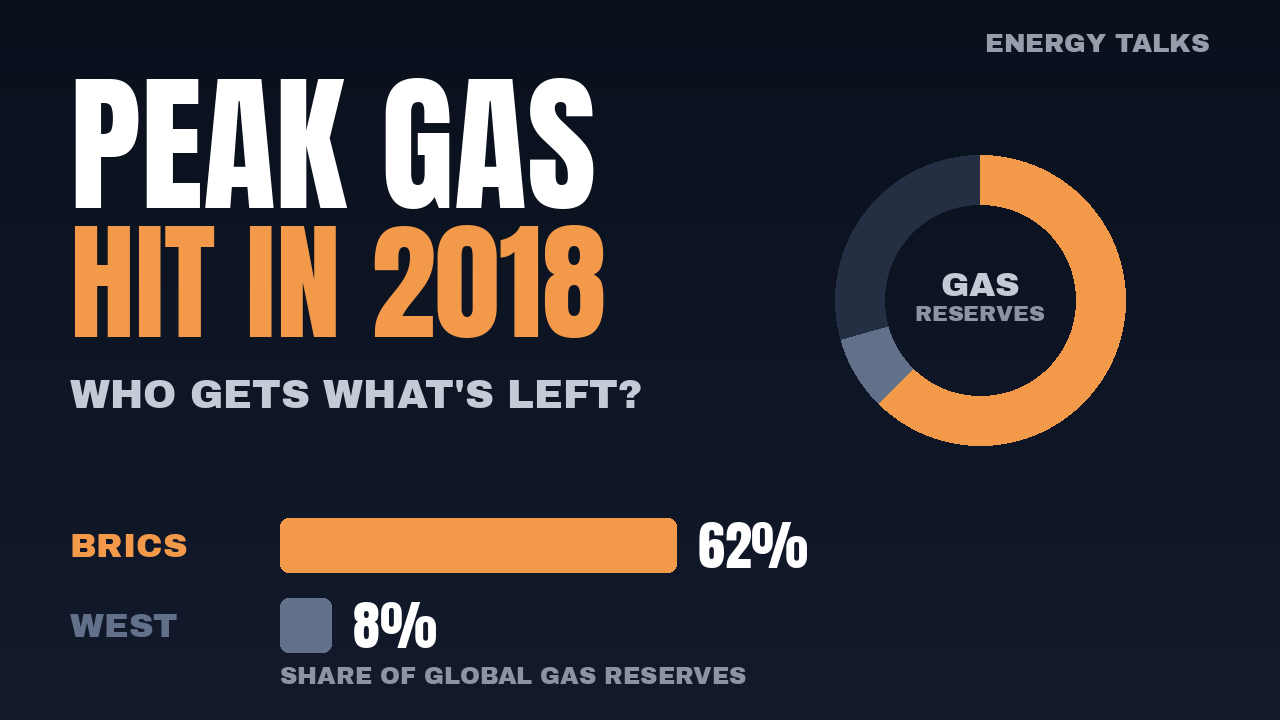
Reserves tell a different story again. Peak gas reserves is dated to 2018, six years before the 2024 production record. BRICS holds 62.4% of what’s left. The West holds 8.2%. Production can keep climbing for years after a reserve peak, which is the position gas is in now. The comparison point is oil, where reserve discovery peaked in the early 1960s, and production has been visibly strained for over a decade since.
Europe’s arithmetic since the Ukraine war
By 2020 figures, the European Union was consuming 332 billion cubic meters of gas a year, more than any other bloc. Russia was the largest supplier, drawing on national production of 227 bcm; the US contributed 82.6 bcm to the market. When Russian gas to Europe was cut, nothing on the books came close to filling the gap. Norway increased supply and profited substantially from a new pipeline, but the shortfall was never fully closed.
Oil, not gas or coal, is the commodity tied to GDP
Coal supplies 34% of global electricity, more than any other source, and accounts for 72% of industrial thermal heat as of 2023. Despite that, there’s no meaningful correlation between coal consumption and GDP. Nuclear shows an even weaker relationship, with too few data points to draw a firm conclusion either way. Oil is the outlier: a tight, decades-long correlation with economic output. The reading here is that modern economies are transport-driven above all else, and the ability to move goods by internal combustion engine is the single commodity most tied to prosperity.
1971 and the divorce between energy and money
Indexing world GDP and oil production to 100 starting in 1965, the two lines track almost perfectly until 1971, when the US dollar decoupled from the gold standard. From that point, the lines diverge, reaching what’s described as a 17:1 ratio today. The framing borrows Gail Tverberg’s real economy/fiat economy split: physical goods and services on one side, financial instruments (derivatives, bank balances, unfunded liabilities) on the other, with the second growing far faster than the first for fifty years.
Two resource pyramids, both narrowing
A parallel materials argument runs alongside the energy one. A century ago, oil gushed out of the ground under its own pressure, and mineral deposits like Michigan copper were high-grade and small. Today’s oil requires extensive processing infrastructure, and mining has moved to massive, low-grade orebodies like Escondida. As ore grain size shrinks (driven by finer disseminated deposits), the energy required to grind it to a usable size rises exponentially, a relationship sometimes called Hukki’s law. The average American, per USGS estimates, will consume roughly 1.37 million kilograms of minerals, metals, and fuels over a lifetime. The case being made is that three pressures, depleting ore and energy quality, a deteriorating biosphere, and technology’s demand for larger volumes of purer material, are converging on the same industrial system at once.
What “catching up” would actually require
Model a scenario where BRICS nations, then the rest of the world, consume oil per capita at Germany’s 2018 level. Under that model, BRICS oil demand rises 254%, the rest of the world rises 71%, and global demand needs an additional 117 million barrels a day even as US consumption falls. Against Ghawar’s 3.8 million barrels a day of production, that gap is equivalent to 31 new Ghawar-sized fields. None have been found.
The petrodollar’s four pillars, and the first visible cracks
Four supports underpin the current dollar system: the US dollar’s status as global reserve currency since Bretton Woods in 1944; the SWIFT messaging network, whose board includes the US Federal Reserve, the Bank of England, the Bank of Japan, the ECB, and the National Bank of Belgium; the 1974 agreement in which Saudi Arabia priced oil exclusively in dollars in exchange for US military protection; and a global military footprint that has shrunk from over 1,000 bases to roughly 750 across around 80 countries (base counts vary meaningfully by source and methodology, so treat this as an order-of-magnitude figure).
The first visible crack is dated to 2022: the EU’s removal of seven Russian banks from SWIFT, including Sberbank, which handled roughly half of Russia’s banking assets, coincided with the ruble losing about half its value. Russia then demanded gas payment in rubles and cut supply when the EU refused, redirecting exports to China.
BRICS 2.0 and the tools of de-dollarization
The 2024 expansion of BRICS to include partner nations pushed the bloc’s combined share to roughly 38% of global crude and condensate production, 28% of oil reserves, 52.9% of gas reserves, and 39% of gas production. A rough market-power framework is applied to this (below 25% share is a competitive market, above 30% allows price influence, above 50% allows dictating supply terms, above 75% allows outright control) to argue the bloc is closing in on structural leverage. That threshold framework is a personal heuristic, not a standard used in antitrust economics, so it’s best read as illustrative rather than a formal benchmark.
The de-dollarization toolkit is already in motion: BRICS Pay as an early SWIFT alternative, China’s CIPS and Russia’s SPFS as parallel messaging systems, and a proposed “BRICS dollar” floated in 2024 that has not been implemented. Since 2022, the UAE has settled some oil trades in Indian rupees, and Saudi Arabia opened to multi-currency oil settlement in 2024, though the dollar remains preferred. Venezuela, before January 2026, was reportedly moving to integrate with China’s CIPS and price its reserves in a yuan-led, partly gold-backed currency basket.
Where this lands: the Caracas raid
On January 3, 2026, US special operations forces raided Caracas and captured President Nicolas Maduro and his wife, Cilia Flores, flying them to New York to face narco-trafficking charges in the Southern District of New York. Delcy Rodriguez was sworn in as interim president days later. The lecture reads this as the clearest recent evidence that the rules-based international order, and with it the norms that made global contract law predictable, no longer holds. That reading is contestable: the Trump administration has characterized the operation as a lawful counter-narcotics arrest of an indicted criminal, not a violation of sovereignty. Both framings are circulating in the public record, and neither is settled.
Add EnergyNews.biz as a preferred source on Google


