



An Italian engineering venture is developing a machine that converts the restless motion of the sea into electricity while potentially serving as a breakwater and floating coastal structure. Its central idea is deceptively simple: let the waves move water, use that motion to drive air to flow in one direction, and extract energy with a turbine. The difficult part is proving that the system can survive the ocean long enough to make the promise commercially meaningful.
The energy hiding in every wave
A wave advances towards the shoreline, gathers itself against the shallows and breaks. Water surges forward, retreats and returns, carrying energy generated perhaps hundreds or thousands of kilometres away by winds crossing the open sea.
This motion is familiar to anyone who has stood beside a harbour. Harnessing it, however, has proved far more difficult than understanding it.
For decades, engineers have explored ways to convert ocean motion into electricity. Floating buoys bobbing through the swell, hinged structures flexing with passing waves, and underwater mechanisms responding to pressure changes have all offered routes towards a new source of renewable power. Yet wave energy has struggled to make the transition from ingenious prototypes to a widely deployed electricity technology.
The obstacle is not an absence of energy. It is the environment in which that energy must be captured.
A machine operating at sea faces saltwater corrosion, structural fatigue, biofouling, unpredictable wave conditions and the possibility of extreme storms. Maintenance can require specialist vessels, suitable weather windows and expensive offshore operations. A device that performs well during a controlled test may become uneconomic if it demands frequent repairs or loses production whenever conditions deteriorate.
The scale of the commercial challenge remains substantial. At the end of 2024, the European Union had approximately 1.12 megawatts of operational wave-energy capacity, according to the European Commission’s Blue Economy reporting. That figure captures how early the technology remains compared with established renewable electricity systems.
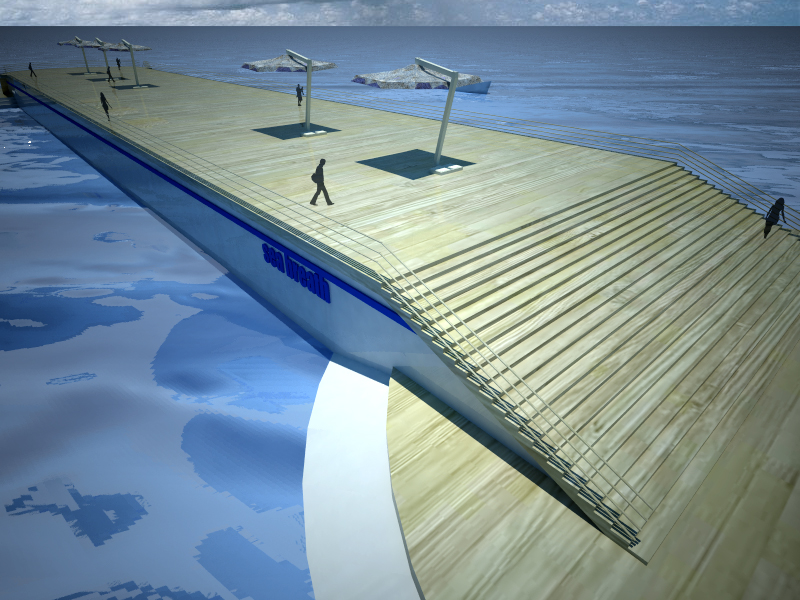
Against this backdrop, Seabreath, an Italian-developed wave-energy system, proposes a different approach. Rather than attempting to eliminate the unpredictable motion of waves, it aims to channel their movement through a series of air chambers and use the resulting airflow to drive a turbine. The company also envisages a structure capable of serving as a coastal breakwater or floating pier.
The proposition is ambitious: one structure, several functions, and fewer moving components exposed to the most punishing part of the marine environment.
Whether those advantages can be translated into dependable, affordable electricity is the engineering question at the heart of the project.
A machine powered by breathing air
Seabreath belongs to a family of technologies known as oscillating water column wave-energy converters, or OWC systems.
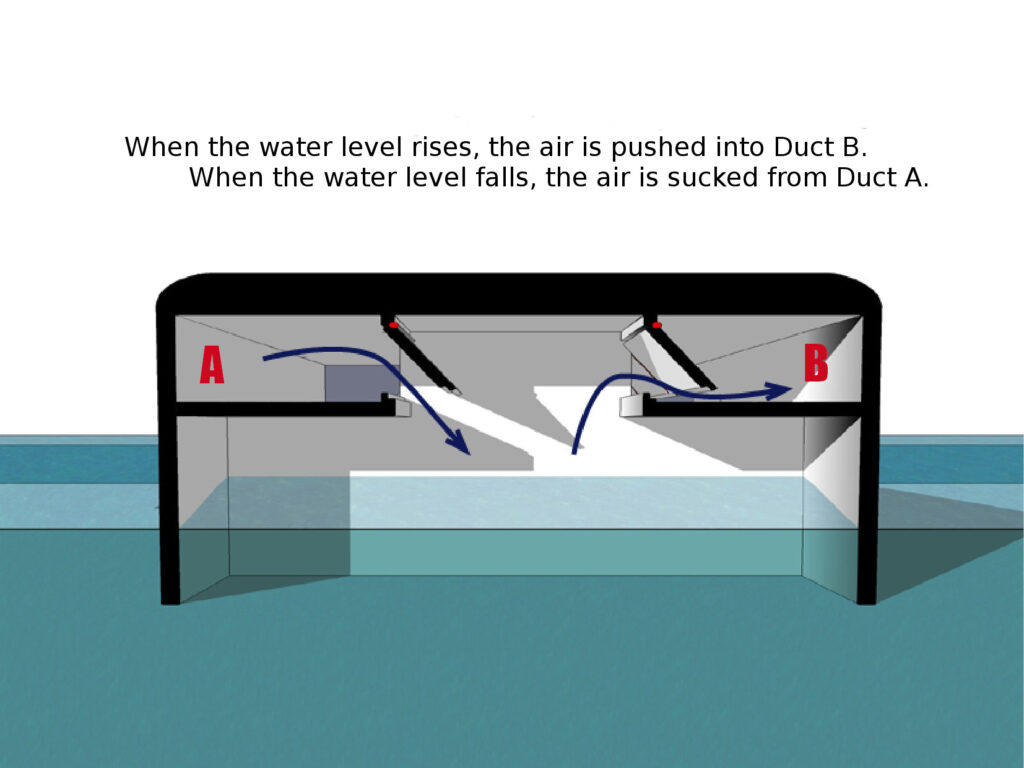
The underlying principle is straightforward. A partially submerged chamber traps air above a column of seawater. The lower section remains open to the sea, allowing passing waves to make the internal water level rise and fall.
When a wave pushes water upward inside the chamber, the trapped air is compressed and forced through a duct. As the wave withdraws and the water level drops, the air pressure changes and air is drawn back into the chamber. A turbine connected to an electrical generator converts the movement of air into mechanical rotation and, ultimately, electricity.
In conventional OWC designs, this alternating airflow creates a particular problem. The turbine must accommodate air moving in both directions, or the system must use a mechanism that effectively rectifies the flow. Turbines designed for this operating pattern face aerodynamic trade-offs, and the changing pressure and airflow can reduce the amount of available wave energy converted into useful power. The European Marine Energy Centre identifies the oscillating water column as an established category of wave-energy technology based on precisely this interaction between water movement, trapped air and a turbine.
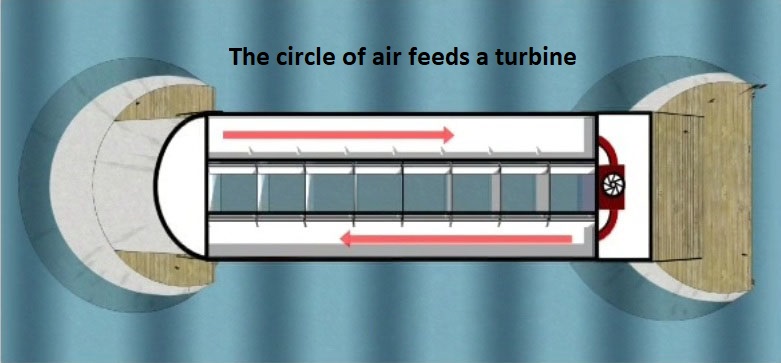
Seabreath’s proposed innovation is to reorganise the chamber system so that it can produce a continuous, unidirectional airflow through a single high-efficiency turbine.
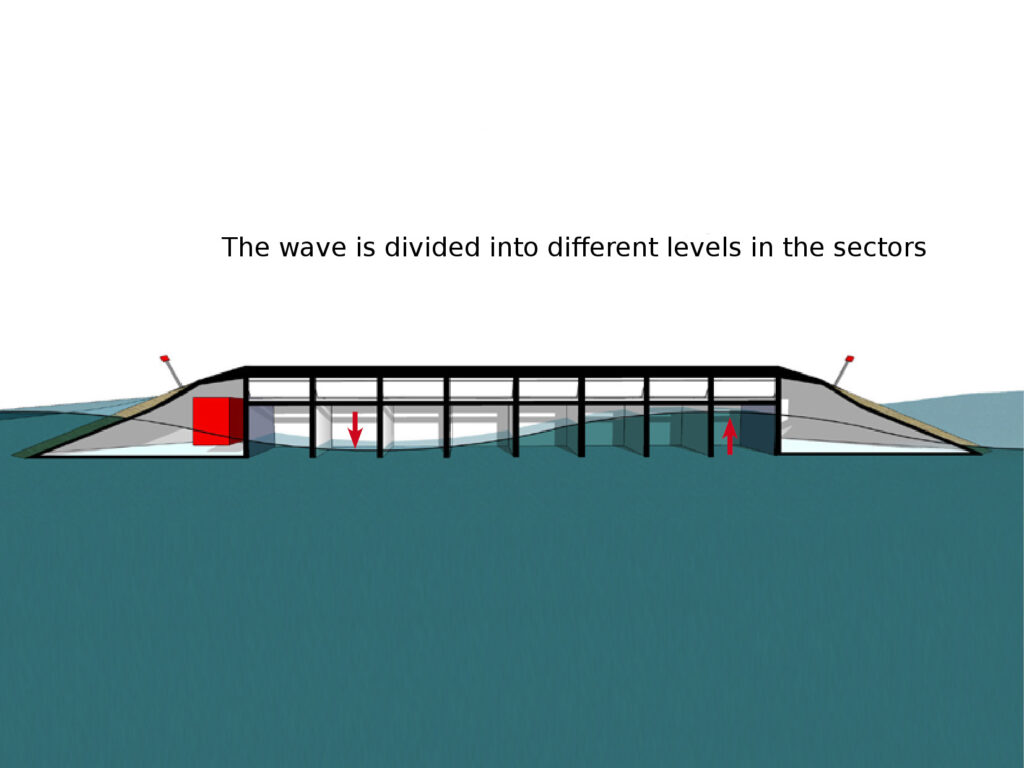
Its design combines multiple chambers, external compensation valves and air-delivery ducts. As the waves move, changes in the chambers’ water levels generate pressure differences. The system is designed to regulate those differences so that the turbine receives air flowing in one direction, rather than having to operate through repeated changes in flow direction.
The multi-chamber architecture is intended to capture a larger portion of the incoming wave front while smoothing some of the pressure variations produced by irregular waves. Instead of relying on one chamber to respond to every fluctuation, the system distributes the interaction across several chambers connected to a common conversion mechanism.
According to Seabreath’s technical materials, this arrangement could approximately double performance relative to conventional oscillating water column systems using Wells turbines.
That is a potentially important claim, but the word performance requires precision. Turbine efficiency, chamber efficiency, and total electricity generated over a year are different measurements. A system might improve the efficiency of its turbine without delivering a proportional increase in annual energy production. The outcome depends on the wave climate, chamber geometry, losses in the airflow system, generator performance and the hours spent operating in different conditions.
To establish the claimed advantage, testing must therefore compare complete systems under equivalent conditions, including the energy captured from the waves, the electricity delivered to the grid and the system’s behaviour during changing sea states.
The central idea is compelling: solve part of the efficiency problem through the arrangement of the machine rather than simply making the turbine more sophisticated. Its value will depend on whether the measured results survive a comparison with real-world operating data.
Why put the machine near the coast?
Seabreath’s second major design decision concerns where the system operates.
The project is designed as a floating, modular structure intended for nearshore deployment. This places it between the exposed offshore environment and the familiar infrastructure of harbours, ports and coastal settlements.
The location matters. Deep-water wave conditions can offer valuable energy resources, but reaching them may require more complex moorings, underwater infrastructure, specialist installation vessels and difficult maintenance operations. A device closer to shore may be easier to access, tow, inspect and repair.
Seabreath’s design aims to exploit these advantages. Its materials describe a modular configuration without submerged mechanical moving parts, with the intention of reducing exposure to corrosion, wear and fatigue. Modules could, in principle, be assembled into larger installations, replaced individually or brought closer to shore for maintenance.
The project also proposes using recycled shipping containers as structural elements and logistical units. In this concept, a container would do more than transport components: it would form part of the chamber architecture that interacts with the water.
The attraction is obvious. Standardised industrial components have established dimensions, handling methods and global transport networks. Reusing them could reduce certain manufacturing and logistics costs while making the system easier to move between sites.
But repurposing a shipping container does not automatically make it a suitable long-term marine structure. Wave loading, corrosion, fatigue, sealing, internal pressure changes, and reinforcement requirements all need to be addressed. The cost advantage must be assessed across the full lifecycle, including preparation, installation, inspection, repairs and eventual removal.
The same qualification applies to modularity. Small, repeatable units can simplify manufacturing and deployment, but adding more units also adds interfaces, connections and structural loads that must work together. The important measure is not how easily a device can be assembled on land. It is how reliably the assembled structure operates after months and years in seawater.
For Seabreath, the nearshore setting is therefore both an opportunity and a design constraint. It offers more accessible maintenance and the possibility of integration with existing infrastructure, but it demands a solution adapted to the local seabed, wave climate, navigation requirements and shoreline conditions.
When a power generator becomes coastal infrastructure
The most distinctive part of Seabreath’s proposal may be that it is not intended to function solely as an electricity generator.
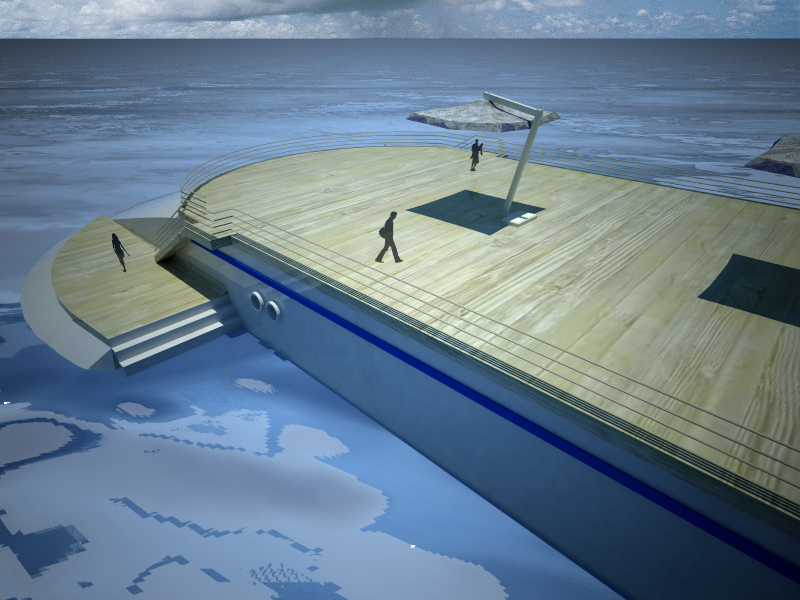
The company envisages installations that also act as breakwaters, absorbing or redirecting some wave energy before it reaches the shoreline. Larger configurations could potentially serve as floating piers, creating usable space around ports, islands and coastal facilities.
This dual-purpose approach could change the economics of deployment.
A standalone wave-energy converter must justify its capital cost primarily through electricity generation. A structure that also provides measurable coastal protection or useful waterfront space may offer additional value to a port authority or municipality. The customer would be assessing not only its energy output, but also whether it could contribute to infrastructure that would otherwise need to be constructed separately.
The most plausible early applications may therefore be places where energy and coastal infrastructure overlap: island communities with limited grid connections, ports seeking local renewable generation, remote facilities and locations considering upgrades to coastal defences.
However, the benefits would depend heavily on the installation site. A structure that attenuates waves under one set of conditions may offer a different level of protection under another. Its effect on sediment movement, currents, neighbouring shorelines and access for vessels would need to be understood before any protective function could be credited in an engineering or financial assessment.
The ecological argument also requires care. Seabreath’s materials describe the potential for a low-impact design that could support marine habitat regeneration. Yet the presence of a structure in a marine environment can alter local hydrodynamics and seabed conditions, while construction and operation can introduce physical disturbance and noise. Environmental effects vary by site and technology, and the wider wave-energy sector continues to examine these questions.
A carefully sited structure might provide surfaces that marine organisms use for attachment or shelter. That possibility is not equivalent to demonstrating a net ecological benefit. The distinction can be established only through appropriate baseline surveys, monitoring after installation, and comparison with the environmental conditions that would have existed without the device.
The same evidence standard should apply to coastal protection. If Seabreath can generate electricity while reducing the force of incoming waves, the combined service could prove valuable. The level of protection, however, must be quantified rather than assumed from the physical presence of the structure.
The sea is the real test laboratory
The transition from a promising engineering concept to a reliable wave-energy product is measured in more than laboratory efficiency.
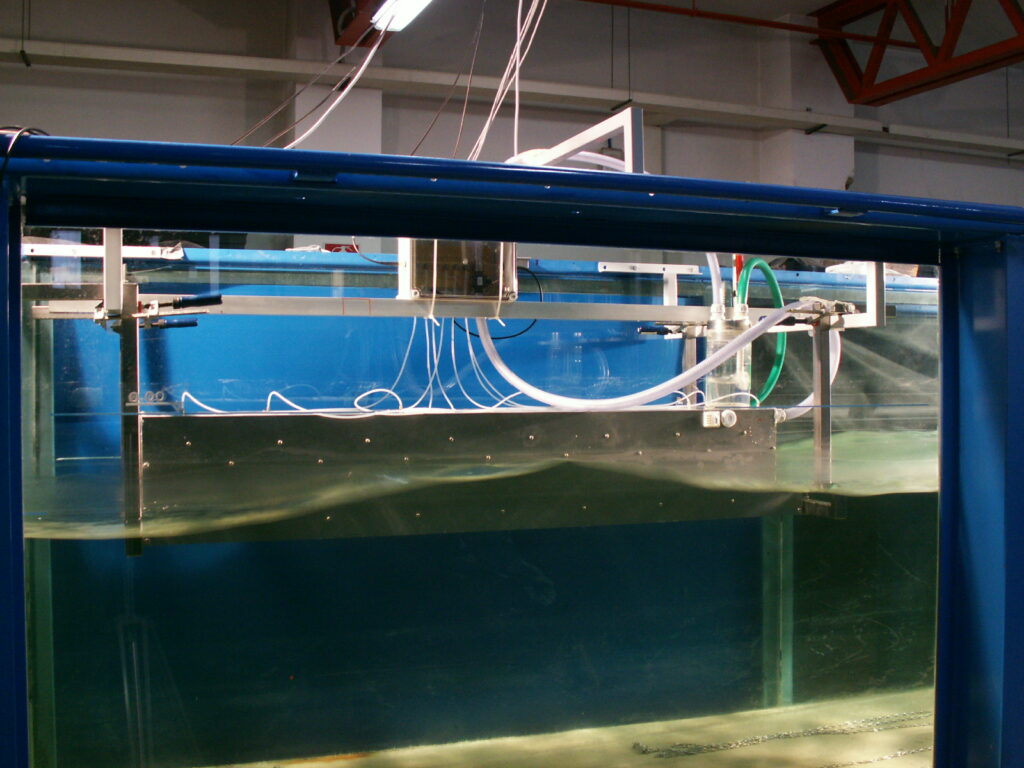
Seabreath’s supplied pitch deck reports that laboratory validation at university facilities has been completed and identifies open-sea testing as the next stage of development. Its roadmap targets technology demonstration in 2026–2027, followed by first commercial pilots in 2028–2029 and industrialisation and initial sales during 2030–2031.
Those dates are targets, not evidence that the milestones have been completed. They describe the development pathway the project intends to follow.
The distinction is important because laboratory conditions cannot reproduce every aspect of the marine environment. Real waves arrive in irregular sequences. Their height, period, and direction change, sometimes rapidly. Storms can impose loads far beyond normal operating conditions, while prolonged exposure tests materials and joints in ways short experiments cannot.
A useful sea trial must answer several questions simultaneously. Does the system capture energy over a range of realistic wave conditions? Does airflow remain stable when waves arrive from different directions? How much electricity reaches the generator after losses in the chambers, ducts, and turbine? What happens when wave conditions exceed the normal operating range? Can the structure protect itself without relying on complex electronic systems, as the design proposes?
Long-term reliability may prove as important as the peak conversion efficiency. A device that produces slightly more power but needs frequent intervention could be less valuable than one with lower peak performance and predictable maintenance requirements.
The project’s development stage also needs to be stated consistently. The supplied presentation describes Seabreath as entering TRL 6 and progressing towards open-sea testing. However, the detailed technology information on the company’s website also describes its current stage as TRL 4–5 and lists a TRL 6 full-scale prototype as the next step. These descriptions do not establish the same level of maturity. In the technology-readiness framework, TRL 6 generally indicates that a technology has been demonstrated in a relevant environment. Resolving the difference matters when assessing the evidence already available and the testing still required.
The next decisive evidence will be measured performance from the device itself, supported by clear documentation of the test conditions and the system configuration.
The economics behind the engineering
Wave-energy projects often encounter a difficult commercial equation: the technology must withstand an expensive environment while competing with renewable sources that have benefited from decades of manufacturing scale and deployment experience.
Seabreath’s modular architecture is intended to reduce costs by simplifying construction, transport, installation, and maintenance. Avoiding submerged mechanical moving parts could reduce certain failure modes, while the prospect of towing modules to shore could simplify some repair operations.
The pitch deck projects a customer payback period of four to six years and estimates a gross margin of 40–60% per module. It also presents the anticipated energy cost as competitive with offshore wind and solar. These are financial projections rather than demonstrated commercial outcomes, and the supplied presentation does not provide enough underlying assumptions to independently reproduce them.
A serious assessment would require a clearly specified power rating, measured annual energy yield for defined wave climates, capital cost per installed kilowatt, expected availability, maintenance intervals, mooring and electrical connection costs, and a transparent estimate of the levelised cost of electricity. It would also need to distinguish costs at a first demonstration site from costs expected after standardised mass production.
Customer payback cannot be inferred from turbine efficiency alone. It depends on how much electricity is generated, what the customer pays for it, how much can be consumed on site, whether power must be stored, and how much it costs to maintain and finance the system.
The commercial route proposed by Seabreath reflects this challenge. The company plans to begin with pilot installations at ports and islands, then move towards early module sales and integration with existing infrastructure. Later stages envisage industrial production and international licensing.
This sequence makes sense for a technology that must validate not just the conversion mechanism but the installation model, operating performance and economics. A port, island or coastal authority could provide a test environment where energy production is only one part of the value proposition. Early deployments could also generate operational evidence that conventional investors and infrastructure owners will require before committing to larger projects.
But the order of proof matters. Industrialisation can lower unit costs only after a workable design has been established, manufacturing processes have been standardised, and reliability is understood. Scaling too early risks multiplying unresolved problems across a larger fleet.
A different relationship with the coastline
The ocean will not become a dependable source of electricity merely because its waves are powerful. A commercially successful system must turn an energetic but variable natural process into electricity at a cost and reliability level that customers can accept.
Seabreath’s concept addresses several persistent challenges through a combination of multi-chamber air capture, a unidirectional turbine, floating modular construction and the possible integration of energy generation with coastal infrastructure. If its engineering assumptions are borne out, this combination could give wave power a role in settings where conventional generation and coastal protection already compete for space and capital.
The opportunity is not that wave energy will replace solar or wind. It is that a complementary source could contribute in locations where waves are a useful local resource, particularly where the same installation can serve more than one infrastructure need. That role would still depend on the local wave climate, grid connection, competing energy options, and the cost of operating the equipment over its lifetime.
For now, Seabreath remains a development proposition whose central claims need to be tested at sea. Its most important milestone will not be a rendering of a floating structure or a projected efficiency figure. It will be a body of independently assessable evidence showing how much electricity the system actually delivers, how consistently it operates, what it costs to maintain, and how the installation affects the surrounding coast.
That evidence will determine whether Seabreath’s proposed machine can do more than imitate the rhythm of the ocean. It will determine whether the motion of the sea can become a practical part of the energy system built along its shores.
Add EnergyNews.biz as a preferred source on Google


