




In 2024 the average daily r² between hourly net battery dispatch and day-ahead prices was 0.88 on California’s CAISO grid and 0.73 on the ERCOT grid in Texas, and 0.76 against 0.65 for real-time prices. A study in the Journal of Energy Storage reads that gap as a difference in market maturity. The number measures how closely batteries follow prices, and prices are not emissions, so the result says less about decarbonization than the paper’s framing suggests.
The study by Peplinski, Calderon, Mayes and Sanders uses historical dispatch, generation, average emissions factor and price data from both system operators. Its own literature review opens with the point that storage is not inherently a green technology and that benefits depend on the regional fleet, market structure and operating practices. The correlation figures are the test of that statement.
CAISO: what the correlations show
The CAISO series runs from 2018 to 2024, with 2018 data available only from April, and the two grids are compared for 2024. CAISO oversees most of California’s power system and reaches 30 million customers, while ERCOT covers 75 percent of Texas land and 90 percent of the state’s electric load, serving 27 million customers. The comparison is therefore between two large systems, but at very different stages of battery deployment.
Both grids show similar diurnal charging cycles. The difference is in how tightly dispatch tracks price, at both annual and daily scale. On CAISO, the paper reports tighter correlations with each year since 2021. Before 2021 CAISO had limited battery dispatch and no noticeable intraday pattern, which the authors take to indicate that batteries mainly provided ancillary services. ERCOT only recently developed significant battery capacity.
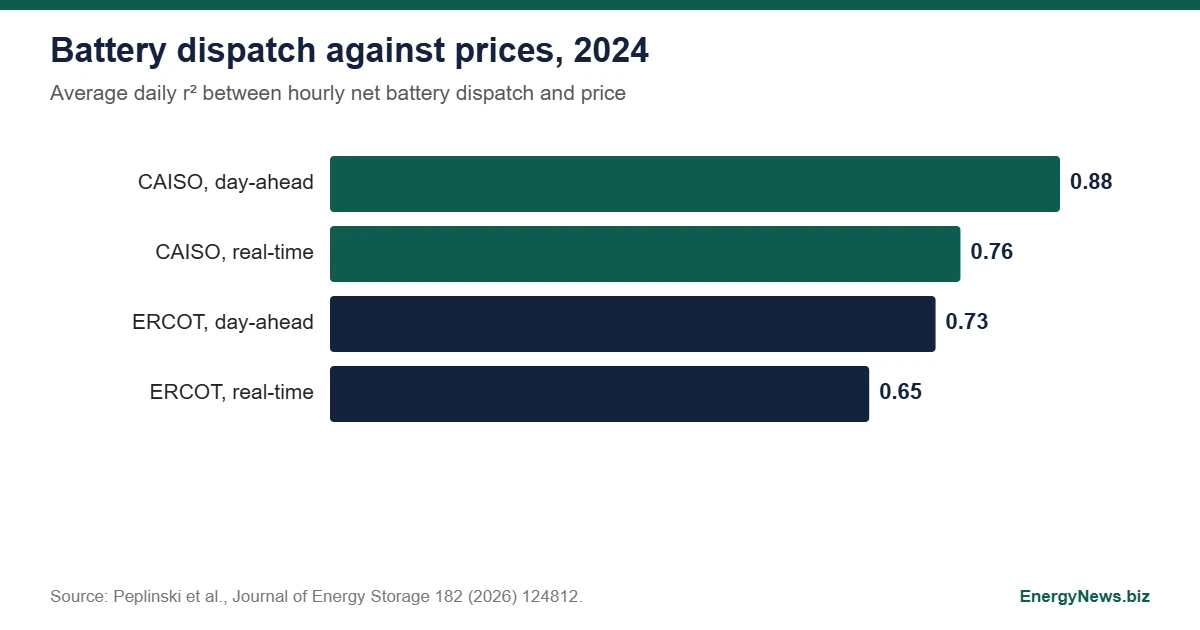
Put in terms of unexplained variance, the day-ahead gap is larger than the headline difference. An r² of 0.88 leaves 12 percent of the variation in hourly dispatch unexplained by price, and 0.73 leaves 27 percent, so ERCOT’s unexplained share is about 2.3 times CAISO’s. In real time the shares are 24 and 35 percent, a ratio of about 1.5. The day-ahead correlation is higher than the real-time one on both grids.
Price following is not carbon following
The paper’s highlights say the high correlation with prices shows arbitrage is a key battery function on CAISO, and that the correlation of charging with average emissions factors and variable renewable generation highlights storage’s role in CAISO’s decarbonization. The first claim follows from the data. The second needs more. A battery that charges when prices are low and renewables are high will correlate with both if low prices and high renewable output coincide, so the same pattern can be read as price following or as renewable following unless the two are separated.
Average emissions factors add a further limit. They describe the whole grid’s mix in an hour, not the plants that respond to an extra megawatt hour of charging, and the abstract frames the emissions result as discussion of how markets, operations and technologies shape the correlation, not as a measured carbon change. The abstract does not report avoided emissions.
Why ERCOT differs, and what the authors flag
The abstract attributes the lower ERCOT correlations to a more nascent battery market. The paper’s own text lists other drivers that its framing allows: the region’s technology fleet, market structures and operating practices. Dispatch correlated at ISO level also hides local effects. The authors note in their limitations that battery behaviour may track locational marginal prices more tightly than the system level prices they used, and that dispatch and emissions data are often hard to obtain or calculate.
What would have to be true for the CAISO result to carry over: the same price shape, the same fleet mix and a similar share of storage in ancillary services. None of that is shown for other grids. The check that matters next is nodal data for individual batteries, which the limitations section points toward, and a measured emissions comparison between dispatch and a flat charging baseline. For a storage economics case that rests on price spreads, see Romania’s Dumbrava battery and its stated spread. Source: Peplinski, Calderon, Mayes and Sanders, Correlating grid scale battery operation with prices, emissions, and renewables in California and Texas, Journal of Energy Storage 182 (2026) 124812. The work was supported by the US National Science Foundation, and the authors declare no competing interests. The sections read for this analysis were the abstract, highlights and section snippets.
Add EnergyNews.biz as a preferred source on Google


