



GOYANG, South Korea. H2Global double sided auctions were presented at the World Hydrogen Expo 2026 conference at KINTEX on 4 November by Elisabeth Sterner, Regional Representative East Asia at the H2Global Foundation. According to her slides, around USD 9 billion has been earmarked, committed or is being considered by a range of governments around the world for H2Global tenders.
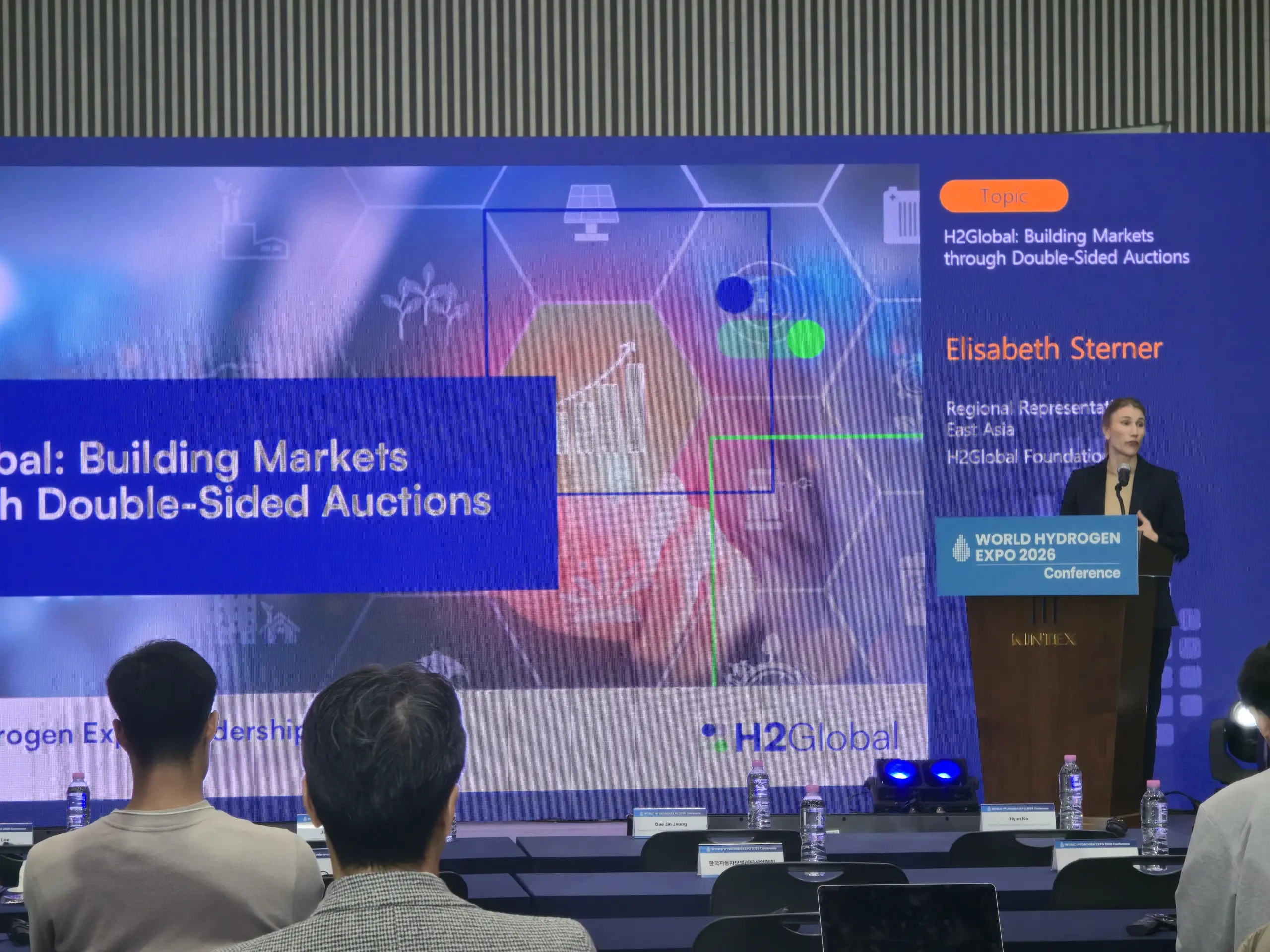
Sterner said Germany was the first government to adopt the approach and still provides a large share of that funding. The idea behind H2Global double sided auctions is to bring hydrogen producers and buyers together through a government backed intermediary, so that long term supply deals and shorter term sales can be matched without either side carrying the full price risk.
Why H2Global double sided auctions were created
Sterner said the scheme was developed roughly five to six years ago as a response to a market failure in emerging hydrogen markets. Supply and demand do not come together because of a mismatch between what producers need to finance projects and what buyers are ready to commit to. She described that mismatch as one big reason why investment in the market is still too low.
From one government to many partners
The first slide on the evolution of H2Global double sided auctions showed three formats. In the original unilateral format, a single government provides the funding for the price gap and decides on the tenders. In the bilateral format, two governments pool their money into one larger funding envelope and tender together. More recently, several countries have started working in a multilateral format.
The unilateral tenders for Germany are the largest block on the slide. A product open tender worth EUR 2.4 billion is at the stage of bid evaluation. A EUR 0.4 billion ammonia tender has produced the first purchase agreement, and a EUR 0.5 billion methanol tender is under way. The multilateral track is currently focused on eSAF, hydrogen derived fuel for aviation, where several European member states are negotiating support worth less than EUR 2.2 billion. Sterner said political talks are still ongoing.
Bilateral tenders link importers and exporters
The first bilateral case is a partnership between Germany and the Netherlands, worth EUR 0.6 billion with a tender process under way. Sterner described it as an alliance of two importing countries that are both targeting production outside their own borders. The other two cases, each worth EUR 0.4 billion, pair Germany with Canada and with Australia. In those, an importing country teams up with a typical exporting nation, production is targeted in the partner country, and the volumes are meant for the German offtake market. The product is still to be decided and preparation is ongoing.
Sterner also pointed to India. She said the German and Indian governments were expected to announce a partnership under the H2Global umbrella this week, and called it something to watch.
How the two auctions work in H2Global double sided auctions
At the centre of H2Global double sided auctions is a government backed intermediary called Hintco, which Sterner said is owned by the H2Global Foundation. Its job is to balance the needs of both sides and absorb as many risks as possible to get projects moving. Two auctions are run, far apart in time.
The first is on the supply side. Producers compete for long term purchase contracts, and the lowest bid signs the agreement with the intermediary. This gives the production side a steady revenue stream at a fixed price. The second auction comes much later. The intermediary resells the volumes it has bought to offtakers on a shorter basis, in yearly delivery batches. A single supply contract can therefore feed many resale auctions, ten times or even more.
The gap between the purchase price and the sale price is covered from public funds. Because the supply and resale auctions are separated in time and both competitive, only the minimum required amount is drawn from the funding commitment, which Sterner called a very efficient tool from a government perspective. Pricing for the product is published so that the wider market can see it.
What each side gets from the mechanism
A closing slide set out the value of H2Global double sided auctions for four groups. Producers get long term revenue certainty and a path to final investment decision. Governments minimise their funding needs and aim for the biggest bang for the buck. Offtakers manage price risk and gain price discovery on the way to a liquid market. For the market as a whole, the scheme creates real business cases, standardised contracts and surfaces regulatory hurdles.
H2Global double sided auctions show how public money can be used to start hydrogen trade before a normal market exists. EnergyNews.biz is an official media partner of World Hydrogen Expo 2026 and is reporting from KINTEX until 6 November. More information on the tenders is available from Hintco, and our earlier report covers the opening of the expo.
Add EnergyNews.biz as a preferred source on Google


