


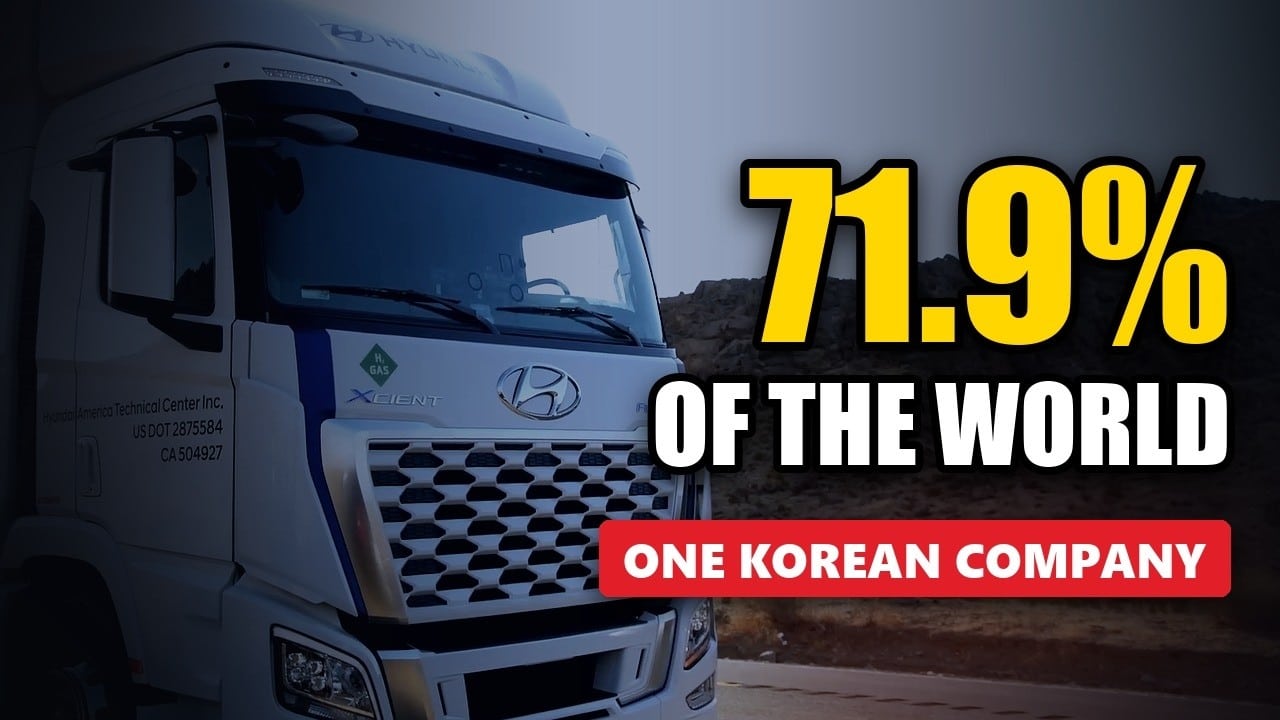


South Korea’s hydrogen policy is the biggest national bet on hydrogen cars, trucks, and power anywhere. While other countries cut back on fuelling stations and fuel cell car sales fell 21.6% worldwide in 2024, one Korean company, Hyundai, sold 71.9% of all hydrogen vehicles on Earth in the first half of 2026, according to SNE Research. The question behind 20 interviews filmed at World Hydrogen Expo 2026 at KINTEX was simple: did Korea do the impossible, or is it just paying more for it?
The vlog above walks the expo floor in ten minutes. This article adds the numbers behind it, measures Korea against its own targets, and links every full interview recorded at the show.
The South Korea hydrogen bet in five dates
The South Korean hydrogen economy did not arrive by accident. Hyundai began fuel cell research in the late 1990s and in 2013 started mass production of the Tucson ix35 Fuel Cell in Ulsan, the first mass-produced fuel cell car. Kolon Industries supplied its humidifier, a point the company repeated at its stand.
In 2019, the government published the Hydrogen Economy Roadmap, which targets 6.2 million fuel cell vehicles and 1,200 refuelling stations by 2040, as listed in the IEA Policies Database. The Hydrogen Economy Act, which Korea calls the first law of its kind, came into force in 2021. In 2023, Korea became the first country past 1 GW of fuel cell power generation, and it ran the first auction dedicated to clean hydrogen power.
Subsidies hold the South Korean hydrogen system together. “Korea gives very good subsidies for hydrogen. The government wants to make a hydrogen ecosystem in Korea,” one exhibitor said. A visitor from CzechInvest put the gap more bluntly: “When it comes to hydrogen, Korea is much more developed than the Czech Republic.”
The flagship: Hyundai
Hyundai is the core of the South Korea hydrogen story. Its stand showed the whole chain, from an electrolyser making hydrogen to buses, trucks and cars using it, and fuel cells turning it back into electricity. Its XCIENT Fuel Cell trucks are deployed in about ten countries. In Switzerland, 48 of them have covered 10 million km in three years and eight months, according to Hyundai.
The all-new NEXO refuels in about five minutes and is rated at 826 km on the WLTP cycle, or 720 km on the Korean cycle. Hyundai had sold 50,262 hydrogen vehicles in Korea by September 2026, and its new KRW 930 billion fuel cell plant in Ulsan is built for 30,000 systems a year.
The fuel bill is easy to check. With a tank of about 6.7 kg and 826 km of WLTP range, the NEXO uses roughly 0.8 kg per 100 km. At the Korean pump price of about ₩10,000 per kg, around $7, that is about ₩8,100 per 100 km, or $5.70. Real driving will cost more than the test cycle suggests.
The full Hyundai interview, including a hydrogen garbage truck with a hand wash sink fed by its own fuel cell, is here.
The supply chain behind the cars
A car is only as good as its supply chain, and the South Korean hydrogen supply chain is where the expo was strongest. In one hall, visitors could follow a molecule from purification to the tank to the ship.
- Kolon Industries makes proton exchange membranes, membrane electrode assemblies and humidifiers. “Most of the customers in the hydrogen market have been contacting Kolon for their own projects,” its representative said. Kolon showed a hydrogen truck built with Tata and is targeting Europe and China.
- Hylium Industries builds liquid hydrogen tanks. A truck tank holds up to four tonnes and gives a range of about 1,000 km, the company says.
- SHI Cryogenics showed cryocoolers that reach 20 K, minus 253°C, cold enough to liquefy hydrogen.
- WIKA Korea showed sensors for liquid hydrogen, where measuring temperature below minus 253°C is the hard part.
- BMT Superlok showed valves for 15,000 psi hydrogen service.
- KwangShin Machine is developing a 500 bar oil-free reciprocating compressor and says more than 70% of its products are exported.
- TMEIC makes IGBT rectifiers, the power supply for electrolysers.
- Vinssen showed a 250 kW fuel cell module for ship propulsion.
- SoluForce says its flexible hydrogen pipe costs 60% to 70% of a steel line.
- Technical Korea showed a purification package that removes oxygen and water after the electrolyser.
- Bumhan Fuel Cell builds fuel cells for Korean Navy submarines and now hydrogen stations.
Every company in the list has a full interview below.
The bold claims
Not every South Korean hydrogen claim at the show holds up. SCL Energy told the camera it can produce hydrogen for $1.5 per kg, against $5 to $10 elsewhere, using 6 kWh per kg. Commercial electrolysers use about 50 to 55 kWh per kg, and splitting water needs about 39 kWh per kg in theory, so 6 kWh per kg cannot come from conventional water electrolysis. SCL was asked for proof in a separate interview. Until independent test data appear, the figure is a company claim, not a benchmark.
Next customer: AI data centers
Several exhibitors see the next South Korean hydrogen market beyond cars. Hyundai Motor Group is investing in the Saemangeum AI Valley, and fuel cell suppliers pitched stackable units that can power a data center “any time, anywhere”. One said simply: “Then we are expanding to data centers. This is a big issue.”
The hydrogen map of Korea
The South Korea hydrogen map started with three pilot hydrogen cities in 2019 and now has more than a dozen. SK’s liquid hydrogen plant in Incheon can make 30,000 tonnes a year, enough for about 5,000 buses, according to Korea.net. Ulsan runs about 190 km of hydrogen pipelines. And Korean suppliers are exporting: “We are supplying a bigger size to the US,” one exhibitor said.
The catch: South Korea hydrogen targets vs reality
This is where the story turns. Korea had about 250 hydrogen stations in 2026. The plan was 310 by 2022.
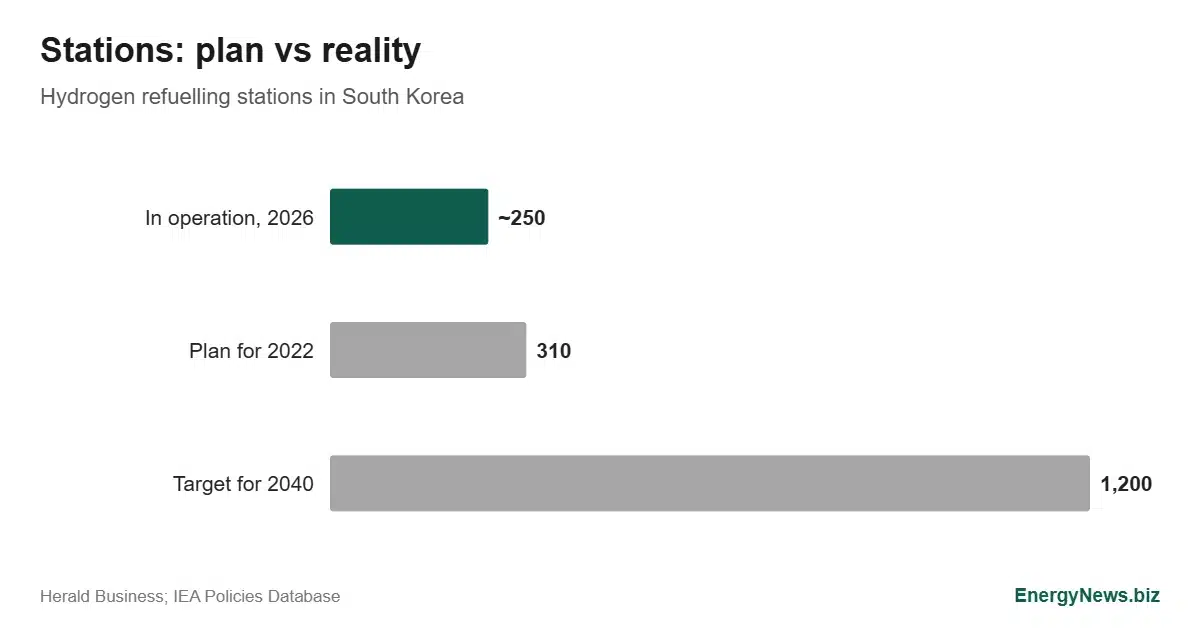
Measured against its own roadmap, the gap is large. Hyundai’s 50,262 vehicles sold in Korea are about 0.8% of the 6.2 million targeted for 2040. Reaching the target would take about 440,000 vehicles a year for the next 14 years. Reaching 1,200 stations means adding about 68 a year. That is about 200 cars per station today, and an operator at the show said plainly: “This is not commercial. It’s developing now. It’s like a demo.”
South Korea’s hydrogen demand is fragile too. NEXO sales in Korea fell from 11,179 in 2022 to 4,709 in 2023, less than half. Only 18 hydrogen vehicles were exported from Korea between January and April 2025. Only 11.5% of the volume in the first clean hydrogen power auction was awarded; the 2025 round was cancelled, and a proposed 2027 budget cuts the hydrogen vehicle subsidy by 23%.
Exhibitors were candid. One said Korea “is a little bit slowed down” and is looking for answers on expansion and uptake. Another, asked about export prospects, said it depends on politics in the United States, and that the real limit is efficiency.
So did Korea do the impossible?
Not yet, but it did something no other country has: it built a full hydrogen industry, from membranes and cryocoolers to trucks and power plants, and kept it growing while others pulled back. That supply chain is now an export asset, whether or not Korean drivers buy hydrogen cars in large numbers.
The weak point of South Korea’s hydrogen is not technology. It is the cost of hydrogen at the pump and the pace of stations, both of which depend on subsidies that are now being trimmed. For suppliers elsewhere, the lesson is clear: South Korea hydrogen is a real market for components and a testing ground for products, but not proof that hydrogen cars can stand without public money.
South Korea hydrogen coverage from earlier editions of the expo is in the 2024 event coverage.
The number to watch
250. That is the number of hydrogen stations in South Korea today. The 2040 plan needs about 68 new ones every year. If the count passes 320 by the end of 2027, the South Korea hydrogen model is back on track. If it stalls, the supply chain on display at KINTEX will increasingly live on exports, not on Korean roads.
Add EnergyNews.biz as a preferred source on Google


