





As battery systems become more complex, validation is increasingly shifting from hardware-intensive testing toward simulation-based workflows that improve repeatability, reduce costs, and accelerate software verification. Battery management systems (BMS), which are central to cell monitoring, safety, and performance optimization, require extensive validation across thousands of operating and fault conditions before reaching production. Testing these scenarios using physical battery packs is often expensive, time-consuming, and difficult to reproduce consistently.
This has elevated demand for dedicated BMS validation platforms capable of accurately emulating battery behavior at the cell level while integrating seamlessly into automated development environments.
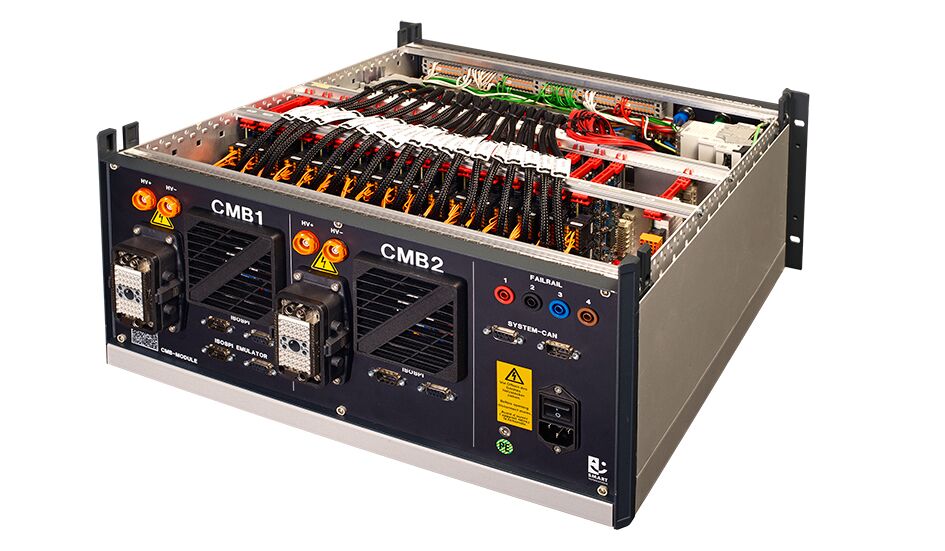
SMART TESTSOLUTIONS has introduced a modular BMS testing platform designed to address these requirements by replacing physical battery cells with high-resolution voltage simulation. At the core of the system is the company’s MCM IntelliSim cell voltage simulation module, which enables engineers to reproduce individual cell voltages under controlled laboratory conditions. This allows development teams to validate normal operating behavior, boundary conditions, and failure modes without relying on live battery packs.
The ability to simulate cells individually has become increasingly important as modern electric vehicle battery packs can contain hundreds of cells managed simultaneously by sophisticated monitoring electronics. Algorithms responsible for state of charge estimation, state of health calculations, balancing strategies, and fault detection depend on highly accurate sensor inputs, making reproducible validation critical throughout the development cycle.
Beyond voltage emulation, comprehensive validation requires testing how the BMS responds to abnormal operating conditions. The platform supports the simulation of balancing currents, current sensors, insulation faults, and common electrical failures including open circuits, short circuits, and reverse polarity events. These controlled fault injection capabilities allow engineers to verify safety mechanisms under repeatable conditions without exposing expensive hardware or personnel to unnecessary risks.
Safety verification has become a growing priority as battery systems evolve toward higher voltages and larger energy capacities. Functional safety requirements demand extensive testing of emergency shutdown functions and high-voltage interlock loop integrity across numerous operating scenarios. Reproducible simulation enables these tests to be automated and repeated consistently, improving validation coverage while reducing dependence on physical prototypes.
Thermal management validation is another area receiving increased attention. Accurate battery temperature monitoring directly influences charging rates, power output, lifespan, and overall system safety. By supporting simulation of NTC and PTC temperature sensors alongside active and passive balancing processes, the testing platform enables validation of thermal control algorithms before hardware integration.
The modular architecture reflects broader trends across automotive and battery development, where scalable testing environments are replacing isolated laboratory setups. The system can operate as a standalone solution or integrate into existing hardware-in-the-loop environments through CAN and Ethernet connectivity. Support for Python and XiL application programming interfaces also enables incorporation into automated regression testing, allowing software updates to be validated continuously throughout the development process.
This shift toward automation aligns with the growing software complexity of battery systems. As manufacturers introduce increasingly sophisticated battery control strategies and over-the-air software updates, development organizations require validation environments capable of supporting continuous integration and continuous testing methodologies alongside traditional hardware verification.
Cost efficiency remains an important consideration across battery development programs. Building and maintaining multiple physical battery packs for software validation significantly increases development expenses while limiting test repeatability. Simulation-based platforms provide an alternative by enabling thousands of operating scenarios to be executed consistently without consuming battery hardware or requiring repeated laboratory preparation.
For battery developers and automotive suppliers, the value of these systems lies less in replacing physical testing than in moving a substantial portion of software and electronics validation earlier in the development cycle. Physical validation remains indispensable before production, but simulation-driven testing allows many software defects, calibration issues, and fault handling problems to be identified before prototype hardware becomes available.
As battery systems continue to increase in complexity across electric vehicles, stationary storage, fuel cells, and industrial applications, demand is expected to grow for validation platforms that combine precise cell simulation, reproducible fault injection, and integration with automated engineering workflows. The industry’s broader transition toward software-defined energy systems makes robust BMS verification not only a quality assurance requirement but an increasingly important component of reducing development time and managing engineering costs.