






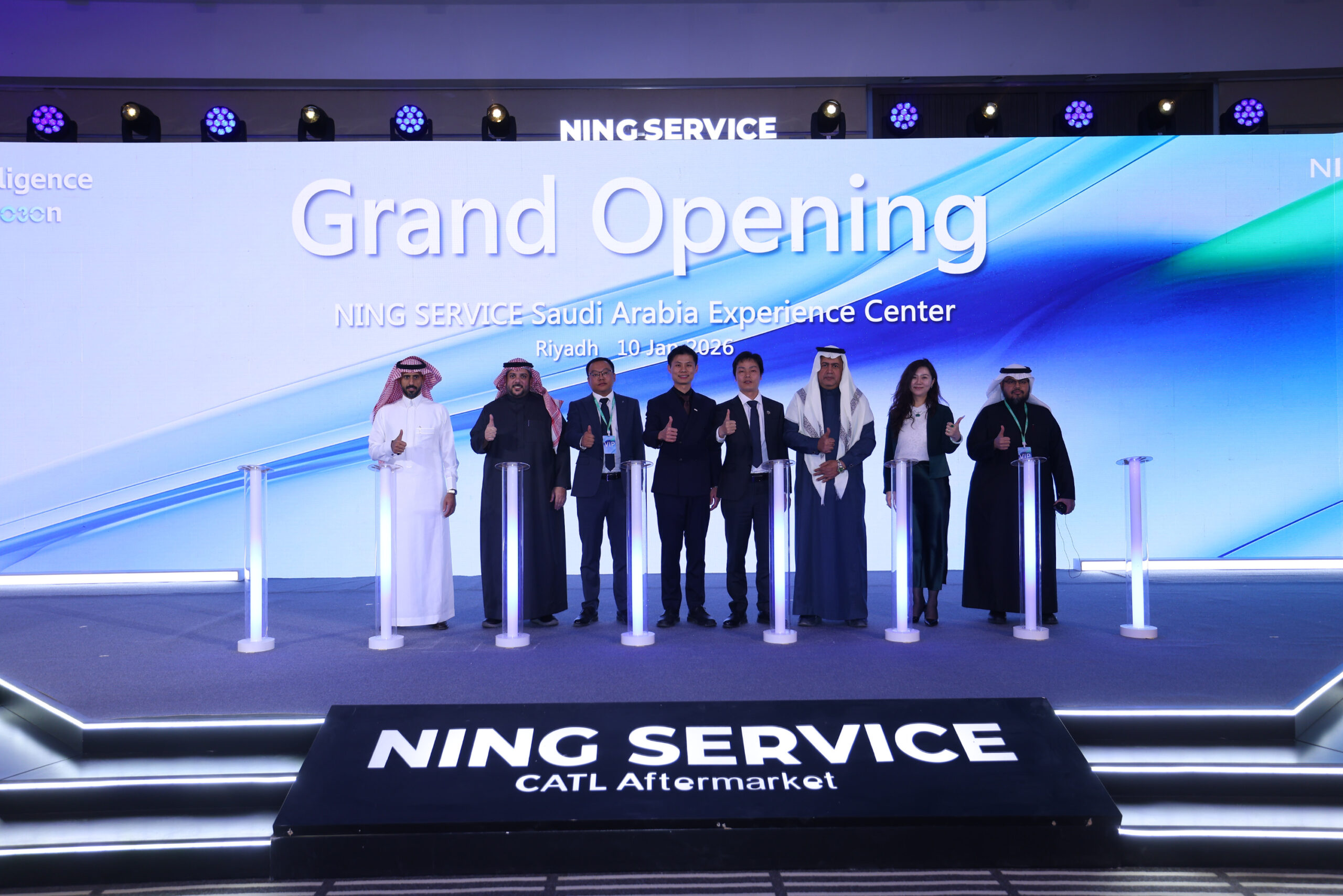
CATL’s opening of the NING SERVICE Experience Center in Riyadh on January 10, 2026 marks a strategic pivot from equipment supply toward operational infrastructure, a segment increasingly determining whether electrification targets under Vision 2030 translate into sustained deployment.
Saudi Arabia has set an objective to convert 30 percent of vehicles in Riyadh to electric by 2030, alongside a broader plan to cut citywide emissions by 50 percent. Similar pressures are emerging across logistics, agriculture, and industrial operations, where policies promote electric forklifts, solar powered farms, and battery backed energy systems. Yet progress remains uneven. Oil dependency continues to shape transport economics, peak electricity demand is rising sharply, extreme heat degrades battery performance, and charging and service networks remain thin relative to projected EV penetration. In this context, CATL’s decision to anchor its Middle East aftermarket strategy in Riyadh reflects an assessment that reliability and cost of ownership, rather than upfront technology readiness, are now the gating factors for adoption.
The Riyadh NING SERVICE Experience Center spans more than 7,000 square meters and integrates diagnostics, maintenance, refurbishment, training, and customer-facing facilities under one roof. Rather than functioning solely as a repair hub, the site is positioned as a regional platform for system-level electrification support across passenger vehicles, commercial fleets, industrial equipment, and stationary energy storage. This approach aligns with a growing recognition in emerging EV markets that fragmented service ecosystems inflate downtime, raise operating costs, and undermine fleet economics, particularly for commercial users.
CATL’s full lifecycle service model addresses these constraints directly. Battery diagnostics, repair, rework, recycling, training, and aftermarket logistics are consolidated into a single operational framework, covering more than seven product categories. For enterprise customers, especially logistics operators and infrastructure providers, this structure reduces uncertainty around asset life, residual value, and maintenance scheduling. In regions where high ambient temperatures accelerate battery degradation, predictive diagnostics and refurbishment capacity can materially affect total cost of ownership, often more than marginal gains in battery energy density.
Localization is a second critical pillar of the Riyadh investment. CATL is using the facility as a training and capability-building hub, embedding technical expertise within the regional workforce rather than relying on imported service capacity. Globally, NING SERVICE operates 10 training centers totaling roughly 2,300 square meters and has certified more than 9,700 after-sales professionals. Replicating this model in the Middle East supports workforce development objectives while also mitigating a structural risk for CATL: the scarcity of qualified technicians capable of handling high-voltage systems, advanced battery management systems, and energy storage installations at scale.
The strategy extends beyond workforce training into ecosystem integration. CATL is engaging with local fuel network operators to deploy green electricity at service stations, infrastructure companies to electrify truck fleets, and energy firms to roll out solar-plus-storage solutions. These discussions reflect a broader shift from isolated pilot projects toward bundled electrification offerings that link vehicles, charging, storage, and energy supply. For markets like Saudi Arabia, where grid reinforcement and renewable integration remain works in progress, such bundled approaches can accelerate deployment without waiting for system-wide upgrades.
Industry partners are already signaling alignment with this model. Al Drees, a major Saudi petroleum and logistics services provider, has publicly indicated plans to deploy solar-plus-storage at gas stations and electrify material handling equipment, framing electrification as a cost and resilience strategy rather than a purely environmental one. For CATL, these partnerships anchor aftermarket services to real operational demand, reducing reliance on speculative EV adoption curves.
From a global perspective, the Riyadh center fits into CATL’s wider service footprint, which includes more than 1,200 professional service stations across 76 countries and 73 spare-parts warehouses, with over 370,000 square meters of warehouse space. The company reports having supported more than six million electric vehicles worldwide through its aftermarket network. This scale matters in regions like the Middle East, where confidence in long-term service availability influences procurement decisions by fleet operators, utilities, and public agencies.