





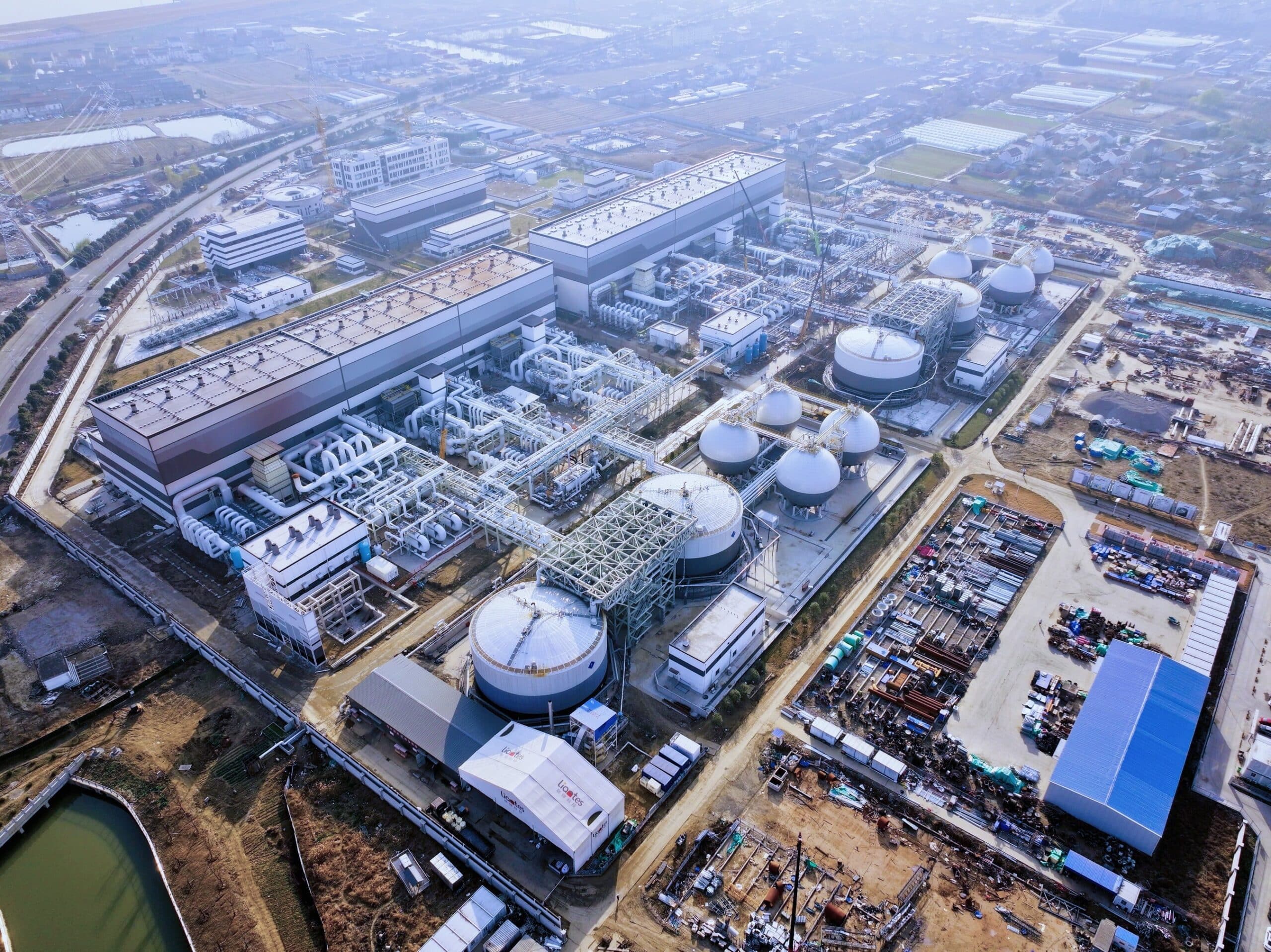
The Huai’an Salt Cavern Compressed Air Energy Storage (CAES) project in Jiangsu Province, China, has entered full operation, marking a significant milestone in long-duration energy storage deployment.
With a total installed capacity of 600 MW and 2,400 MWh of storage, the facility is now the largest CAES station globally and a critical testbed for non‑supplementary combustion storage technology.
Shanghai Electric (SEHK:2727, SSE:601727) supplied the core equipment, including air turbine units, generators, electric motors, and molten salt storage tanks. Unit 2 successfully achieved grid connection and full-load generation on the first attempt, reinforcing engineering confidence in integrating high-capacity CAES systems into China’s evolving power grid.
The Project features two 300 MW high-temperature adiabatic CAES units, which operate without fossil fuel combustion. Compressed air is stored in approximately 980,000 cubic meters of salt caverns at depths between 1,150 and 1,500 meters. A “molten salt + pressurized thermal water” system retains and recycles compression heat, maintaining a conversion efficiency of around 71 percent. During periods of peak demand, the stored air drives turbines to supply power, supporting grid stability through peak shaving and frequency regulation.
The first unit reached full-load operation in December 2025, followed by Unit 2’s recent commissioning. At a total investment of $520 million, the Huai’an station is projected to produce 792 million kWh of electricity annually—sufficient to power roughly 600,000 households. The operation is expected to offset 250,000 tons of standard coal and reduce CO₂ emissions by 600,000 tons per year, providing tangible low-carbon benefits for Jiangsu Province’s energy mix.
The Project underscores Shanghai Electric Power Generation Group’s integrated capabilities in turbine machinery, thermal storage, and power equipment. Delivering a turnkey solution for long-duration energy storage, the company demonstrates a replicable model for high-capacity CAES applications internationally.
As global grids accommodate growing shares of intermittent renewable energy, long-duration storage solutions like CAES become essential. By leveraging compressed air storage with thermal recycling, the Huai’an facility offers a low-carbon alternative to traditional peaking plants, mitigating reliance on fossil fuels while enhancing grid resilience. The operational data and engineering insights from this project are expected to guide further deployments, signaling a shift toward scalable, carbon-conscious energy storage technologies worldwide.