






The moment when wind and solar overtook fossil fuels as the dominant source of electricity in the European Union was not supposed to arrive this soon. Yet wind and solar generated a record 30% of EU power in 2025, exceeding fossil fuels at 29%. That crossover is more than symbolic arithmetic. It fundamentally changes the calculus of electrification, transforming it from a long-run bet into the most rational near-term economic and strategic move available to governments, investors, and industries across the continent.
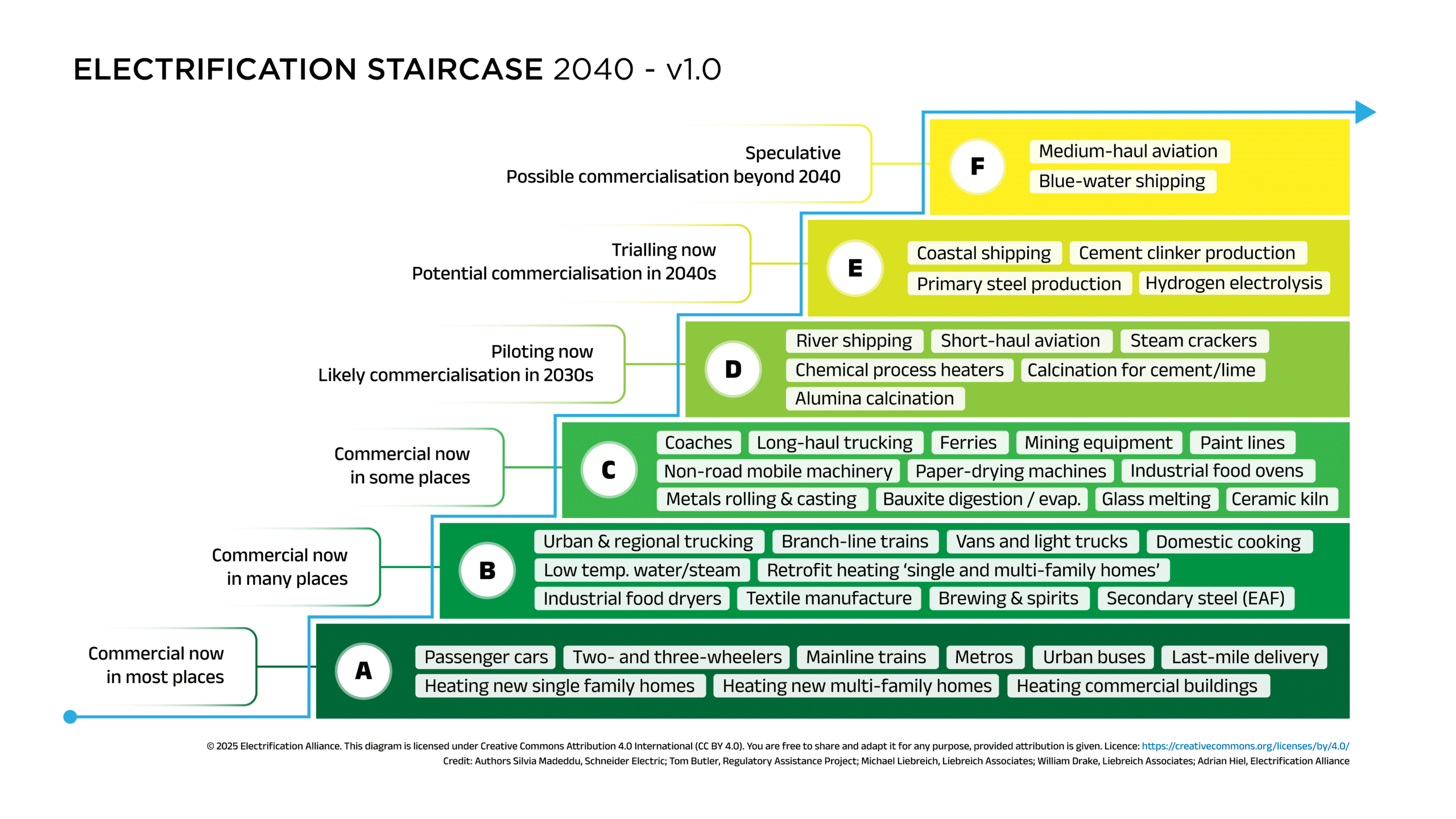
The problem is that this inflection point arrives without a coherent operational framework for what to electrify first, at what pace, and through what sequencing. The Electrification Staircase, a framework developed by the Electrification Alliance in collaboration with Liebreich Associates, Schneider Electric, and the Regulatory Assistance Project, attempts to fill precisely that gap. It provides a roadmap of how electrification can advance across industry, residential, and transport sectors over time, enabling the identification of commercially mature options, those that are commercial yet have significant potential to deepen adoption, and those whose viability remains more challenging and uncertain, such as shipping and aviation.
The framework is a deliberate rebuke to two opposing camps that have each, in their own way, made coherent policy harder to formulate. On one side sits the “electrify everything immediately” school, whose enthusiasm routinely outruns technical and economic reality. On the other sits an entrenched resistance that treats any uncertainty in electrification pathways as a reason to delay across the board. Both positions suffer from the same analytical failure: treating electrification as a binary rather than a sequenced process with distinct windows of commercial readiness.
The bottom rungs of the Staircase represent use cases that are already cost-competitive and require little to no subsidy. The framework is designed to focus policymakers on use cases first, not abstract supply targets, and introduces a time dimension that clarifies what can scale immediately and what requires more innovation or infrastructure. This is a consequential distinction. Resource-constrained governments making industrial policy cannot afford to treat a mature technology like passenger EV charging infrastructure the same as green hydrogen for maritime shipping. Conflating those is not ambition; it is misallocation.
The Staircase’s intellectual lineage runs directly from the Hydrogen Ladder, the framework Michael Liebreich used to discipline the overclaiming that plagued hydrogen policy discussions for much of the early 2020s. Adrian Hiel, who directs the Electrification Alliance and whose conversation with Liebreich gave rise to the Staircase concept, recognized that the hydrogen template, when inverted, could perform an equivalent function: providing a shared vocabulary that cuts through polarization and allows substantive prioritization rather than ideological positioning.
What makes the Staircase structurally different from the Hydrogen Ladder is the explicit time dimension. The Hydrogen Ladder was a steady-state analysis, mapping which uses of hydrogen would and would not be viable once markets matured. The Electrification Staircase is a sequencing tool, mapping not just viability but timing. It asks: given current technology and current economics, where do you start, and where do you build next?
The commercial-readiness framing matters enormously because the compounding logic of electrification is not linear. Electrifying the easy stuff makes the hard stuff easier. More electrification means more grid volume, which means lower electricity costs for everyone. The wins compound and the barriers shrink. That observation reframes the entire policy challenge. Delaying the deployment of commercially ready electrification is not a conservative or prudent stance; it is a self-inflicted constraint that raises the cost and complexity of everything that comes after it.
The energy security argument reinforces this logic with an urgency that climate targets alone have historically failed to generate across politically diverse governments. In 2025, the EU’s gas import bill for the power sector reached €32 billion, 16% higher than the previous year, with average electricity prices during peak gas-use hours rising 11% across the EU. These are not abstract risks. They are measurable transfer payments from European consumers and industries to fossil fuel exporters, recurring year on year, amplified by geopolitical instability, and structurally eliminated only through electrification from domestic renewable sources.
Europe’s central paradox is that while the continent is rich in renewable potential, electricity demand is stagnating. That stagnation is partly a symptom of exactly the policy confusion the Staircase is designed to address. When policymakers treat all electrification use cases as equally uncertain, incentive structures weaken, investor timelines lengthen, and demand growth falters despite the availability of cost-competitive technology.
The industrial heat sector illustrates the challenge most acutely. Low-temperature process heat in the light industry sits in the commercially viable band of the Staircase, with heat pump technology capable of delivering cost-effective solutions at scale today. Yet adoption remains well below its potential, partly because industrial procurement cycles are long and risk-averse, and partly because the business case requires certainty about future electricity prices that current market structures do not easily provide. The Staircase, by naming this as a “deploy now” tier, applies pressure on both sides of that equation: on utilities and grid operators to structure contracts that provide price certainty, and on industrial operators to stop treating commercially available electrification as a pilot program.
Transport tells a different, more advanced story. Roughly 80% of transport emissions sit in the bottom three rows of the Staircase, representing solvable challenges using technology that already exists today. Passenger EVs and light commercial vehicles have crossed the cost-parity threshold in most European markets. The relevant challenge there is no longer technological; it is the pace of charging infrastructure deployment, the availability of affordable grid connection, and the elimination of remaining regulatory friction in fleet procurement. Heavy trucking on defined long-haul corridors is close behind, with battery-electric technology now competitive on total cost of ownership for high-utilization routes where charging infrastructure can be planned.
Where the Staircase performs its most useful function is at the harder end: aviation and shipping, which sit at the top, reflecting the reality that electrification here faces constraints that neither policy nor engineering has yet resolved at a commercial scale. The risk in frameworks of this kind is that they become excuses for indefinite delay in difficult sectors. The Staircase’s architects pre-empted this by designing it as a living document, published under a Creative Commons license with an explicit invitation for challenge and revision, and a commitment to update it as technology and economics evolve.
Over the past five years, wind and solar have grown from 20% to 30% of EU power while fossil fuels have fallen from 37% to 29%. That rate of change in the power sector was itself considered implausibly optimistic a decade ago. The same trajectory, applied to demand-side electrification through a disciplined sequencing framework, should produce equivalent outcomes in transport and heat over the coming decade, provided policymakers resist the temptation to treat all use cases as equally ready or equally impossible, and instead climb the staircase one step at a time.