






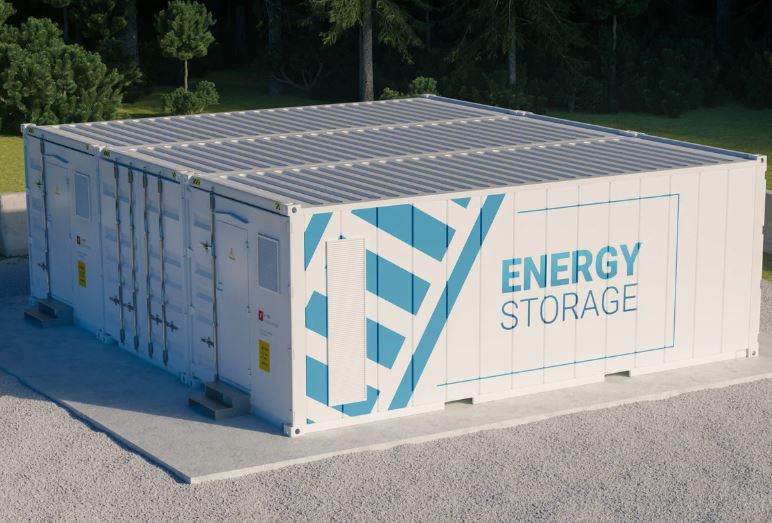
More than half of all new battery storage capacity cleared in PJM’s 2027/28 Residual Capacity Auction belongs to a single project in Licking County, Ohio. Eolian Energy’s Flint Grid Project, a 200 MW system with 5.3 hours of duration producing 1.06 GWh of deliverable energy, began construction this week in Jersey Township, positioned adjacent to the New Albany data centre corridor and the industrial load cluster that has made central Ohio one of the most capacity-constrained zones in the eastern US grid.
The scale of the project relative to the auction it cleared is itself a signal: PJM’s capacity market attracted limited battery participation in previous auctions because existing accreditation methods did not adequately capture what storage assets can reliably deliver, and the 2027/28 auction is the first in which the regulatory groundwork for meaningful battery qualification has been sufficiently developed to allow a 200 MW system to clear as capacity.
PJM Interconnection operates the largest competitive electricity market in the world, covering 13 states and the District of Columbia with approximately 65 gigawatts of peak demand. Its capacity market, the Reliability Pricing Model, procures forward commitments from generators and demand response resources three years ahead of the delivery year, establishing a price signal designed to attract sufficient investment in generation and infrastructure to meet projected peak demand. Battery storage assets participating in capacity markets face a specific challenge: they must demonstrate effective load-carrying capability, a metric that measures the statistical contribution a resource makes to grid reliability during the highest-stress hours, in a framework originally designed for dispatchable thermal generation and hydro that can sustain output indefinitely. A 5.3-hour battery with 200 MW of power capacity delivers approximately 1.06 GWh before depletion, and accreditation methodology must translate that finite energy limitation into a capacity credit that accurately reflects the asset’s reliability contribution.
Why Ohio and Why Now
The New Albany data centre concentration in Licking County represents one of the most acute examples of load growth driven by AI infrastructure investment in the United States. Amazon Web Services, Meta, Google, and Microsoft have all established significant data centre operations in the New Albany area, attracted by available land, transmission access, and Ohio’s regulatory environment. The resulting load growth has created transmission congestion and capacity shortfalls that the region’s existing generation fleet and grid infrastructure were not built to handle.
This is the context in which Eolian committed capital to the Flint Grid Project years before the current demand growth cycle became a mainstream investment theme, as CEO Aaron Zubaty noted at the construction announcement. The observation is more than self-congratulatory: it points to a structural dynamic in US electricity infrastructure where the permitting, planning, and capital commitment process for large storage projects takes three to five years from inception to commercial operation, meaning assets entering service in 2027 reflect decisions made in 2022 or 2023, when the AI data centre demand wave was not yet visible in capacity planning documents. Projects that reach construction now do so because their developers committed before the conventional risk-return calculus would have supported the decision.
The Ohio Power Siting Board’s first grid-scale BESS permit, which Flint Grid holds, reflects the same timing. Ohio’s regulatory framework for utility-scale battery storage was not designed with multi-hundred-megawatt standalone projects in mind, and Eolian’s experience navigating the first permitted project in that jurisdiction produces regulatory learning that subsequent projects can build on, compressing the permitting timeline for the pipeline of projects that will follow.
The PJM Market Structure and What It Means for Storage Economics
PJM’s capacity market provides a long-term revenue stream that materially improves the bankability of large storage projects by layering a predictable capacity payment on top of the energy and ancillary service revenues that storage assets earn through daily market dispatch. The 2027/28 capacity auction cleared at prices that reflected genuine scarcity signals in PJM, driven by the combination of accelerating load growth from data centres and electrification alongside the retirement of thermal generation that the capacity market had previously relied upon. Storage projects clearing in this environment receive capacity payments that in prior auction cycles were insufficient to justify the capital cost of large systems.
Eolian’s focus on developing technical guidelines for bidding processes, creating market products for storage participation, and assessing effective load-carrying capability accreditation methods is not peripheral to the Flint Grid business case. It is central to it. A 1.06 GWh system that clears the capacity market at full accreditation value earns substantially more revenue per unit of capital than the same asset accredited at a fraction of its nameplate capability. PJM’s accreditation methodology for battery storage has been under development and revision, and the extent to which Flint Grid can earn capacity revenue commensurate with its actual reliability contribution will depend on how those methodological questions are resolved before the 2027/28 delivery year.
The 5.3-hour duration is a deliberate design choice that positions the asset to serve the full evening demand peak rather than just the steepest portion of the net load ramp. At current PJM market dynamics, with solar generation creating midday price troughs and evening peaks remaining elevated, a system that can charge at low cost during solar hours and discharge for more than five hours into the evening provides both energy arbitrage revenue and the sustained output during high-value hours that maximises capacity accreditation. This is the operational configuration that the current generation of four-hour battery systems cannot fully replicate, and the additional capital cost of the energy capacity needed to extend from four to 5.3 hours is justified by the revenue difference in markets where the evening peak persists well beyond the point at which a four-hour system would be depleted.
The Transmission Constraint Angle
Eolian’s exploration of energy storage as a means to boost transmission capacity in demand-growth regions points to an application that is distinct from the capacity market revenue model but increasingly relevant in constrained networks like the zones around New Albany. Grid-enhancing technologies, including dynamic line ratings, advanced power flow controllers, and storage systems operating in virtual transmission mode, are being evaluated by PJM and other regional transmission organisations as a faster alternative to physical transmission expansion for relieving specific congestion points.
A storage system co-located with transmission infrastructure can absorb power during periods of transmission congestion, effectively serving as a buffer that reduces the instantaneous transmission demand on constrained lines, and discharge when transmission capacity is available and demand is high. The revenue model for this service sits in transmission-related market products that are less mature than capacity and energy markets but are being actively developed as transmission constraints become a more frequent binding operational constraint in high-load-growth regions. Flint Grid’s location adjacent to major data centre loads and industrial demand in a region experiencing exactly this type of constraint positions it to participate in these emerging product categories as PJM’s market rules evolve.