






Renewable energy sources are projected to comprise 46% of global electricity generation by 2030, up from 30% in 2023, according to International Energy Agency forecasts. Solar and wind are expected to account for nearly all of this expansion. This rapid deployment trajectory creates control system challenges for microgrids integrating intermittent generation, particularly as global renewable capacity is expected to expand by over 5,520 GW during 2024-2030, representing 2.6 times the deployment achieved during 2017-2023.
A recent academic study examines hierarchical control architectures that combine droop-based primary control, adaptive centralized secondary regulation, and battery energy storage systems to address frequency instability and voltage fluctuations inherent in high-penetration renewable microgrids. The control framework, validated through MATLAB/Simulink simulation, demonstrates how lithium-ion battery systems can maintain DC bus voltage stability while compensating for photovoltaic output variability without relying on idealized DC source models that oversimplify real-world operating conditions.
Technical Architecture and Control Hierarchy
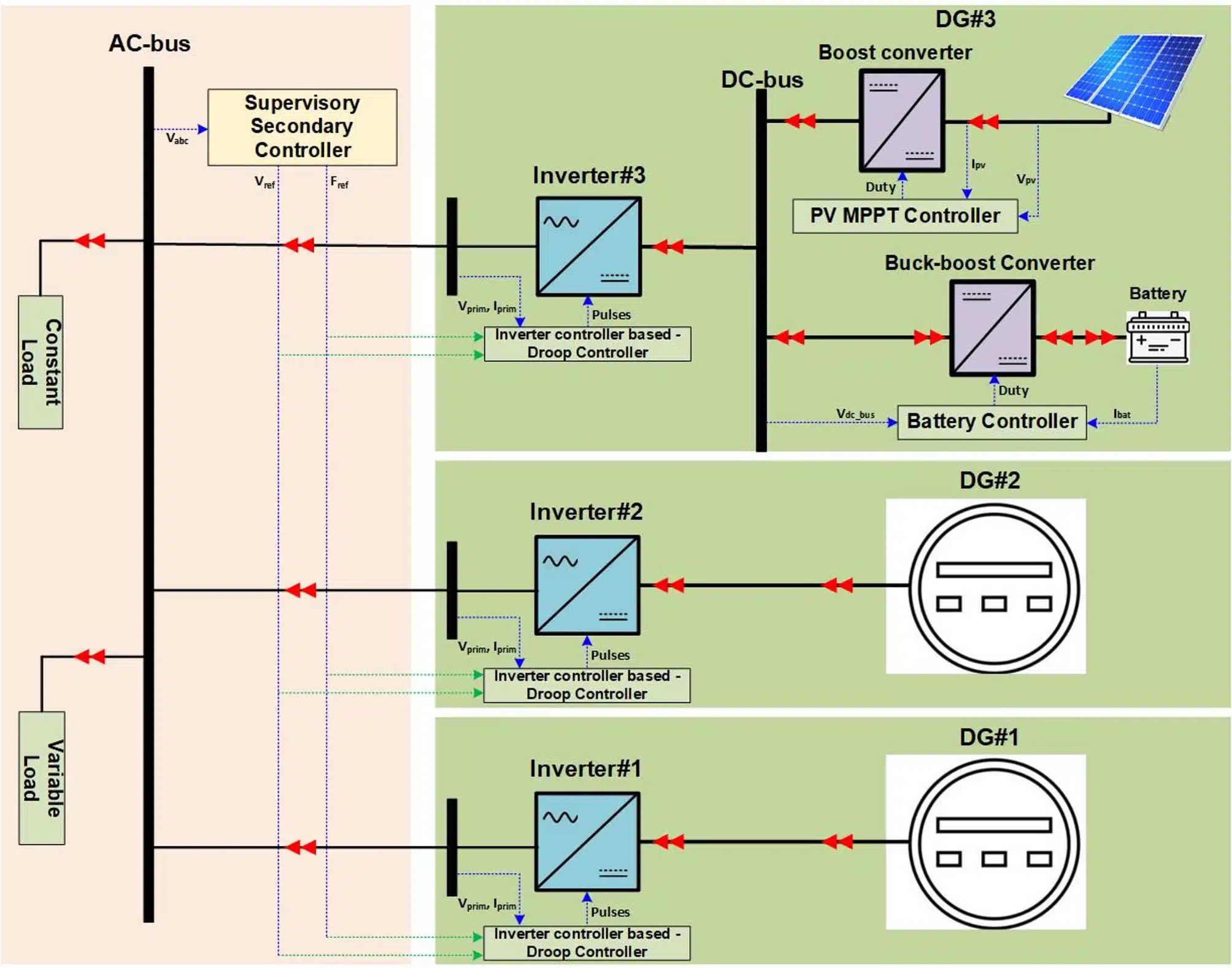
The studied microgrid configuration consists of three distributed generation units interfacing through voltage source converters to a common AC bus serving constant and variable loads. Two units employ idealized DC sources while the third integrates actual photovoltaic arrays with battery storage, enabling comparative analysis between simplified modeling approaches and realistic generation characteristics, including weather-dependent fluctuations and maximum power point tracking dynamics.
Primary control utilizes power-frequency and reactive power-voltage droop characteristics to enable decentralized load sharing among inverters withouta communication infrastructure. The droop coefficients determine how frequency and voltage deviate in response to active and reactive power changes, creating inherent load distribution proportional to unit ratings. This approach trades precise regulation for reliability and scalability, accepting small frequency and voltage deviations to achieve autonomous operation during grid disturbances.
Adaptive centralized secondary control restores frequency and voltage to nominal setpoints by adjusting droop curve references based on measured deviations. A central controller receives three-phase voltage measurements and bus frequency, comparing these values against nominal targets and generating correction signals through proportional-integral controllers. This layered architecture separates fast local response from slower system-wide optimization, matching control dynamics to timescales of different disturbances.
Battery Storage Integration and DC Bus Regulation
The battery control system maintains DC bus voltage stability, critical for proper power electronic converter operation and seamless energy exchange between photovoltaic generation and AC distribution. The control strategy compares actual DC bus voltage against reference values, triggering charging when voltage exceeds nominal levels and discharging when voltage falls below targets. Proportional-integral controllers generate battery current references that inner control loops track through pulse-width modulation of bidirectional DC-DC converters.
Lithium-ion batteries receive preference for microgrid applications due to high energy density, efficiency exceeding 90%, modularity enabling capacity scaling, fast response times measured in milliseconds, and compatibility with renewable integration requirements. The technology faces limitations, including cycle life constraints, temperature sensitivity affecting performance and safety, high upfront costs despite declining trends, and environmental concerns regarding material extraction and end-of-life disposal.
The simulation results demonstrate battery systems dynamically regulating charging and discharging based on instantaneous power requirements, with state-of-charge varying between defined limits while maintaining DC voltage within 2% of nominal values during photovoltaic irradiance fluctuations and load transients. This performance validates the control approach for maintaining voltage stability comparable to idealized DC sources while capturing realistic generation variability.
Photovoltaic Modeling and Maximum Power Point Tracking
The research employs actual photovoltaic system models incorporating environmental factors, partial shading effects, and temperature dependencies rather than simplified constant-voltage or constant-current DC sources. This modeling approach increases computational complexity but provides the accuracy essential for evaluating control system performance under realistic operating conditions where irradiance varies continuously, and generation exhibits stochastic characteristics.
Maximum power point tracking utilizes incremental conductance algorithms that measure voltage and current at photovoltaic array terminals, calculating power derivatives to determine optimal operating points. The controller adjusts boost converter duty cycles to maintain operation at maximum power extraction despite changing environmental conditions. The incremental conductance method demonstrates superior dynamic performance compared to alternative techniques, including perturb-and-observe, particularly during rapidly changing irradiance that characterizes partly cloudy conditions.
Simulation results show photovoltaic power output fluctuating randomly in response to variable solar radiation, with battery storage compensating for these variations to maintain stable power delivery at the point of common coupling. The combined photovoltaic-battery system achieves power quality and stability metrics approaching those of conventional dispatchable generation while capturing renewable energy benefits.
Frequency Regulation and Power Sharing Dynamics
Variable solar radiation impacts system frequency through power imbalances between generation and load, with inadequate regulation causing frequency deviations that can trigger protection systems or damage frequency-sensitive equipment. The droop control mechanism distributes frequency regulation burden among multiple generation units proportional to their droop coefficients, creating a coordinated response without centralized coordination.
The simulation demonstrates frequency variations during photovoltaic output changes and load transients, with battery storage and droop control combining to limit deviations and restore nominal frequency. The adaptive secondary control provides additional correction by adjusting primary control setpoints, achieving frequency restoration within seconds of disturbances while maintaining decentralized primary control benefits.
Power sharing among the three distributed generation units adapts continuously based on available photovoltaic output, battery state-of-charge, and load requirements. The control architecture ensures each unit contributes according to capacity while preventing overload conditions that could trigger protective disconnection. This proportional sharing mechanism proves essential for microgrid stability during islanded operation when utility grid support becomes unavailable.
Reactive Power Management and Voltage Stability
Beyond active power and frequency control, reactive power management maintains voltage levels throughout the microgrid distribution system. The reactive power-voltage droop characteristic adjusts each inverter’s reactive power output based on local voltage measurements, creating decentralized voltage support without requiring communication of system-wide conditions.
The three inverters collectively provide reactive power compensation responding to inductive and capacitive load characteristics, maintaining point-of-common-coupling voltage within acceptable tolerances despite dynamic loading. Simulation results show minimal voltage deviation during load insertion and rejection events, validating the reactive power control effectiveness for voltage stability.
The integration of battery storage enhances reactive power capability by maintaining adequate DC bus voltage for inverter operation across all operating conditions. Without a stable DC voltage, inverter’s reactive power range becomes constrained, limiting voltage support capability during system stress. The battery control system’s ability to regulate DC voltage despite photovoltaic intermittency proves critical for maintaining full reactive power support functionality.
Comparative Performance Analysis
Validation exercises compare the proposed photovoltaic-battery-controller configuration against conventional idealized DC source approaches, evaluating frequency response, voltage stability, and power delivery characteristics. The comparison reveals similar performance metrics between realistic and idealized models, though the photovoltaic-battery system requires more sophisticated control and introduces additional complexity through battery management and maximum power point tracking.
The frequency stabilization achieved using actual photovoltaic generation with battery storage matches idealized DC source performance, demonstrating that practical implementations can achieve theoretical performance levels with appropriate control design. Voltage response at the point of common coupling shows comparable stability between approaches, validating that battery-photovoltaic integration does not compromise system performance relative to simplified models.
Active power delivery to loads exhibits equivalent characteristics across modeling approaches, confirming the battery-photovoltaic system can reliably meet demand despite generation intermittency. This validation matters significantly for microgrid deployment decisions where stakeholders must assess whether practical systems can achieve performance predicted by simplified analysis tools commonly used during feasibility studies and preliminary design.
Scalability and Implementation Challenges
The demonstrated control architecture assumes three distributed generation units serving defined loads within a single microgrid, raising questions about scalability to larger systems with tens or hundreds of generation sources. Communication latency, controller processing requirements, and coordination complexity all increase with system size, potentially limiting practical deployment scale without architectural modifications.
The adaptive centralized secondary control introduces a single-point-of-failure risk where a central controller malfunction could prevent frequency and voltage restoration despite functional primary control. Redundant controller configurations and communication paths can mitigate this vulnerability, but add cost and complexity. Alternative distributed secondary control approaches exist that eliminate central controller dependence while maintaining restoration capability, though at the expense of convergence speed and optimality guarantees.
Battery degradation from cycling affects long-term system economics and performance, with capacity fade and resistance increase,s reducing storage capability and round-trip efficiency over operational lifetimes measured in years to decades. The control system must adapt to changing battery characteristics, potentially adjusting charging strategies or deration limits to maintain stability margins as storage performance declines. Whether the demonstrated control approach remains effective across full battery lifecycles requires validation through extended simulation or field demonstration.
The research acknowledges future work requirements, including machine learning integration for predictive maintenance, scalability assessment in larger networks, interoperability evaluation with utility grids, and experimental validation across diverse environmental conditions. These extensions prove necessary for translating simulation results into deployable systems facing real-world constraints, including component failures, communication disruptions, extreme weather events, and cyber-physical security threats not captured in idealized simulation environments.