




Quaise Energy has raised 280 million dollars total to prove a drilling technology that, as of its most recent disclosed test results, has not yet reached the depth Fervo Energy achieved years ago with conventional rotary drilling at an enhanced geothermal plant already selling power in Nevada. The gap between Quaise’s demonstrated progress and the more than 5 kilometers Project Obsidian ultimately requires is the more relevant number for judging what the new financing actually buys.
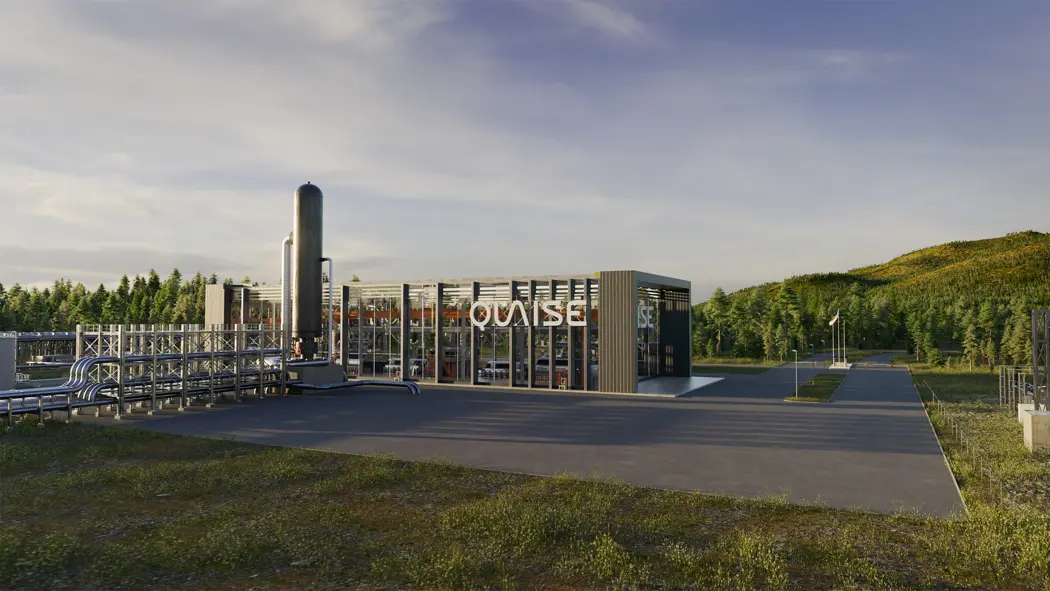
Quaise Energy closed the final tranche of a Series B round in late August, bringing in 180 million dollars and lifting the company’s cumulative funding to 280 million dollars since its founding, with Nabors Industries contributing 35 million dollars of the round and becoming Quaise’s largest shareholder at a fully diluted stake of 14%. The proceeds are earmarked for Project Obsidian, a planned superhot geothermal plant on federally leased land in Oregon’s Deschutes National Forest that aims to reach rock at 300 to 500 degrees Celsius by drilling beyond 5 kilometers, depths and temperatures well outside what conventional rotary drilling can reach economically because drill bits degrade too quickly in rock that hot and hard. Quaise’s answer is a hybrid platform that pairs standard rotary drilling for the upper section of each well with a gyrotron powered millimeter wave system, developed from research at MIT, that ablates rock with electromagnetic energy rather than mechanical contact for the deeper, hotter sections.
The company’s own disclosed testing progress puts the current state of that technology well short of what Project Obsidian will eventually require. At its Central Texas field site, Quaise had drilled to roughly 330 feet, about 100 meters, using the millimeter wave system as of early 2026, with a stated goal of reaching close to 3,300 feet, roughly a kilometer, later in the year. By comparison, Fervo Energy’s first commercial project, a 3.5 megawatt enhanced geothermal plant in Nevada that has been generating power using conventional drilling, was completed at well depths more than twice that target. Reaching the vertical depths Project Obsidian’s commercial design calls for, more than 5 kilometers, represents roughly a fivefold increase beyond the approximately one kilometer milestone Quaise was targeting for 2026 testing, a scale up that has to happen on a drilling method with no prior track record at that depth, while Fervo’s technology was already producing revenue at a fraction of the distance Quaise still has to cover.
The capital markets have priced that difference in maturity accordingly. Quaise’s Series B drew a specific and telling investor mix, Prelude Ventures leading the round with participation from Japanese energy companies JERA and Idemitsu Kosan, industrial conglomerate Mitsubishi, and Nabors, a group weighted toward strategic and venture capital rather than the kind of public equity markets that have already validated Fervo’s more conventional enhanced geothermal approach. Fervo raised 1.89 billion dollars in a single Nasdaq listing in May 2026, pricing at a valuation of 7.7 billion dollars before its shares climbed further, a single transaction worth more than six times everything Quaise has raised across its entire history. That gap is not simply about company age or management execution. It reflects a real difference in technical risk between an enhanced geothermal approach already producing contracted, revenue generating power at moderate depths and temperatures, and a fundamentally new rock ablation method that must still prove it can operate reliably at multiples of the depth it has so far demonstrated, under thermal and pressure conditions no drilling technology has sustained at commercial scale.
Nabors’ involvement adds a useful, more skeptical lens on how experienced drilling operators are actually pricing that risk. Beyond its equity stake, Nabors has an exclusivity arrangement to provide drilling services for Quaise’s projects and already has a PACE-B rig actively drilling at Project Obsidian, giving the company, in its own words, a way to “deploy its differentiated drilling, automation, and well-construction capabilities into attractive adjacent energy markets.” Because Quaise’s platform is explicitly hybrid, conventional rotary drilling handles the upper well sections regardless of whether the millimeter wave technology ultimately performs at the depths and temperatures the project needs, Nabors captures revenue and operational relevance from the conventional portion of every well drilled at Obsidian whether or not the novel gyrotron technology that defines Quaise’s entire value proposition succeeds at scale. That is a rational hedge for an oilfield services company entering a genuinely uncertain new market, but it means Nabors’ financial commitment should not be read as an unqualified technical endorsement of millimeter wave drilling specifically, a distinction the framing of Nabors as Quaise’s largest shareholder tends to obscure.
None of this means Project Obsidian is unlikely to make progress. The company has shown real, if incremental, technical advancement, moving from a 100 kilowatt gyrotron in earlier testing toward a 1 megawatt unit targeted for deployment around early 2026, a tenfold increase in the power delivered downhole that is a genuine engineering milestone on the path to commercial scale, and JERA’s own characterization of the technology as having “the potential to make geothermal a truly global baseload resource” is appropriately hedged language from a sophisticated corporate investor rather than a claim of proven performance. What the 2030 commercial operation target actually requires, however, is not just continued fundraising success but a drilling depth progression that, on the company’s own most recently disclosed test results, still has to close a gap measured in kilometers rather than the hundreds of meters covered so far, within a timeline of roughly four years. The 180 million dollar Series B extends the company’s runway to attempt that, but it does not shorten the distance between where Quaise’s drilling technology currently stands and where Project Obsidian’s underlying business case assumes it will be.