






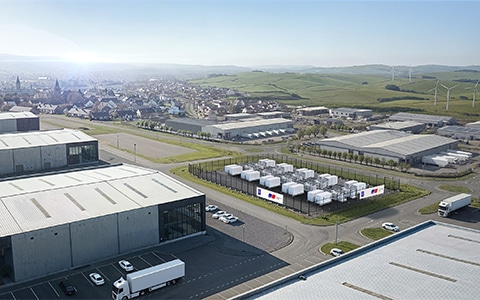
Rolls-Royce has begun construction of its first large-scale battery energy storage system in the domestic market, signaling a strategic shift from global deployments toward participation in one of Europe’s most advanced storage ecosystems.
The project, located in Falkirk, is being delivered under an engineering, procurement, and construction contract for Voltaria Helios Energy Storage. With a planned capacity of 86 MWh and output of 43 MW, the facility is designed to connect to the grid in 2026 and become operational in 2027. While modest relative to national targets, the project reflects a broader structural trend: storage is transitioning from pilot deployments to essential grid infrastructure.
The UK’s electricity system is increasingly shaped by high penetration of wind generation, particularly offshore capacity. This has introduced a growing mismatch between generation peaks and demand profiles, leading to curtailment of renewable output during periods of oversupply. Curtailment not only reduces system efficiency but also imposes direct costs through compensation mechanisms paid to generators.
Battery storage addresses this imbalance by shifting excess generation to periods of higher demand. The Falkirk system will store electricity during peak renewable output and discharge it when demand rises, reducing the need for fossil-based balancing generation. In this sense, storage is less a decarbonization technology in isolation and more an enabling layer for higher renewable utilization.
The UK’s 27 GW storage target under its Clean Power 2030 framework reflects this systemic role. Grid-scale batteries are expected to provide frequency response, peak shaving, and reserve capacity, functions traditionally performed by gas-fired plants. However, achieving this substitution at scale depends on both deployment speed and market mechanisms that adequately compensate storage operators for these services.
Rolls-Royce’s entry into the UK grid-scale storage segment builds on its experience with more than 200 battery projects globally, primarily through its mtu EnergyPack systems. The Falkirk installation represents a shift toward larger, utility-connected applications within a mature market where competition among integrators is intensifying.
The company’s role extends beyond equipment supply to full turnkey delivery, including system design, integration, and long-term maintenance under a 15-year service agreement. This model reflects a broader industry trend toward lifecycle-based contracts, where performance guarantees and operational reliability are critical for project financing.
The integration of battery technology, in this case sourced from established manufacturers such as CATL, with proprietary control systems highlights the increasing importance of software in storage economics. Revenue optimization depends not only on physical capacity but also on the ability to respond dynamically to market signals, including wholesale electricity prices and ancillary service demand.
Market Maturity and Competitive Pressure
The UK is widely regarded as one of Europe’s most developed markets for battery energy storage, with established revenue streams from frequency response services and capacity markets. This maturity has attracted a growing number of developers and investors, increasing competition for grid connections and project financing.
Helios Energy Investments and Renewables Infrastructure Capital, through their joint venture Voltaria, are positioning themselves within this competitive landscape by building a portfolio of storage assets. The Falkirk project is described as the first in a planned series, suggesting a strategy focused on scaling through replication rather than one-off deployments.
However, market maturity does not eliminate risk. Revenue stacking strategies, where storage assets participate in multiple markets simultaneously, depend on regulatory stability and price volatility. Changes in market rules or saturation of ancillary service markets can compress returns, particularly as more capacity comes online.
Despite strong policy support, the pace of storage deployment in the UK is constrained by grid connection timelines and infrastructure bottlenecks. Securing a connection agreement can take several years, creating a lag between project announcement and commissioning.
The Falkirk project’s timeline, with grid connection expected in 2026 and operation in 2027, reflects these constraints. While construction can proceed relatively quickly, integration into the transmission network remains a limiting factor for scaling storage capacity.
Additionally, as storage penetration increases, system operators must manage new complexities related to dispatch coordination and grid stability. Large volumes of battery storage can introduce challenges in frequency control if not properly integrated with system operations and market mechanisms.
The economic case for battery storage in the UK is closely tied to its ability to reduce system costs. By minimizing renewable curtailment and displacing peaking generation, storage can lower overall electricity prices and reduce reliance on imported fossil fuels.
However, the cost structure of storage projects remains sensitive to capital expenditure, financing conditions, and battery lifecycle performance. Degradation rates, replacement costs, and long-term maintenance requirements all influence project economics over multi-decade horizons.
Rolls-Royce’s long-term service agreement for the Falkirk project reflects an attempt to address these uncertainties by providing operational continuity and performance assurance. Such arrangements are becoming standard in the sector as investors seek to mitigate technical and operational risks.