





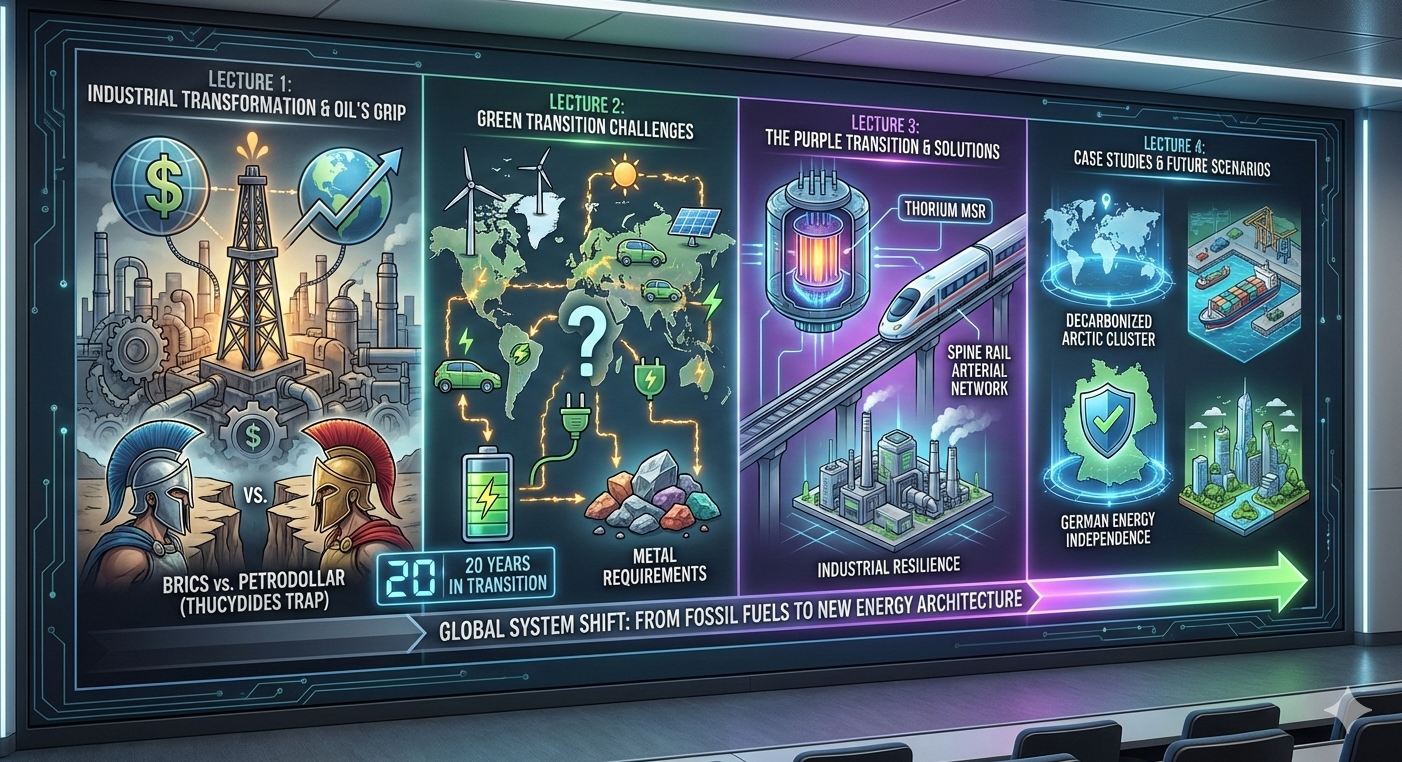
If you want a fast reality check on the last twenty years, ignore speeches and watch the commodity signal. The argument in this lecture sequence is blunt: the industrial economy is not “transitioning” in the comforting sense of swapping inputs while preserving the same machine. It is reorganizing under constraint, and the constraint is still oil, not ideology.
You can purchase the full masterclass here.
WATCH 1st PART OF MASTERCLASS HERE

This matters because the dominant public story assumes continuity. Electrify everything, scale wind and solar, add batteries, and industrial society keeps its current shape. The lectures make the opposite claim: the shape is already changing, and the driver is a tightening set of physical and financial limits that the policy conversation keeps treating as optional.
The industrial system is transforming because the master resource is still oil
The first lecture’s core framing is old-fashioned and therefore useful: energy is work done, and work done is economic value. The claim is not that energy “matters” in a moral sense, but that it is mathematically entangled with output. When energy supply becomes volatile, the economy does not politely adjust. It breaks in specific places first.
That is why the lecture spends time on fragility rather than technology optimism. The modern industrial economy is built on choke points, concentrated transit routes, cross-border pipelines, and high-fixed-cost terminals. The system is not merely exposed to disruptions; it is designed in a way that turns small disruptions into outsized consequences. The uncomfortable implication is that “resilience” is not a slogan; it is an architectural problem.
Then comes the harder pivot: the transition has not been an orderly displacement. Even as renewables scale, the system can still be expanding fossil fuel throughput. That is a deeply inconvenient data pattern for any narrative built on simple substitution. If the total machine keeps growing, adding renewables does not automatically mean fossil fuels decline in absolute terms.
The lecture’s most strategically charged thread is the geopolitical one: the BRICS bloc versus the petrodollar alliance, with oil reserves, production control, and settlement systems as the prize. In this framing, barrels are not just energy. They are monetary leverage. If a rival settlement architecture gains enough resource backing and enough participation, the “energy transition” becomes secondary to a reordering of payment rails, capital access, and sanction power.
This is where the lecture introduces its Thucydides-trap-style hypothesis for the era: when a dominant system is saturated with debt and dependent on maintaining its monetary privilege, it faces incentives to act earlier and more aggressively than it would under stable fundamentals. Not because leaders are irrational, but because the option set narrows.
Lecture 1 also treats the 2000s as the real inflection point, not a distant future. The logic runs like this: early-2000s supply constraints and geopolitical shocks push volatility into oil, the oil shock propagates into the wider economy, and then the policy response papers over structural stress with financial engineering rather than resolving it. If that is even directionally correct, then the headline lesson is brutal: the system did not “recover” from 2008. It stabilized itself through monetary expansion, and the bill is paid through eroded purchasing power and political instability.
The lecture leans into an idea many energy professionals avoid stating plainly: the world does not run out of oil first. It runs out of cheap balance sheets and social tolerance for volatility. Oil becomes “too expensive” not only geologically, but institutionally, as capital costs rise, depletion demands constant reinvestment, and consumers’ real purchasing power fails to keep up.
The green transition is constrained by arithmetic, not ambition
The second lecture does something most debates refuse to do: it forces the transition into a bounded systems exercise using a reference-year map of the global machine.
Start with 2018 and treat it as an inventory. Fleet size, distance traveled, industrial heat demand, shipping, aviation, and power generation. Then ask the question the transition rhetoric often dodges: what does it physically take to replace fossil fuel services with renewable tech systems at scale?
That question quickly becomes a sensitivity analysis problem. Not “are renewables good,” but “what happens to total generation capacity, backup requirements, materials demand, and deployment tempo under different assumptions?”
Biofuels appear here as a test of wishful thinking. Can they contribute meaningfully, and if so, where, without colliding with land, food, and logistics limits? The lecture implies the real value of biofuels is not as a universal substitute, but as a constrained option in hard-to-electrify niches, and only under strict resource accounting.
Then comes the grid reality: if you increase electrification aggressively, the required generation capacity jumps, and the shape of the build changes. The power mix is not a vibes debate; it is a question of how many new power stations, of what type, built at what pace, tied to what minerals, installed under what permitting and financing constraints.
The battery section is where online discourse tends to devolve, so the lecture treats stationary storage as a boundary case: how much storage is needed under different reliability targets, and what is the implied materials footprint? The point is not to declare storage “impossible,” but to force the trade-offs into the open.
Conventional uranium nuclear enters as another boundary case. Even if you like it, can it expand fast enough and supply chain fast enough to be a primary replacement within the relevant time window? If the answer is “not at the pace required,” then nuclear becomes part of a portfolio, not a single lever that rescues the plan.
The second part of the sensitivity analysis is recycling, because recycling is the escape hatch people invoke when mineral arithmetic becomes uncomfortable. The lecture’s posture is skeptical: recycling helps, but it cannot save a system whose scale assumptions exceed both current stock and realistic recovery rates, especially during the buildout phase when the installed base is still being created.
The net effect of Lecture 2 is not “the green transition is a scam.” It is sharper: the green transition is a plan that becomes fragile when you treat it as a full-system replacement rather than a partial decarbonization strategy. The headwinds are structural.
If the green plan hits limits, the question becomes what architecture replaces it
The “purple transition” is presented as a counterproposal: a different system architecture built around specific technologies deployed in a staged way.
The central candidate is thorium-fueled molten salt reactors as a high-density power source, benchmarked against conventional nuclear and against other options using energy return on energy invested logic. The move here is strategic: if you can secure high-density, high-reliability power, you can redesign industrial heat, transport, and materials processing around a smaller set of constraints.
From there, the solution set expands into industrial heat via iron powder combustion, long-range transport via ammonia fuels, and non-lithium battery approaches for vehicles, combined with a transport redesign concept that shifts the system from individualized, fuel-intensive mobility toward a spine-and-artery network.
Whether you buy each component is less important than the structural logic: if the energy architecture changes, the industrial design and transport design must change with it. You do not bolt a new engine onto the old machine and expect the same outputs at the same scale and reliability.
The case studies are where the proposal stops being abstract. Finland’s industrial cluster, a mine site decarbonization pathway with claimed operating expenditure implications, Rotterdam, Germany’s energy sovereignty framing, and a Nordic integrated corridor concept. The point of these case studies is not that they are turnkey plans ready for procurement. It is that system design has to be evaluated in place, against geography, heat demand, logistics, and industrial composition, not in generic global averages.
What this lecture sequence is really selling, underneath the technology debate, is a worldview: energy transition is inseparable from monetary systems, industrial design, and geopolitical bargaining power. If oil remains the master resource while settlement systems fragment and debt saturation rises, then the transition debate will keep producing comforting narratives while the underlying system shifts anyway.
That is the provocation professionals should sit with: you may be arguing about the “best” transition pathway while the world is reorganizing around the ability to secure energy, materials, and payment rails under conflict conditions. If that is the game, the correct question is no longer “what is the cleanest solution,” but “what energy architecture can survive volatility without dismantling industrial capability.”