


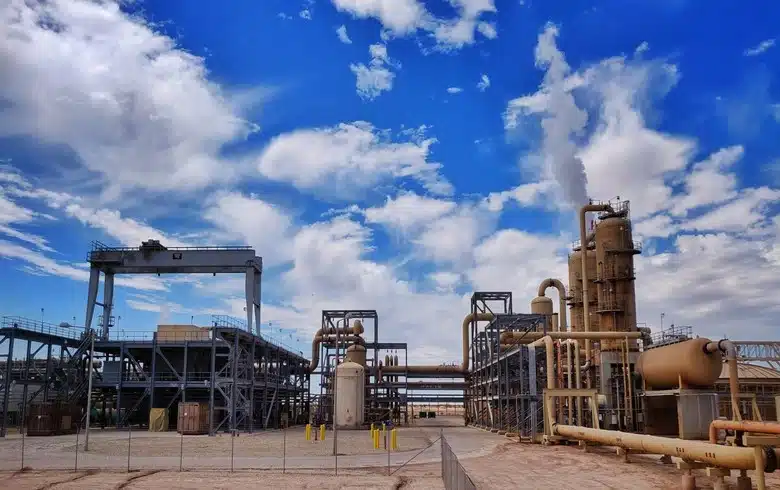


A consortium including HOCHTIEF, Siemens Financial Services, and Demeter has taken a 15% equity stake in the Phase One Lionheart project entity for €133 million, the European Investment Bank has committed €250 million, and Germany’s state-owned KfW bank has contributed €150 million in equity directly through the Deutschlandfonds. The total financing package for Phase One of Vulcan Energy’s Lionheart project reached €2.2 billion at financial close in May 2026. With the first drawdown now active and civil construction underway at the 30 MW geothermal power plant in Landau, the project has moved from its decade-long development phase into execution. The question is no longer whether the financing is real. It is whether the technology will perform at industrial scale in a way that no predecessor has demonstrated.
Lionheart is positioned at the intersection of two acute European supply chain vulnerabilities: lithium for battery production and geothermal energy as dispatchable renewable power. Phase One targets 24,000 tonnes of lithium hydroxide monohydrate annually, sufficient for approximately 500,000 electric vehicle batteries, alongside 275 GWh of renewable electricity and 560 GWh of heat over an estimated 30-year project life. The electricity and heat are co-products, generated from the geothermal brine that is extracted to recover lithium, then reinjected into the reservoir after heat extraction and lithium recovery. The integration is the project’s most distinctive feature and its most significant technical uncertainty: no facility has operated direct lithium extraction from geothermal brine at anything close to the scale Vulcan is targeting in Phase One.
What the Technology Actually Does
Lithium is extracted from naturally heated deep geothermal brines, and by reinjecting lithium-depleted brine into the reservoir after heat extraction and lithium recovery, the process avoids the evaporation ponds and high surface impact associated with conventional brine and hard rock lithium extraction. Vulcan’s adsorption-type direct lithium extraction technology selectively captures lithium ions from the brine using sorbent materials, allowing the depleted brine to be returned to the subsurface while lithium concentrate proceeds to the central processing plant for conversion to battery-grade lithium hydroxide monohydrate.
The Upper Rhine Valley Brine Field, which extends across the German-French border, is one of Europe’s most productive geothermal zones and has been commercially exploited for heat and power generation for decades. The brine’s lithium concentration and the field’s temperature profile are well characterised from this operational history. What has not been demonstrated is the sustained performance of DLE sorbent materials at the flow rates, temperatures, and impurity profiles that commercial-scale Lionheart operations will encounter over years of continuous cycling. Sorbent degradation, lithium recovery rates under operational variability, and the efficiency of the lithium concentration and purification steps from brine to battery-grade specification are the technical risks that will determine whether the 27.8% pre-tax internal rate of return and four-year payback projected in Vulcan’s 2023 bridging engineering study can be achieved in practice.
The Financing Architecture and Its Signals
The financing structure combines debt, equity, and public support, and further disbursements remain tied to specific operational benchmarks. The milestone-linked drawdown structure provides lenders and equity investors with contractual protections against cost overruns or construction delays, but it also means the full €2.2 billion is not available unconditionally. Vulcan must meet defined construction and operational thresholds to access successive tranches, which aligns incentives between the company and its financial partners but introduces liquidity risk if benchmarks are delayed.
The composition of the financing consortium is notable. The €528 million equity raising at €2.24 per share combined with the EIB debt facility, KfW equity, and strategic investor consortium creates a structure in which European public institutions are carrying a substantial share of the early-stage risk, alongside private capital that has accepted exposure to a technology not yet validated at commercial scale. The EIB’s involvement reflects a deliberate policy decision to treat Lionheart as a Critical Raw Materials Act demonstrator, accepting technology risk that purely commercial lenders might not.
A €104 million Li4BAT grant from the German federal government, co-funded by the states of Rhineland-Palatinate and Hesse, is being disbursed pro rata over 36 months following eligible expenditure from October 2025. The layering of federal grant, state co-funding, KfW equity via the Deutschlandfonds, and EIB debt positions Lionheart as one of the most publicly supported industrial projects in Germany’s critical materials strategy, which is a meaningful signal of political commitment but also a reflection of how much commercial risk remains embedded in the technology.
The Critical Raw Materials Context
The project is increasingly viewed as a test case for the European Union’s Critical Raw Materials Act, aiming to reduce dependence on Chinese lithium supplies. The CRMA sets a domestic production target of 10% of EU annual consumption for strategic raw materials by 2030 and a domestic processing target of 40%. European lithium production currently contributes a negligible share of continental battery supply chain requirements, with the vast majority of lithium hydroxide imported from China, which dominates chemical processing even where Australian or Chilean spodumene provides the raw feedstock. A single Lionheart Phase One delivering 24,000 tonnes per year would be material against the 2030 target, but it would not by itself change the fundamental structure of European lithium supply dependence.
What matters more than the volume, given the timescale, is whether Lionheart produces the operational data and engineering knowledge that enables a second and third phase to be financed at lower risk and cost. Commercial startup is targeted for 2028, which gives a relatively short window before the Critical Raw Materials Act’s 2030 benchmarks arrive. If the Landau geothermal power plant and the Frankfurt central lithium chemicals plant commissioned on April 24, 2026, both perform as designed in 2028, the European lithium supply chain will have a reference project that no amount of policy ambition has yet provided. If commissioning slips or battery-grade specification proves difficult to achieve consistently at scale, the demonstration effect runs in the opposite direction, and the gap between European critical materials policy and European critical materials reality will be that much harder to close.


