


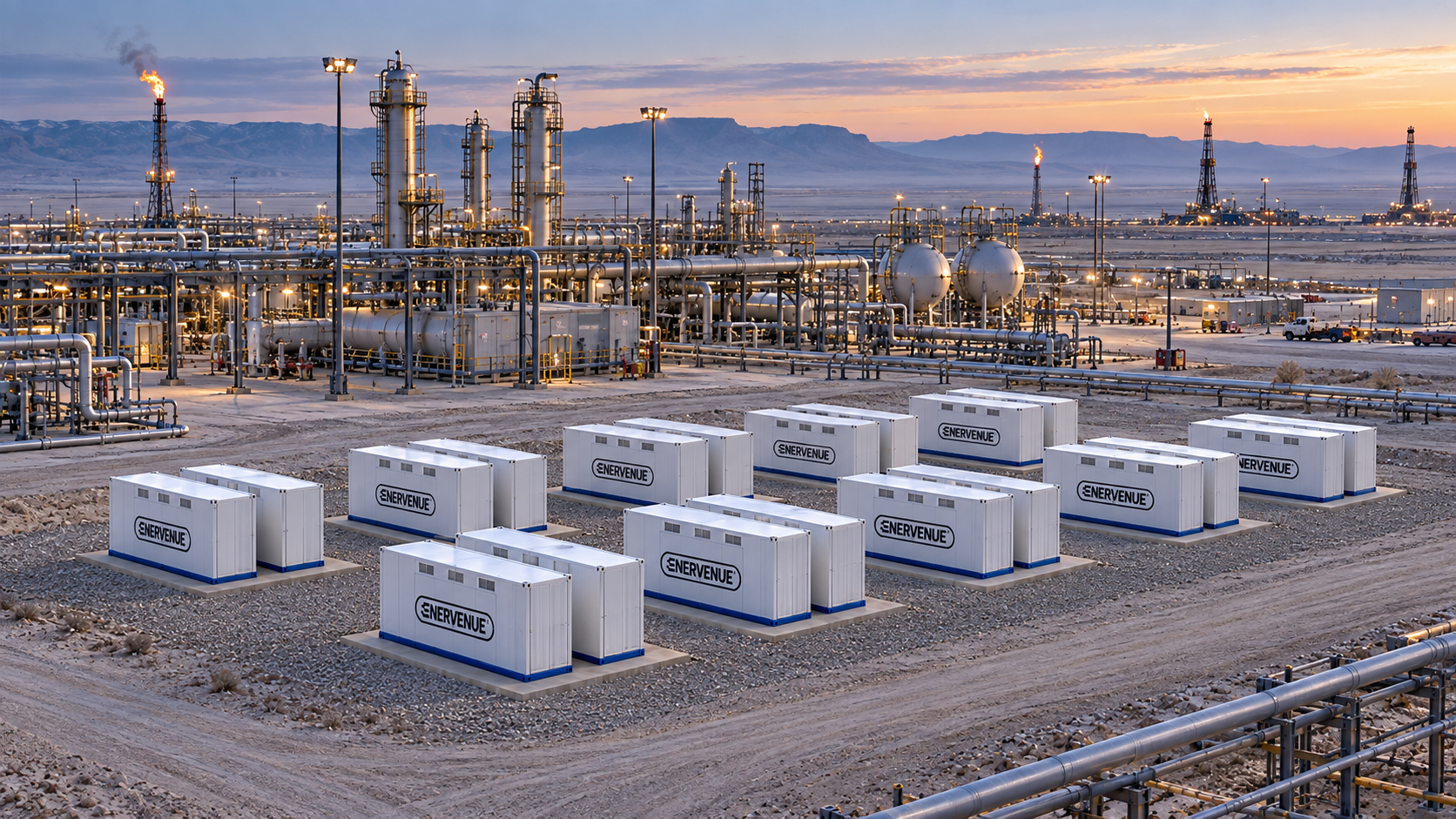


In September 2022, EnerVenue signed a master supply agreement covering 250 MWh from 2023 to 2025, with deliveries of 50, 100, and 100 MWh, for an earlier generation of its product. The order it now calls its first commercial contract at multi-megawatt-hour scale is 26 containerized units totaling 11 MWh for an unnamed Chinese oil and gas producer, with the first three due in December from a production line that made its first conforming cell at the end of September.
Eleven megawatt-hours across 26 units works out to about 423 kWh per container. Launch coverage of the Energy Prism by Charged EVs gave the product’s range as 600 kWh to 1 MWh, a range the press release itself does not state. If that range is right, either the units are configured below the published minimum or the capacity figure and the range describe different things, and the company has not said which. The release also does not name the producer, the oilfield or the price. The first three units ship in December, inside the window in which EnerVenue says the line is still ramping to full rate, and the other 23 follow in March 2027.
The 2022 agreements put that scale in context. The September 2022 master supply agreement was with Green Energy Renewable Solutions, owned by Denmark’s Nicon Industries. It came alongside a May 2022 agreement with Pine Gate Renewables for 2,400 MWh over four years, a June 2022 agreement to supply 460 MWh to Sonnell Power Solutions in Puerto Rico, and a 2023 EnerVenue presentation claiming more than 800 MWh in firm purchase orders. Those agreements covered an earlier generation of the product, and what was delivered under them is not documented in the materials reviewed. Against that backdrop, the release’s description of the Northern China project as the company’s first commercial contract at the multi-megawatt-hour scale raises the question of how earlier-announced volumes translated into shipments.
The current line sits in Changzhou, China, after EnerVenue abandoned in 2024 the 264 million dollar, 450 job Kentucky factory it announced in 2023. Chief executive Henning Rath told Reuters the choice came down to skills and supply chain depth, and that without building in China it would be “very difficult with the capital available” to prove the manufacturing process at commercial scale. He declined to disclose the plant’s cost but gave a range of 20 million to 50 million dollars. The rounds Canary Media itemizes, a 12 million dollar seed, a 100 million dollar Series A, a 308 million dollar Series B, and the 300 million dollar extension announced in March, add up to roughly 720 million dollars, consistent with the company’s “over 700 million,” which, on Rath’s range, puts the factory at about 3% to 7% of capital raised. Rath has said 1 GWh of annual production in 2027 is the scale that unlocks competitive unit economics, which suggests the 250 MWh first phase has not reached it.
The ownership and customer overlap deserves the same attention as the order. The March round was led by Full Vision Capital, the family office of Hong Kong property heir Peter Lee Ka-kit, whose broader group includes Towngas, according to Rath. Towngas is the customer for the only disclosed installation of the fourth-generation cell, a 150 kWh system pairing onsite renewables with electric bus charging at Jintan, commissioned in November 2025. Saudi Aramco and SLB, both oil and gas names, are also investors, and the first large order comes from an oil and gas operator whose identity has not been disclosed.
That Jintan system is the basis for the 30,000-cycle and 30-year claims on the current cell. In the roughly 11 months since commissioning, even three cycles a day would amount to about 1,000 cycles, around 3% of the rating, and one cycle a day would be about 335, closer to 1%. The company’s website cites 0.2% degradation per year, which over 30 years would mean about 6% total capacity loss, and attributes verification to a third party; the underlying data was not in the materials reviewed. Earlier generations have been in the field, including five 365 kWh deployments listed in the 2023 presentation and an RWE pilot test announced in December 2024, and cells have shipped to customers in the United States, Belgium and Saudi Arabia. But Reuters reports EnerVenue redesigned both the battery and the factory after Kentucky, and Rath told Canary Media the company spent nearly two more years on a fourth generation, so those earlier units say little about the cell in this order. The nickel-hydrogen heritage the release cites, the Hubble Space Telescope and the International Space Station, is widely documented, but it does not by itself show how a fourth-generation stationary cell ages over 30,000 cycles.
The lithium-ion comparison used to frame the economics has also shifted. A company spokesperson told pv magazine in July that a typical lithium-ion cell delivers around 4,000 cycles; EnerVenue’s website lists 6,000 to 8,000; and the September release says 8,000 to 10,000 with replacement or augmentation every seven to ten years. Those last two figures are compatible only at roughly two to four full cycles a day, since 8,000 cycles over ten years is 2.2 a day and 10,000 over seven is 3.9. The release says the project shifts daytime solar output into the hours when the site draws power; assuming about one cycle a day, 30 years consumes about 10,950 cycles, 36.5% of the 30,000 rating, while an 8,000- to 10,000-cycle lithium cell would last 22 to 27 years. On that assumption, cycle count does not decide this project; calendar life does. The comparison then runs against products such as CATL’s TENER, reported at more than 15,000 cycles and an expected 20-year life, though CATL’s own launch release stressed five years of zero degradation without specifying warranty terms, and against China’s own battery plan, which sets a 15,000-cycle target for long-life lithium batteries.
The safety case, which the company says decided the sale, is stated more firmly in marketing than in the engineering language behind it. The release says the cell carries “zero risk of fire from thermal runaway,” while the chief technology officer says the chemistry “does not produce the same progression of events” that leads to ignition or propagation, a narrower claim. The cell contains hydrogen gas under pressure; in earlier IEEE Spectrum coverage, the company’s then chief executive said peak pressure was about 5% of a typical fuel cell tank, and a fourth-generation figure was not in the materials reviewed. The company told pv magazine that under abuse, the cells are designed to release steam through a pressure relief rather than propagate fire. The release reports a UL 9540A result of no propagation at the cell level only, and says nothing about module, unit, or installation-level testing. The electrolyte is water-based and non-flammable, but the company’s own technical description calls it alkaline. That the customer chose EnerVenue on safety is the vendor’s account, not the operator’s.
Published performance figures are also more modest than headline claims. The two editions of pv magazine’s product coverage give rack-level round-trip efficiency of at least 85% in one and at least 87% in the other, with a peak cell efficiency of 87% at 25 C, against “90%+” on the company’s website, which may refer to a different measurement boundary. If the lower rack-level figure is the relevant one on a solar-fed site, 85% versus 90% means 15% of stored energy lost instead of 10%, half again as much. The 191 mm by 2,078 mm cell stores 3.0 kWh, about 50 Wh per liter on its cylindrical envelope by my calculation, assuming 191 mm is the diameter, against 430 Wh per liter that CATL claims for its L-series cells. That is consistent with the low volumetric density the chemistry is known for and with a Wood Mackenzie analyst’s comment, in earlier coverage, that more space and more batteries would be needed than with lithium-ion. The company answers with footprint per square foot through stacking. A spokesperson put the in-service operating range at minus 10 C to 45 C, narrower than the minus 20 C to 60 C cell range quoted at launch and than the company’s “world’s harshest environments” language, and the site is described only as northern China, so the fit cannot be assessed.
Scale is the last test. The Changzhou line’s 250 MWh a year is about 0.1% of the 218.0 GWh of power and storage batteries China produced in July alone, per CABIA data, and this order is 4.4% of one year of that capacity. BloombergNEF’s 2025 survey put the lowest observed LFP stationary storage cell at about 36 dollars per kWh and the average stationary storage pack at 70 dollars, while InfoLink tracked mainstream 314 Ah cells in China at 0.365 yuan per Wh on April 20, about 51 dollars per kWh at the exchange rate implied in Energy-Storage.News’s reporting. EnerVenue has disclosed no price. The memoranda signed at the factory opening with Towngas, Shanghai Electric, Guangzhou Development Group and Desert Technologies were described as agreements with prospective partners, not orders. Production in North America, Europe, and the Middle East is floated from 2028, depending on demand and regulatory conditions, a date after the Energy Department rules due around December on grid storage batteries under the August executive order. Until then, volume production for every market sits in Changzhou.
Add EnergyNews.biz as a preferred source on Google


