





Energy Dome plans to spend about €6.5 million over two years to triple the output of a plant that employs 30 people today. The Italian long duration storage developer opened the manufacturing site in Piacenza on 12 October 2026 to build the large domes at the centre of its CO2 Battery, and the three projects it named as the plant’s first customers are in India, the United States and Ireland.
Three domes, three durations
Energy Dome says it has shipped the first dome made entirely in house to India, for the 20 MW/160 MWh Kudgi project with state owned NTPC. Production is underway for the 20 MW/200 MWh Columbia Energy Storage Project in Wisconsin, with Alliant Energy, and the next component is destined for a 23 MW/200 MWh project in Rhode, Ireland. The durations are 8 hours at Kudgi, 10 hours in Wisconsin and about 8.7 hours in Ireland.
Together the three projects are 63 MW and 560 MWh, an average of 8.9 hours, and they are a fraction of the company’s stated totals. The announcement gives no baseline production figure, so the tripling cannot be converted into domes or MWh a year.
€2 million spent, €4.5 million to come, 50 to 60 jobs
The company invested about €2 million in the Piacenza site over the past year to upgrade the building, buy machinery and improve electrical and network infrastructure. It plans to raise the total to about €6.5 million over the next two years, with the goal of tripling production capacity and lifting the workforce from 30 to between 80 and 90 by 2028. The remaining €4.5 million spread over 50 to 60 new jobs is about €75,000 to €90,000 of capital per added job.
2 GWh in hand, 30 GWh in the pipeline
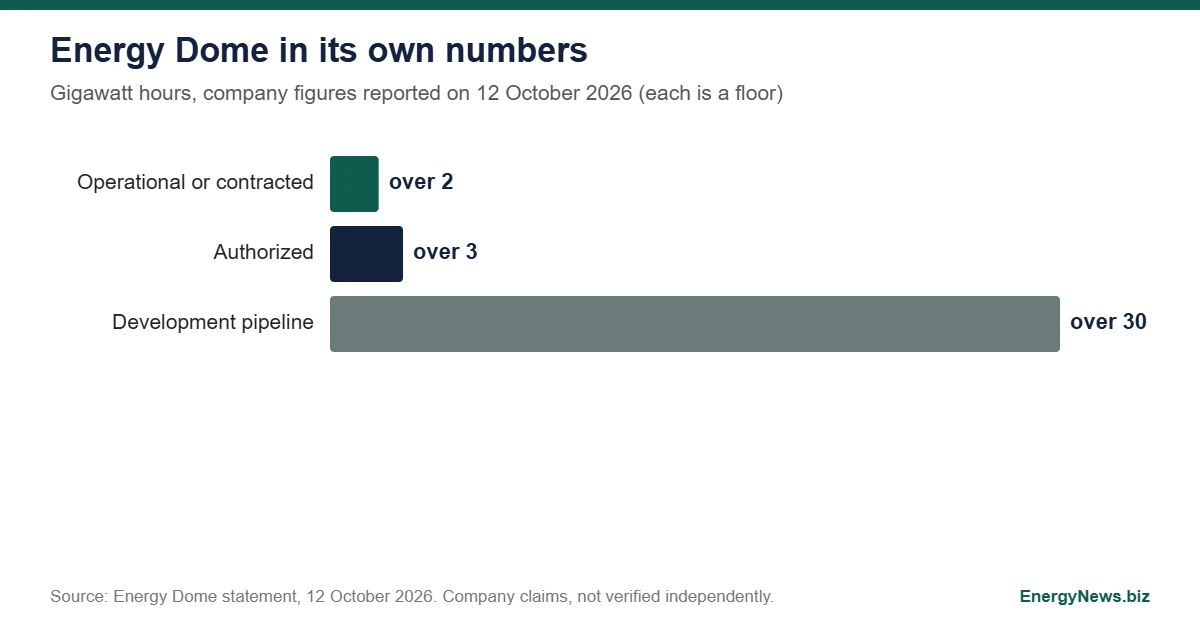
Energy Dome reports a presence on four continents, with more than 2 GWh of projects operational or under contract, more than 3 GWh authorized and a development pipeline above 30 GWh. Those are company figures, and each is stated as a floor. Read in order, they describe a funnel: on the stated floors, about 7 percent of the pipeline is operational or contracted, and the three named projects account for less than 28 percent of that 2 GWh. The plant’s capacity in MWh a year is not disclosed.
Italian demand, foreign deliveries
The company cites Italy’s National Integrated Energy and Climate Plan, grid operator Terna’s stated need for 50 GWh of storage by 2030 and the new MACSE storage procurement mechanism as factors supporting demand. All three are evidence of an Italian market. None of the three named projects is in Italy, so the plant’s early output serves the export case, and the domestic case rests on MACSE results that the announcement does not report. Against Terna’s 50 GWh, the 560 MWh of named projects is 1.1 percent.
Energy Dome also says its technology relies on European supply chains, including steel and turbomachinery, rather than supply chains outside Europe. The announcement gives no local content share or supplier names, so the claim cannot be weighed. A plant of this size mainly shows where the domes are made, not where the compressors and heat exchangers come from.
What the announcement does not say
The opening statement leaves out most of the numbers that would let the investment be tested: the number of domes the plant can build in a year, the price per dome or per MWh, the floor area of the site, the share of components sourced inside Europe, the commissioning dates of the three named projects and any independent verification of the 2, 3 and 30 GWh figures. It does say the first dome made entirely in house has already left for India, which implies that earlier domes were not made entirely in house, though the earlier arrangement is not described.
The dated checks are few: the workforce target of 80 to 90 by 2028, the €6.5 million investment over two years, and the delivery of the Ireland component after the Wisconsin dome. No commissioning dates are given for Kudgi or Columbia. For another storage project that slipped from its first announced date, see BMW’s Leipzig hydrogen link. Source: Energy Dome statement on the opening of its Piacenza manufacturing plant, reported 12 October 2026.
Add EnergyNews.biz as a preferred source on Google


