




PET waste electrolysis can lower the anodic potential by up to 1 V, a review in the International Journal of Hydrogen Energy reports, by replacing the slow oxygen reaction at the anode of a water electrolyser with the oxidation of ethylene glycol from PET waste, and the same cell then makes chemicals at the anode and hydrogen at the cathode. In a cell that runs at 1.8 to 2.2 V, a full 1 V is 45 to 56 percent of the voltage, so the claim deserves a test of what it covers and what it leaves out.
The claim in numbers
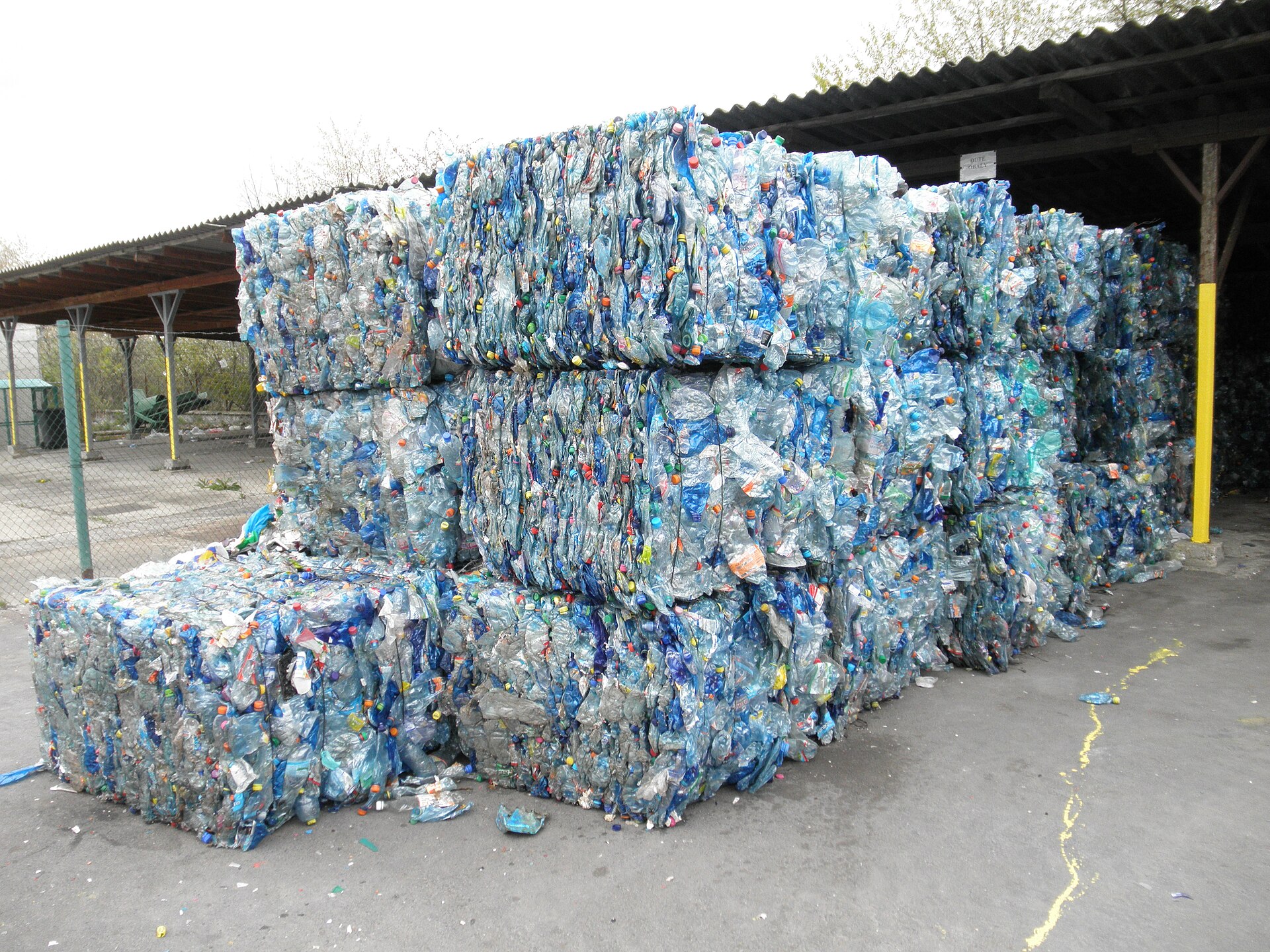
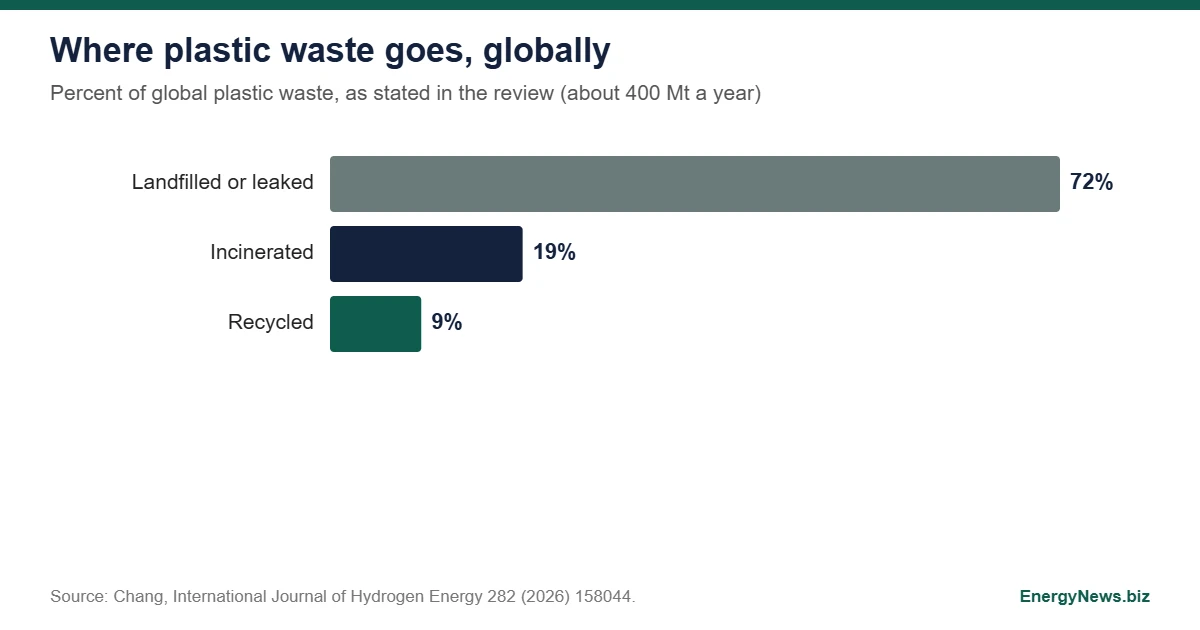
The review, by Siu Hua Chang of Universiti Teknologi MARA, starts from a waste problem. Global plastic production reached about 450 Mt in 2025, up from about 436 Mt in 2023, and plastic waste is about 400 Mt a year, of which only about 9 percent is recycled, 19 percent incinerated and 72 percent landfilled or leaked. PET is a priority target because its ester backbone breaks down by hydrolysis into ethylene glycol, which oxidises readily, and recoverable terephthalate salts.
On the electrochemistry side, water splitting needs 1.23 V thermodynamically, but the oxygen evolution reaction adds an overpotential of 0.7 to 1.0 V, so industrial cells run at 1.8 to 2.2 V at current densities of 600 to 2,000 mA per square centimetre and 50 to 80 °C. Ethylene glycol oxidation replaces that sluggish anode reaction, lowers the anodic potential by up to 1 V according to the studies the review cites, and produces salts of organic acids that carry value.
What 1 V is worth per kilogram of hydrogen
At 100 percent Faradaic efficiency, producing a kilogram of hydrogen takes about 26.6 kWh for every volt of cell voltage, from two electrons per hydrogen molecule and 496 mol of hydrogen per kilogram. A cell at 1.8 to 2.2 V therefore needs 48 to 59 kWh per kilogram, and a cell 1 V lower needs 21 to 32 kWh, a difference of up to 26.6 kWh per kilogram. Those figures assume the full 1 V reduction holds at industrial current densities, which the phrase “up to” does not promise, and they count only the electrolysis step.
The hydrolysis step is where the bill is
Before electrolysis, PET has to be hydrolysed in concentrated alkali. The review says typical conditions use potassium or sodium hydroxide of up to 10 M at up to 180 °C for up to 84 hours, consuming two equivalents of alkali per PET repeat unit. For the PET repeat unit of 192.2 g per mole, a kilogram of PET holds 5.2 mol, so the stoichiometric alkali is about 0.42 kg of sodium hydroxide, or 0.58 kg of potassium hydroxide, and the glycol released is about 0.32 kg at full conversion. Heating to 180 °C for up to 84 hours is an energy and equipment cost that the 1 V saving has to pay for, and the review lists process integration and techno-economic viability among the open challenges.
| Per kilogram of PET, complete hydrolysis | Amount |
|---|---|
| PET repeat units | 5.2 mol |
| Sodium hydroxide consumed | About 0.42 kg (potassium hydroxide: 0.58 kg) |
| Ethylene glycol released | About 0.32 kg |
A field that is growing and still thin on synthesis
The review counts the literature. A Scopus search for 2007 to 2026 returns 97 documents on PET, electrolysis and chemicals, 62 on PET, electrolysis and hydrogen, and 45 on all four terms, with growth from a nascent stage to rapid expansion since 2023. Research articles make up 95 to 97 percent of that output and reviews 3 to 5 percent, which the author reads as a lack of consolidated understanding. The paper’s contribution is to cover the whole process in one place, from feedstock suitability and hydrolysis to cell design, catalysts, electrolytes and mechanisms.
The test for the technology is a full energy and mass balance that includes hydrolysis, product separation and catalyst and membrane lifetime, which are the durability, mass transport and scale up issues the review names. The calculation above shows the size of the prize on one side of that balance. For a related question on hydrogen from waste streams, see Coins’ mobile system that makes hydrogen from recovered solar silicon. Source: Siu Hua Chang, Electrolysis of PET waste into value-added chemicals and hydrogen: a review, International Journal of Hydrogen Energy 282 (2026) 158044. The sections read for this analysis were the abstract, highlights, introduction and section snippets.
Add EnergyNews.biz as a preferred source on Google


