




An immersion cooling battery thermal management system that puts cells in direct contact with an insulating coolant can cut peak temperature and improve uniformity, but the gain depends heavily on where the coolant enters and leaves the pack. That is the finding of a computational fluid dynamics study in the Journal of Energy Storage by Hongda Li, Qiuwan Shen and Shian Li (DOI 10.1016/j.est.2026.125298). Only the abstract, highlights, introduction and section previews were available for this report, so the figures below come from the abstract and the full methods and conclusions were not reviewed.
What the immersion cooling study set out to do
In an immersion cooling design the coolant touches the battery surface directly, which removes the interfacial thermal resistance of a conventional liquid-cooled plate and simplifies the structure. The authors note that performance is not set by the method alone. Coolant properties, cell arrangement, inlet and outlet layout, channel size and flow rate all interact, and compact modules suffer from biased flow, backflow and dead zones where coolant is not renewed near hot cells. Simply raising the flow rate lowers temperature but raises pressure drop and pump energy. The study therefore compares three inlet and outlet arrangements and several baffle plate angles, tracking maximum temperature, temperature difference across the pack and pressure drop together.
Immersion cooling results reported in the abstract
| Case | Maximum temperature | Temperature difference | Pressure drop |
|---|---|---|---|
| Inlet and outlet arrangement, from | 308.5 K | 8.36 K | 51.0 Pa |
| Side inlet and outlet, to | 307.8 K | 7.66 K | 77.32 Pa |
| Horizontal baffle | 307.26 K | not stated | 171.55 Pa |
| Baffle angle raised to 20 degrees | 308.59 K | not stated | 199.44 Pa |
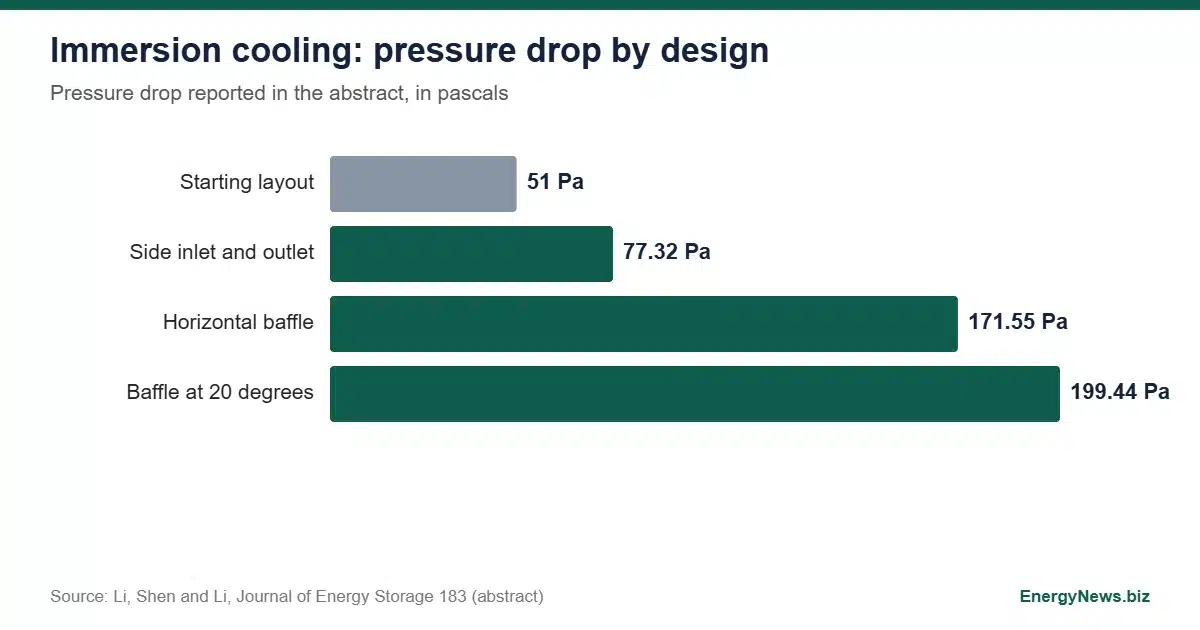
The side arrangement forms what the authors call a gap flow between cells, giving the lowest maximum temperature and the most even temperature field of the three layouts. The top arrangement suffers flow short-circuiting and heat accumulation. The reported change is modest in absolute terms, 0.7 K on the peak and 0.7 K on the spread (an 8.4% reduction from 8.36 K), but it costs a 51.6% rise in pressure drop, from 51.0 Pa to 77.32 Pa.
Baffles guide coolant into critical regions. A horizontal baffle pulled the peak down to 307.26 K, but the pressure drop reached 171.55 Pa. At a 20 degree baffle angle the peak was 308.59 K and the pressure drop 199.44 Pa, so steeper angles lost the thermal benefit while adding hydraulic loss. The authors conclude that the best balance between heat transfer and flow resistance sits at small baffle angles.
Why it matters, and what is missing
Thermal uniformity is a lifetime and safety lever for lithium-ion packs, because hot spots accelerate degradation and can contribute to thermal runaway. The result that the inlet and outlet layout dominates, rather than the choice of baffle, gives pack designers a low cost place to start. The research sits within a wider battery research thread, such as our earlier look at hybrid grid storage chemistry, and US laboratory work on battery thermal behaviour is catalogued by the National Renewable Energy Laboratory.
Limits apply. This is a numerical study and the abstract does not mention experimental validation, coolant type, flow rate, pack size or cell format. The temperature gains are measured in tenths of a kelvin on a baseline that is already near 308 K, so the practical value would depend on duty cycle and on pump power in a real system. Anyone using these numbers should read the full paper for the model assumptions.
For pack designers, the immersion cooling message is to settle the flow path before adding structures. Immersion cooling already removes the contact resistance of cold plates, so the remaining gains come from avoiding short-circuited flow and dead zones, and any immersion cooling baffle has to earn its pressure drop. A system with lower pump power and a tighter temperature spread would be preferred for fast charging and high energy density modules, which is the use case the authors emphasise. Because only the abstract was reviewed, readers should treat the numbers as indicative and check the paper for the geometry, coolant and boundary conditions behind the immersion cooling results.
Add EnergyNews.biz as a preferred source on Google


