


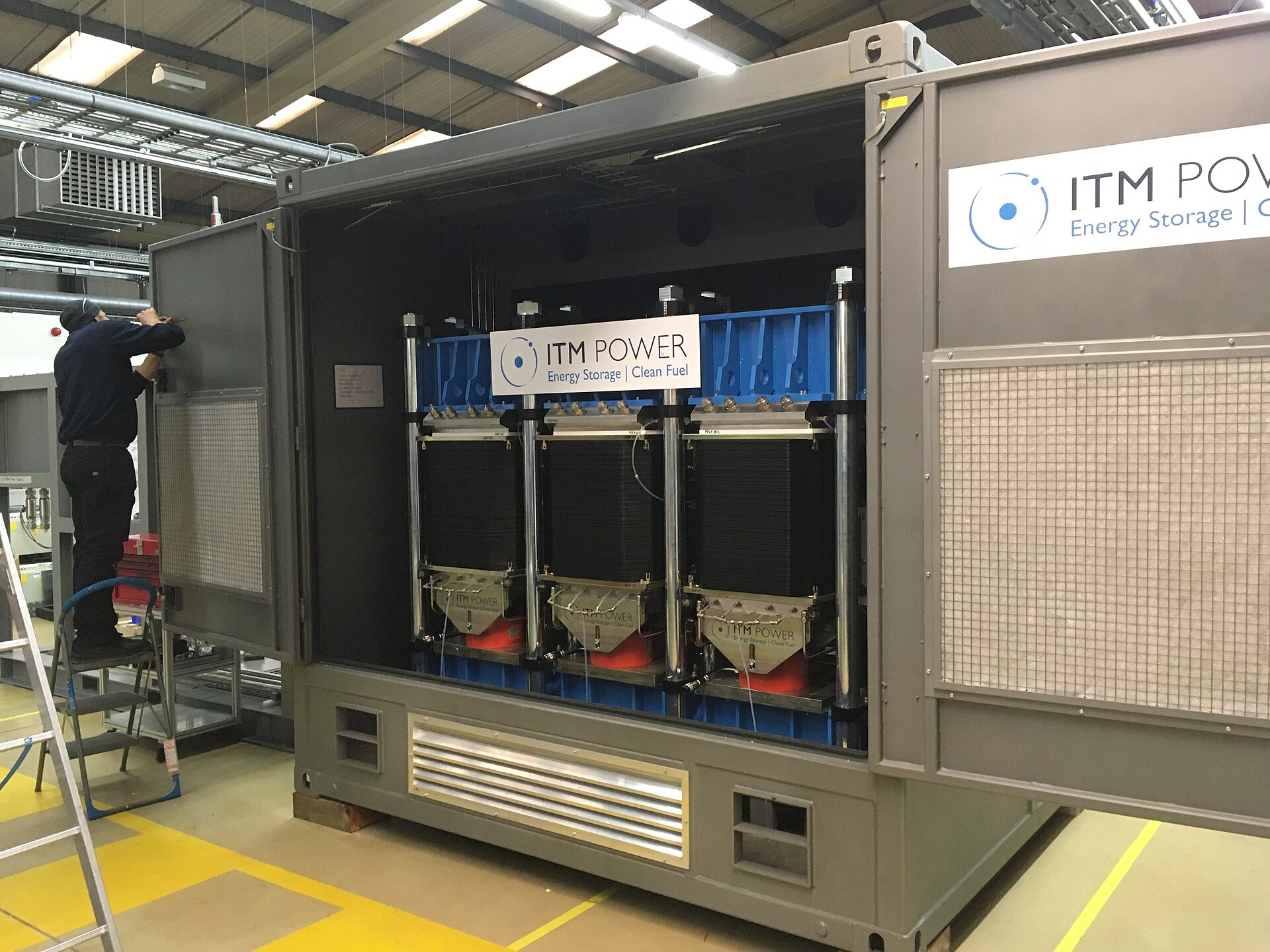


Public acceptance of hydrogen in Germany does not follow a single script. A nationally representative survey of 1,201 adults, published in the International Journal of Hydrogen Energy (DOI 10.1016/j.ijhydene.2026.158170), found that people rated a reversible solid oxide cell facility more warmly than an electrically assisted gasification facility, and that what drives support in both cases is perceived cost, safety and benefit far more than who the respondent is. The paper is open access and this article draws on its full text, including the conclusion.
How the survey tested public acceptance of hydrogen
The online survey ran across Germany in October 2025 through a market research panel and reached 1,201 adults. Each respondent was shown a video about one of two emerging green hydrogen technologies and then asked what they felt about a plant near their home. One technology was reversible solid oxide cells, called rSOC, which run as an electrolyser when power is plentiful and as a fuel cell when it is not. The other was electrically assisted gasification, called eGas, which the authors associate with waste-based feedstocks. The questionnaire was shaped by focus groups held in 2024 and used five point scales.
Awareness was not the obstacle. When asked what comes to mind on hearing the word hydrogen, about 31% named energy or fuel, 17% named mobility, 15% recalled chemistry or science lessons and 14% linked it to clean energy, while only about 4% had no thoughts. Experience with actual hydrogen projects, the authors note, remains limited because deployment is early.
Two technologies, two different welcomes
Respondents reported significantly less positive feelings about a nearby eGas plant (mean 3.23) than a nearby rSOC plant (mean 3.58). They also expected a worse community reaction to eGas (2.82 against 3.04) and gave it a lower overall evaluation (3.69 against 3.95). All three gaps were statistically significant, with small to moderate effect sizes. Across perceived benefits, cost, safety and trust in industry, the rSOC group scored higher, and the widest gap was on perceived safety. The gap in trust in the municipality was the smallest and did not survive the authors’ correction for multiple comparisons.
What actually predicts support
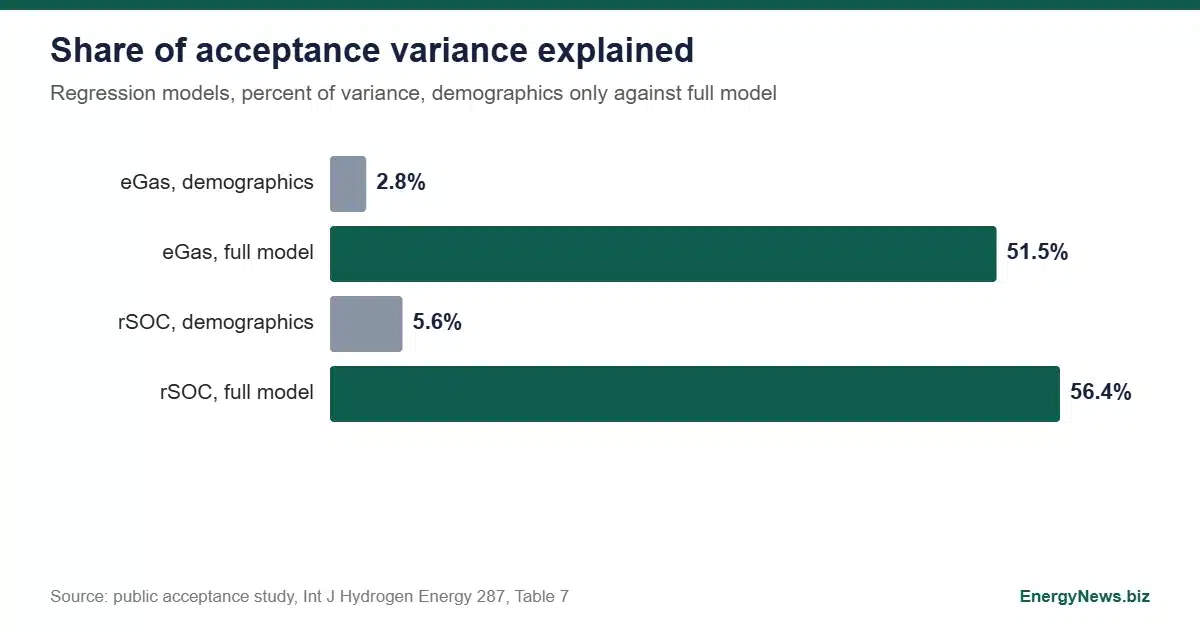
Demographics explained very little. Age, gender, education and income together accounted for 2.8% of the variance in eGas acceptance and 5.6% for rSOC. Once attitudes were added, the models explained 51.5% and 56.4%. Perceived cost, meaning whether people judged the project costs as justified, was the strongest single predictor in both groups, followed by perceived safety and perceived benefits at similar strength. Trust in industry mattered modestly, and environmental attitudes predicted acceptance of eGas but not rSOC. Men reported higher acceptance than women in both groups. Higher education and income predicted rSOC acceptance at first, but those effects faded once attitudes were included, which suggests they work through how favourably people see the technology.
A pooled test found no reliable difference between the two technologies in what drives acceptance. In the authors’ reading, a common set of attitudes sits under both, while the level of acceptance differs by technology. That is a useful result for developers: the lever is the same, but the starting point is not. It also echoes the cost pressure seen in policy, for example in recent analysis of green hydrogen costs and in the gap between subsidy and market reality.
Limits and what the authors recommend
The sample leaned younger and more active than the population. Unemployment was 7.4% against 3.4% nationally, and retirees were 10.1% against 22%, which the authors attribute to online recruitment. Respondents judged a short video, not a real project, and the authors themselves caution that firmer conclusions on siting preferences need further research. The results describe attitudes in Germany in late 2025 and may not transfer elsewhere.
The policy advice is practical. Engagement should be early, local and technology specific, with transparent communication on siting and impacts. Waste-based routes such as eGas may need to address emissions, industrial processes and waste streams head on, while rSOC messaging can lean on its link to renewable power and acknowledge land use, visual impact and grid needs. Public acceptance of hydrogen, in short, is something to be earned technology by technology.
For project developers, the survey suggests that public acceptance of hydrogen should be measured per technology and per site rather than assumed from general support for hydrogen. A plant that people see as safe, affordable and beneficial is likely to win local consent, and the public acceptance of hydrogen found here is closely tied to those three judgements. Early and honest local engagement is therefore a cost of doing business, not an optional extra, and public acceptance of hydrogen may shift again as familiarity grows.
Add EnergyNews.biz as a preferred source on Google


