




China clean tech exports are doing something no Chinese climate pledge has managed to do on its own: changing emissions in other countries. A report from the Centre for Research on Energy and Clean Air, a Finland based research group, estimates that the clean technology China ships abroad in 2026 will avert about 450 million tonnes of CO2 a year once installed, roughly what Brazil emits annually.
That is a striking number, and it deserves both attention and scepticism. Independent experts quoted in coverage of the report said the scale looked plausible but that they could not validate the underlying data.
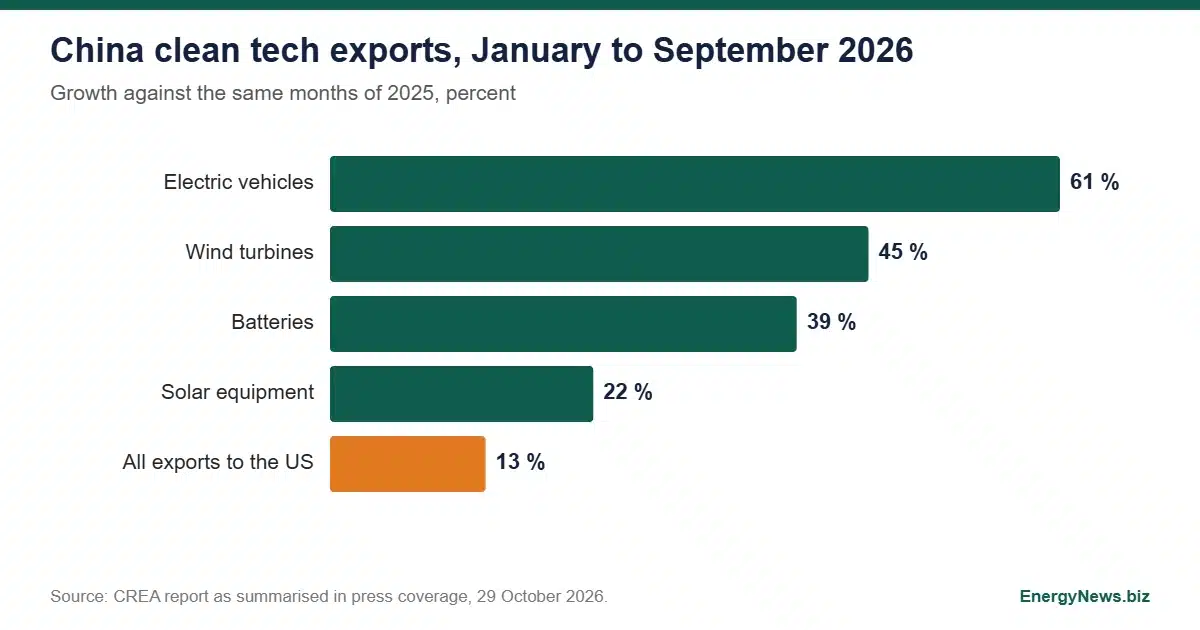
Where China clean tech exports are growing fastest
Between January and September 2026, compared with the same months of 2025, exports of electric vehicles rose 61 percent, wind turbines 45 percent, batteries 39 percent and solar equipment 22 percent, according to the report as summarised in press coverage. The value of electric vehicle exports reportedly reached 72.8 billion dollars, against 39.7 billion a year earlier. Even exports of clean technology to the United States grew, by 13 percent, despite the tariff barriers around that market.
The ranking is revealing. Mature solar equipment is growing slowest, because its volumes are already enormous and prices are low. The fastest growth is in vehicles and wind, products that bring a new generation of buyers into the market.
How the 450 million tonnes is built
The method, as described, combines export data with the electricity systems of the destination countries and with emissions from Chinese manufacturing. A panel exported to a coal heavy grid avoids more CO2 than the same panel in a clean one, so the answer depends on where the products land. The report also projects that if the trend holds, lifetime avoided emissions could reach about 8,400 million tonnes, which it compares with roughly 24 percent of annual global emissions.
These two figures use different bases, and the public summary does not define the first one in detail. Anyone quoting them should say so. Avoided emissions are a counterfactual, a statement about what would have happened if the buyer had chosen fossil equipment instead, and counterfactuals can be pushed in either direction by assumptions.
Exports as climate policy
The opinion this evidence supports is that China’s export machine now matters more to global emissions than most national targets. A country that cuts its own emissions by a few percent moves a small number. A country that sells the cheapest batteries, panels and vehicles on earth moves the baseline for dozens of others. It is also why the story is political: trade barriers, local content rules and security reviews are, in effect, decisions about how fast the world decarbonises.
The same logic cuts the other way. If one supplier dominates, every grid that depends on it inherits its risks, from shipping disruption to export tax changes. Domestic reforms inside China matter here too, for example the new southern power market covered in a report on its launch, because a more flexible home grid shapes how much equipment the country can both use and sell.
What to check next
Three questions will decide whether the headline survives scrutiny. Whether the full report publishes its method and data. Whether avoided emissions are counted against a realistic alternative rather than the dirtiest one. And whether import countries build the grids and storage needed to use the equipment they buy. The research group publishes its work at energyandcleanair.org, where the full document should be checked.
Whatever the final number, China clean tech exports have become a climate variable in their own right, and the debate about them is only starting.
Add EnergyNews.biz as a preferred source on Google


