




China’s southern power market has moved from trial to formal operation. An opening ceremony took place in Guangzhou on 24 October, and reports on 28 October describe a joint notice from the National Development and Reform Commission and the National Energy Administration that approves the step. The southern power market covers the five regions served by China Southern Power Grid: Guangdong, Guangxi, Yunnan, Guizhou and Hainan.
The scale explains why the move matters beyond China. According to figures reported around the launch, nearly 900 billion kWh was traded in the first nine months of 2026, which is more than 70% of China Southern Power Grid’s sales. The market counts about 290,000 participants. It is described as the first regional power market in the country to reach formal status, and the notice reportedly points toward a unified national platform by 2030.
How the southern power market is built
Coal, hydro, nuclear, wind, solar and gas plants bid into the same market and are paid uniform market clearing prices, according to the report on the launch. Settlement trials began in June 2025, and the grid company’s statement, as reported on 28 October, narrows the settlement period to 15 minutes. A short settlement period matters for wind and solar, because their output changes faster than hourly blocks can follow.
The notice also asks that electricity consumers take part in trading directly, with the exception of supplies that the government guarantees. That is a change in who sets the price: demand becomes a bidder rather than a bystander. The region is a mix that few markets can match. Yunnan is rich in hydropower, Guangdong is the largest load centre, and Hainan is an island system, so prices in the southern power market have to balance very different physical conditions.
What the figures say about volume
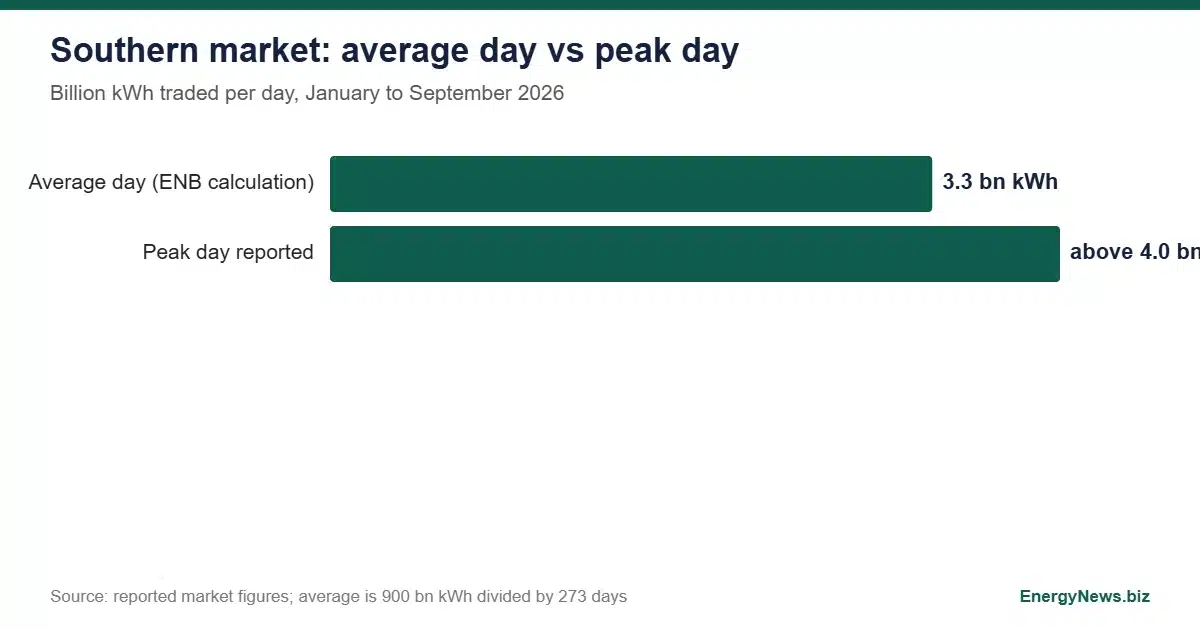
Average trade works out to about 3.3 billion kWh a day over the 273 days from January to September, an ENB calculation from the reported nine month total. The single day peak reported was above 4 billion kWh, which matches the 4 TWh a day upper range that China Southern Power Grid cites for the market. A peak only about a fifth above the average suggests a market in steady use rather than one that spikes on a few days.
Cross regional trading is the smaller part of the picture. A record above 19.4 billion kWh was reported for the first nine months, roughly 2% of the total if both figures use the same basis, which the reports do not state. Most of the southern power market therefore still clears power inside the region, and the link to other grids remains the next thing to build.
Why renewables developers are watching
On 27 October the director general of the International Renewable Energy Agency, Francesco La Camera, said China turned away enough clean power in the first half of 2026 to supply Mexico for a year. He blamed a mismatch between generation capacity and the capacity to distribute and transmit electricity. A market with 15 minute prices and direct consumer participation gives wind and solar owners a signal that shows when power is short, which is the kind of tool that can move storage and flexible demand to where they are worth most.
That link to storage is already a theme in Chinese research. A recent ENB article on long duration storage looked at how faster technology learning could cut coal use in a China wide model for 2040. A functioning southern power market is one place where such storage would earn its revenue in practice, if the rules reward the hours when it is needed.
What to watch next
Three questions will decide how far the southern power market changes the picture. The first is the text of the joint notice itself, which the reports reviewed do not reproduce and which ENB could not locate, so the details above rest on reports of it. The second is how the 15 minute settlement treats batteries and other flexible resources. The third is whether the other regional pilots merge into the national platform by 2030, as the notice is reported to intend.
For developers and investors outside China, the launch is a useful reference case. It shows a regional market built from a trial that began in 2022 and widened step by step, and it shows how quickly the volumes grew once consumers and generators were inside the same price system.
Add EnergyNews.biz as a preferred source on Google


