





A cascaded molten salt thermal energy storage system fitted to a coal-fired unit reaches a peak shaving capacity of 82.081 to 89.262 MW, a maximum equivalent round trip efficiency of 48.84%, a levelized cost of electricity of 0.421 dollars per kWh and a payback period of 4.1 years, according to a paper in the Journal of Energy Storage (volume 183, article 125309, DOI 10.1016/j.est.2026.125309). The economic figures belong to the combined scheme, which the authors describe as the best of the configurations they compare.
Only the abstract, highlights, introduction and section openings were available for this report. The unit size, the electricity prices, the discount rate and the full results tables are not in those parts, so they are not reported here.
How the thermal energy storage system is built
The authors, Haotian Yuan, Xiaojing Ma, Wenpan Xu and Lin Cheng, propose a molten salt thermal energy storage system driven by steam of several grades and by an electric boiler together. The configuration has an electric boiler, two molten salt tanks (one for low temperature salt, one for high temperature salt), two molten salt pumps, two molten salt heat exchangers and a steam turbine. The system buys valley electricity from the grid and converts it to heat in the electric boiler.
The reason for combining the two heat sources, per the introduction, is that boiler and turbine limits keep the minimum load of a coal-fired unit around 25%, while an electric boiler responds faster and can absorb surplus renewable electricity in valley load or curtailment periods. Using electricity alone turns high grade energy straight into heat and degrades it, the paper notes, so the design also charges with multi grade steam and releases heat through several pathways to reduce exergy destruction.
Efficiency in context
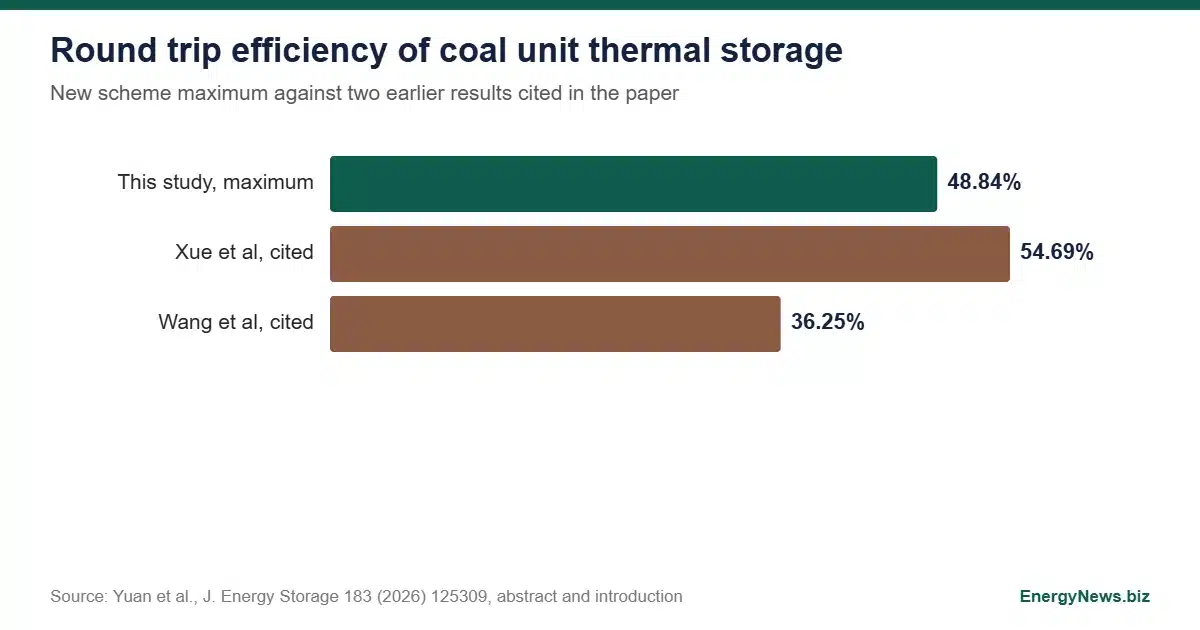
The introduction lists earlier steam driven and combined schemes for coal-fired units. One reached a highest round trip efficiency of 36.25% with a minimum unit load of 14.23%. Another, combining high temperature and low temperature molten salt storage, reached an equivalent round trip efficiency of 54.69% and an exergy efficiency of 37.43%. Set against those two results, the 48.84% maximum of the new scheme sits between them.
The authors say such results are hard to compare, because system boundaries, the treatment of the turbine power lost to steam extraction and the inclusion of electric boiler consumption all differ between studies. They propose a unified thermo-economic framework so that charging schemes, release pathways and combined configurations can be judged on consistent boundaries.
| Scheme | Equivalent round trip efficiency | Source |
|---|---|---|
| This study, maximum of the hybrid solutions | 48.84% | Abstract and highlights |
| High and low temperature molten salt coupling | 54.69% | Cited in the introduction |
| Steam extraction scheme, highest case | 36.25% | Cited in the introduction |
What the economics do and do not show
The levelized cost of 0.421 dollars per kWh and the 4.1 year payback are modelling outputs. The abstract does not give the electricity price paid at valley hours, the price received at peak, the capacity of the unit or the discount rate, so the figures cannot be set against storage costs from other studies.
A payback of 4.1 years in a model that buys valley electricity would depend on the spread between valley and peak prices. ENB covered a battery system with a payback model (grid-forming inverters) and a long duration storage planning study (Northwest China) this week.
The study concerns ultra-supercritical coal-fired units, according to its keywords. Whether the same arrangement transfers to other thermal plants is not addressed in the parts that were read. The funding listed is the State Key Laboratory of Power System Operation and Control (No. SKLD25KZ02), an Excellent Graduate Student Innovation Project of Xinjiang University (No. XTDK2025YJS100) and the National Key Research and Development Program of China (No. 2024YFB4104904-3). The authors declare no competing interests.
Open points in the full text
Four items decide how far the thermal energy storage result travels: the capacity of the coal-fired unit, the electricity prices behind the 0.421 dollar figure, which configuration produced the 82.081 MW and which the 89.262 MW end of the range, and the definition of equivalent round trip efficiency used for the 48.84%. The full paper is the only place those answers can come from.
Add EnergyNews.biz as a preferred source on Google


