




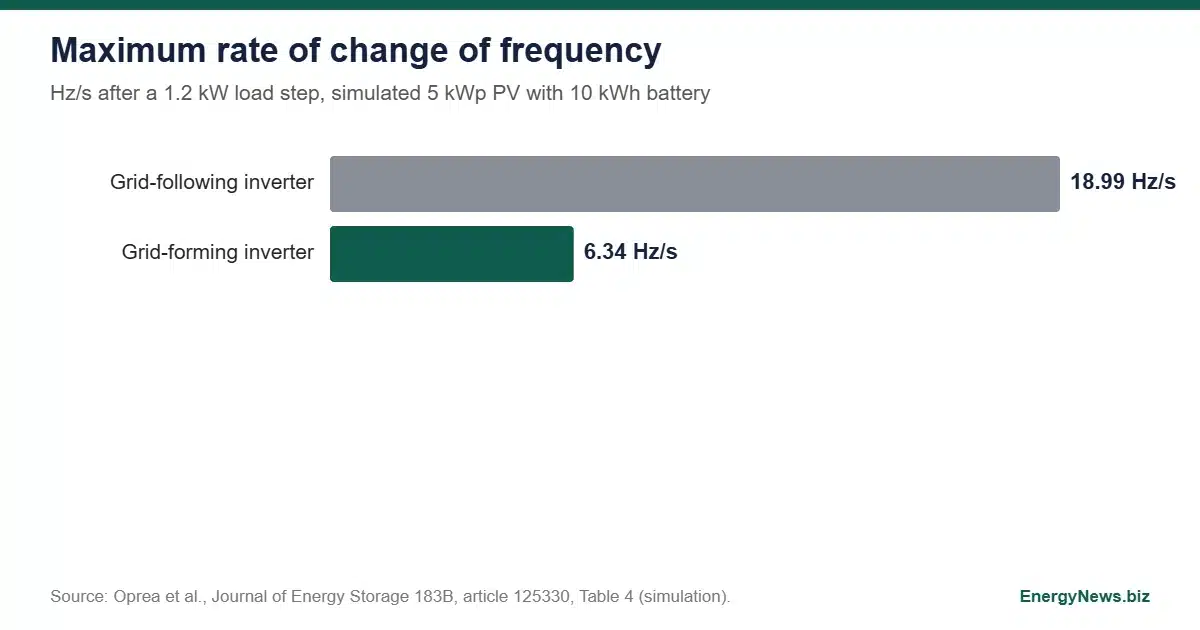
A Romanian study finds that grid-forming inverters can improve both grid stability and household economics when they replace conventional grid-following control in a rooftop solar and battery system. The paper, in Journal of Energy Storage volume 183 part B, reports that the maximum rate of change of frequency fell from 18.99 to 6.34 Hz/s, and that the grid-forming version reached a payback on its extra cost in about 2.85 years under the authors’ assumptions.
How the grid-forming inverters study was built
The authors, Niculae Oprea, Radu Porumb, Adam Wasilewski, Adela Bâra and Simona-Vasilica Oprea, modelled a residential prosumer with a 5 kWp photovoltaic array, a 10 kWh lithium battery and a 5 kVA bidirectional inverter. The model was an electromagnetic transient simulation in MATLAB and Simulink with a 50 microsecond step. It was calibrated against one month of real telemetry, 1 to 31 August 2025, taken at one minute resolution from a hybrid inverter on a house in the Bucharest area.
The grid-following inverter synchronised to the grid through a phase-locked loop. The grid-forming version generated its own voltage and frequency references through droop control, set at 0.015 Hz per kW, combined with a virtual inertia constant of 2.5 seconds. The authors describe these as a reference parameter set, not a model of any commercial product.
What grid-forming inverters changed in the simulations
Two disturbances were tested in separate runs: a 1.2 kW step increase in load, and a 20% voltage sag lasting 200 milliseconds. Under the load step the grid-forming inverter limited the maximum frequency deviation to 0.18 Hz against 0.62 Hz for the grid-following unit, and settled in 3.0 seconds against 7.5 seconds. In the voltage sag the maximum deviation was 0.08 per unit against 0.20, with recovery in 2.0 seconds against 5.0 seconds. The rate of change of frequency fell by about 66%, from 18.99 to 6.34 Hz/s.
The paper also lists a qualitative difference that the numbers do not capture. A grid-following inverter shuts down when the grid goes off, while a grid-forming one can keep supplying critical loads in island mode. That ability is what drives the economic side of the analysis.
The payback case for grid-forming inverters
The techno-economic model compares the two configurations through net present value, internal rate of return, levelised cost and payback. The highlights report an NPV of about 2,591 euros for the grid-forming system, an internal rate of return of 10.4%, and a payback on the grid-forming premium of about 2.85 years. Annual net cash flow is given as 1,142 euros a year for grid-forming against 615 euros for grid-following. The model credits the grid-forming system with revenue from ancillary services and with avoided outage costs, while it assumes the grid-following system earns close to nothing from either.
That assumption matters. A residential system that only maximises self-consumption gains little from grid-forming control, and the authors say so: the grid-following option remains more attractive for simple households focused on self-consumption. The grid-forming case improves where renewable penetration is high, the grid is weak, outages are frequent, or flexibility markets are open. The size of the cash-flow gap therefore depends on whether such revenues and outage savings are actually available to a Romanian household, which the paper treats as an assumption.
System context for grid-forming inverters in Romania
The paper places the case study in a national picture. Using Romania’s long term strategy scenario, which sets a renewable share of 36.2% in 2030 and 86.1% in 2050, the authors estimate that inverter-based capacity passes about 60% of installed capacity around 2034 to 2036, with coal and lignite closure planned by the end of 2031. They stress that 60% is a planning indicator, not a stability threshold, and note that other studies put the needed grid-forming share at 30 to 40% for specific networks.
Limits of the grid-forming inverters results
The dynamic tests cover only two disturbances. Severe and asymmetric faults, sudden islanding and reconnection were not simulated, and the authors expect inverter current limits to constrain the response in severe faults. The evidence is a simulation of one household calibrated on one month of data, so the payback figure should be read as an outcome of the stated assumptions rather than a market price. The data are available from the authors on request. As a worked example from the telemetry, a 42 W imbalance between 2,745 W of generation and 2,703 W of load at 16:00 gives a droop frequency offset of only 0.00063 Hz. For network operators, the practical reading is narrower and still useful: grid-forming inverters change small-system dynamics a lot in simulation, and the financial case rests on revenues that regulators have yet to open to prosumers. The full paper is open access through its DOI, and related grid-forming work is covered in the Hazelwood battery story and the proactive battery control paper. ENTSO-E, the body that brings together European transmission operators, is the reference point for grid code requirements of this kind.
Add EnergyNews.biz as a preferred source on Google


