




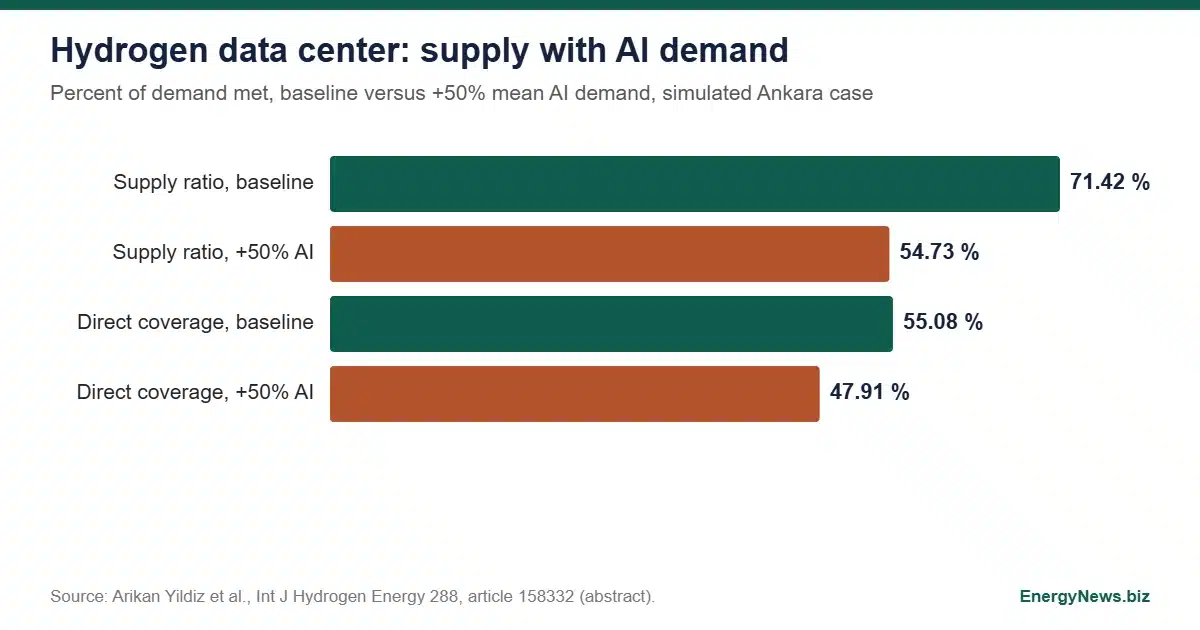
Every new block of AI inference demand that lands on a hydrogen data center takes more from the system than it adds, according to a new simulation study. The paper, in the International Journal of Hydrogen Energy volume 288, finds that when additional AI related demand reaches 50% of the baseline mean load, the share of demand the renewable and hydrogen system can supply falls from 71.42% to 54.73%, even though the solar, wind and hydrogen equipment is unchanged.
The authors argue that this gap in the literature is the reason for the work. Earlier studies of the hydrogen data center concept have mostly looked at sizing, backup power, economics and integrated designs, while the hourly effect of rising AI workloads on the renewable electricity and hydrogen pathway has received less attention. Annual averages hide the problem, because what matters is when the extra load arrives relative to the weather, which is why the model follows every hour of the year in sequence.
How the hydrogen data center was modelled
Yağmur Arıkan Yildiz, Şekip Esat Hayber and Murat Uyar built an hourly model over a full 8,784 hour year. The hydrogen data center in the study is a case study set in Ankara, Türkiye, not an existing facility, and its demand is normalised per megawatt of mean baseline load so that the results do not depend on a particular site size.
Conventional demand comes from a UK Power Networks data center utilisation profile. The AI inference demand is derived from measured power data for the Llama 3 70B model running on NVIDIA H100 GPUs, and the weather inputs are hourly solar irradiation, temperature and wind speed for Ankara.
The energy system itself is a familiar chain. Photovoltaic and wind generation supply the load directly, and surplus electricity runs a proton exchange membrane electrolyser. The hydrogen goes into storage, and a proton exchange membrane fuel cell turns it back into electricity when generation falls short. Four scenarios hold all of this equipment fixed and add mean AI related demand of 0% to 50% of the baseline mean, so that the effect of workload growth is isolated from any change in capacity.
What AI load does to a hydrogen data center
Going from the baseline to the highest demand case, direct renewable coverage falls from 55.08% to 47.91%. The renewable surplus that feeds the electrolyser drops by 37.35%, and potential hydrogen production falls by the same share. Per megawatt of mean baseline demand, annual hydrogen production declines from 71.74 to 44.94 tonnes, and fuel cell generation from 1.43 to 0.90 GWh. Unmet electricity demand rises from 2.51 to 5.97 GWh, more than double, and the load supply ratio, the overall share of demand met, drops from 71.42% to 54.73%.
The logic is straightforward once the hours are laid out. Extra inference demand arrives in the same hours when the sun and wind are already being used, so it eats the surplus first. Less surplus means less hydrogen, less hydrogen means less fuel cell output in the evening and at night, and the shortfall grows in the very hours the storage was supposed to cover. The study describes this as a propagation through the whole renewable electricity and hydrogen pathway.
Robustness of the hydrogen data center result
The authors tested whether a better system design would make the decline go away. A sensitivity analysis varied the photovoltaic and wind mix, the electrolyser electricity consumption per kilogram, the fuel cell efficiency and the hydrogen storage capacity.
According to the abstract, the fall in the load supply ratio persisted across all of the ranges examined. In practice that suggests the problem is one of capacity relative to demand, not a tuning issue, so a hydrogen data center that takes on more AI load would need more generation or other supply, not only a larger tank.
Limits of the hydrogen data center study
The conclusions apply within the model assumptions that the authors adopt. The location is one Turkish city, the AI profile comes from one model on one GPU type, and the framework uses normalised demand, so it says nothing about the cost of the extra capacity or about any specific project.
The full text of the paper is paywalled, so this report relies on the abstract, highlights, introduction and the start of the conclusions. The study also does not price the extra capacity that would close the gap. The numbers above are the authors’ own and should be read as simulation outputs, not forecasts.
Why a hydrogen data center matters for projects now
The question is not academic. Developers are already putting electrolysis next to compute, and our report on Hyundai’s Saemangeum AI Valley plan shows a one trillion won electrolysis line sitting beside a 5.8 trillion won data center budget, with no stated share of the load that on site generation would cover. The new study gives a way to frame that gap: the more inference work a site hosts, the larger the generation and storage needs to be for the same supply ratio.
Earlier work on hydrogen demand profiles for electricity and ammonia made a similar point about demand shape. The International Energy Agency’s Energy and AI report sets the wider picture of data center electricity use, and the paper itself is available through its DOI. For any hydrogen data center proposal, the sensible question to ask is how much AI demand the supply ratio was calculated for.
Add EnergyNews.biz as a preferred source on Google


