


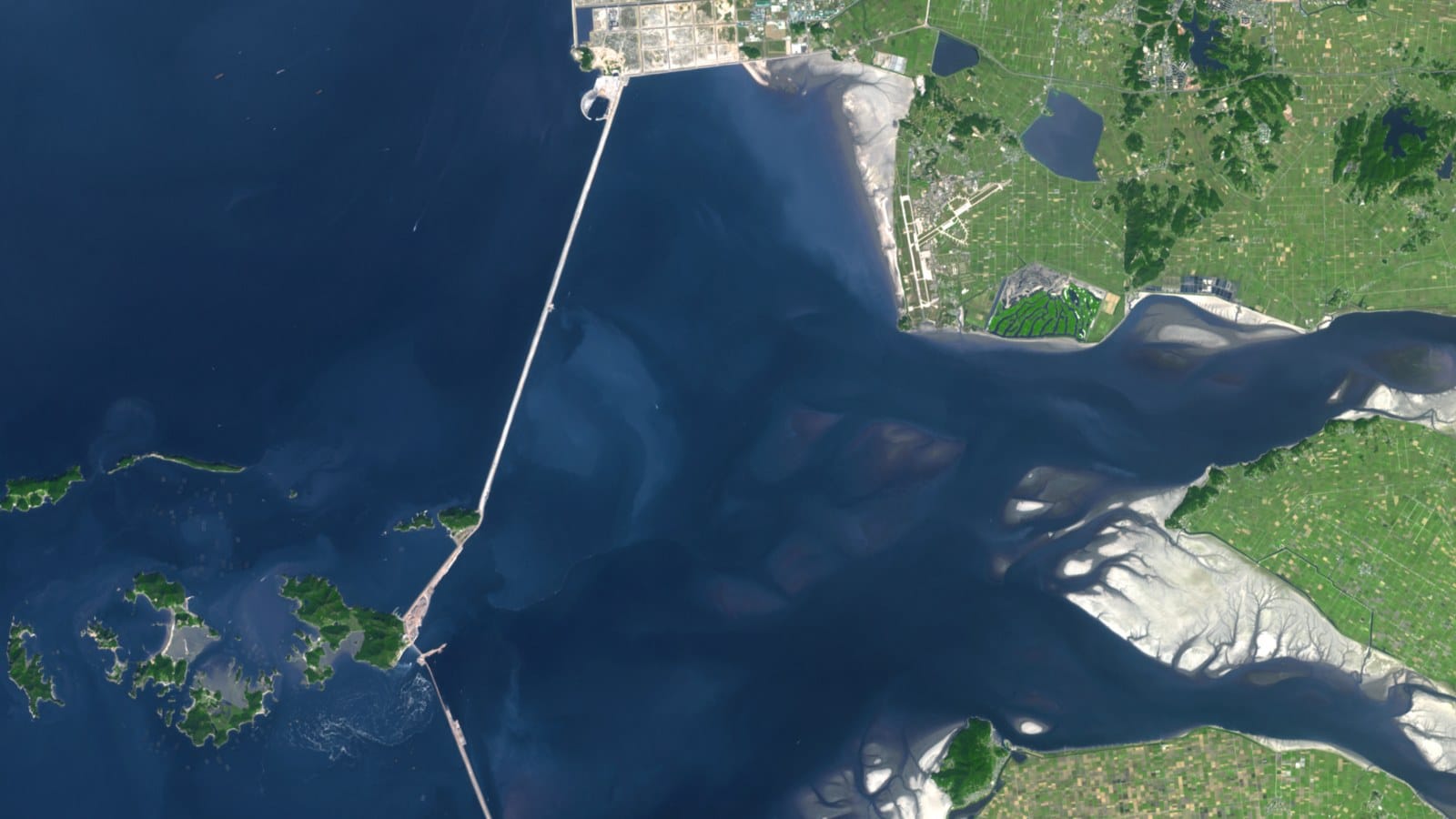


Hyundai Motor Group is putting about 9 trillion won behind Saemangeum AI Valley, a single site in North Jeolla Province that is meant to combine AI data centers, solar power, a water electrolysis hydrogen plant and robot manufacturing. The company set out the plan in February 2026, and on 29 October 2026 its vice chairman Jang Jae-hoon presented the current status and the support it still needs at an on-site meeting at the Saemangeum Energy Convergence Complex Support Center.
What Saemangeum AI Valley would build
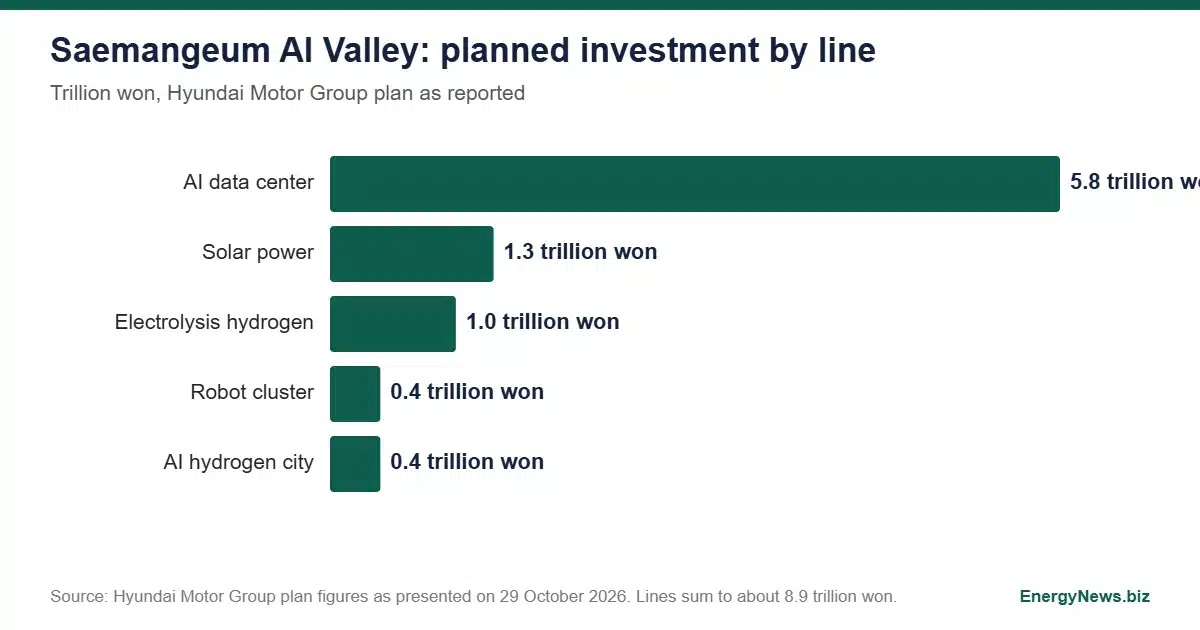
The project covers about 1,124,000 square meters, or 112.4 hectares, on reclaimed land managed by the Saemangeum Development and Investment Agency. The largest line is the AI data center, at 5.8 trillion won. Solar power facilities follow at 1.3 trillion won, a water electrolysis hydrogen plant at 1 trillion won, and a robot manufacturing and parts cluster and an AI hydrogen city at 400 billion won each. Added together the lines come to roughly 8.9 trillion won, which matches the round figure of 9 trillion won used for the whole plan.
What makes Saemangeum AI Valley unusual is the order of the pieces. Most data center announcements treat power as something to be bought from the grid. Here the solar facilities and the electrolysis plant sit on the same site as the compute, and Hyundai has already created a solar special purpose company, established in September, to supply electricity to the project. The hydrogen plant then adds a second energy product that the site can use or sell. The idea is to keep the energy question inside the project boundary rather than leaving it to a later grid connection request.
Scale is the other distinguishing feature. A 112.4 hectare site with a 5.8 trillion won data center means the compute load will be large, and the solar and hydrogen lines of 2.3 trillion won together are unlikely to cover all of it by themselves. How much of the demand the on site generation can meet, and how much will still come from the grid, is not stated in the plan as presented, and it will determine how much of the energy case holds up once the buildings are operating.
Where Saemangeum AI Valley stands with government
After the February announcement Hyundai created a dedicated team and organized promotion structures for its AI, robotics and hydrogen divisions. It has also joined a government led task force on Saemangeum and Jeonbuk, which discusses policy support and infrastructure for the site. Hyundai says it is now negotiating permits, infrastructure support and other assistance with the government, and that is the part of Saemangeum AI Valley that remains open.
The company described its solar special purpose company as proceeding as planned and said the other business areas are on schedule. Those are statements from Hyundai, and the project has not published delivery dates, a construction start or a first power date. For readers following the sector, the practical signal will be the permit decisions and the grid and water infrastructure commitments, because a data center of this scale depends on both before any servers are installed.
People and skills for Saemangeum AI Valley
Hyundai is also preparing a local workforce pipeline. It is discussing a contract based academic department with Jeonbuk National University, and it is negotiating with the Jeonbuk Provincial Office of Education to convert Meister and specialized high school curricula toward training in physical AI. Linking schools to a single industrial site is a familiar approach in Korea, and it suggests that Saemangeum AI Valley is planned as a long term employer in the region and not only as a construction project.
The meeting on 29 October drew senior political attendance. The event was hosted by the Democratic Party’s Mega Growth Special Committee, and attendees included the party leader Kim Min-seok, Saemangeum agency head Moon Sung-yo and Jeonbuk Governor Lee Won-taek, with Hyundai E&C chief executive Lee Han-woo attending for the company. Political support of that level matters for permits, but it does not by itself settle questions of cost or timing.
How Saemangeum AI Valley fits Hyundai’s hydrogen push
The electrolysis plant gives the project a link to Hyundai’s wider hydrogen strategy, which ENB has followed from fuel cell supply to city scale planning. Our coverage of the Hyundai fuel cell story and of the Gangwon hydrogen city plan shows the same pattern, with demand and production planned together. Korea’s hydrogen industry also used World Hydrogen Expo 2026 to present its pipeline, and a one trillion won electrolysis plant at Saemangeum AI Valley would be among the larger single investments in that pipeline.
The open questions are the plant’s capacity, its electrolyzer technology and where the hydrogen would go, since none of these are given in the plan as presented. Hydrogen produced next to a solar farm and a data center could serve backup power, industrial users or the planned AI hydrogen city, but the company has not said which. Until it does, the one trillion won line is best read as a commitment of intent.
What to watch next
Three things will show whether Saemangeum AI Valley moves from announcement to construction. The first is the outcome of the permit and infrastructure negotiations with the government. The second is any disclosure of the solar special purpose company’s capacity and its power supply arrangements. The third is a delivery schedule for the data center, which is by far the largest cost line. Until those appear, Saemangeum AI Valley is a well defined plan with a clear budget and a still unfinished approval path, and the 9 trillion won figure should be read as a target, not as spending already made.
Add EnergyNews.biz as a preferred source on Google


