


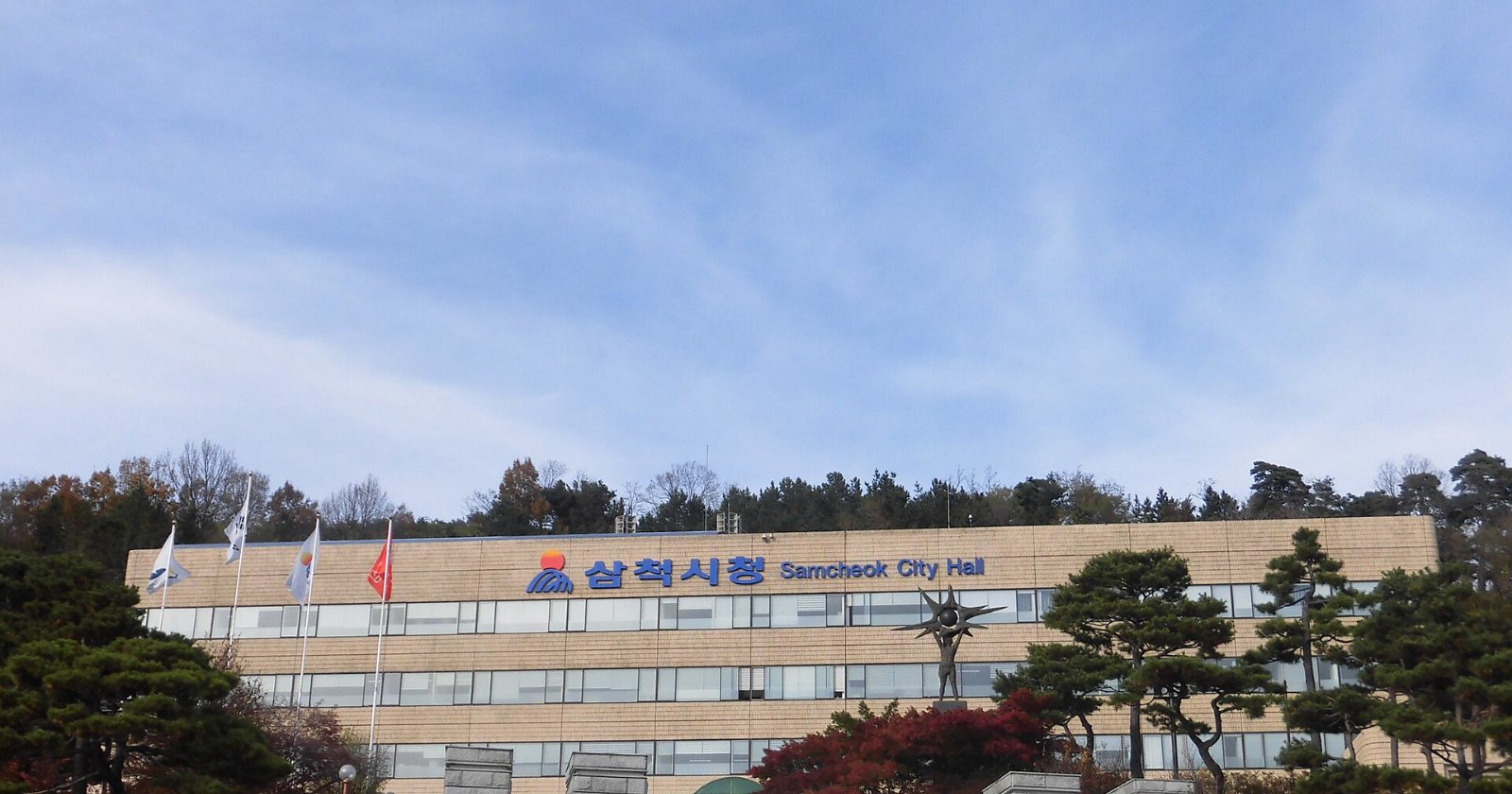


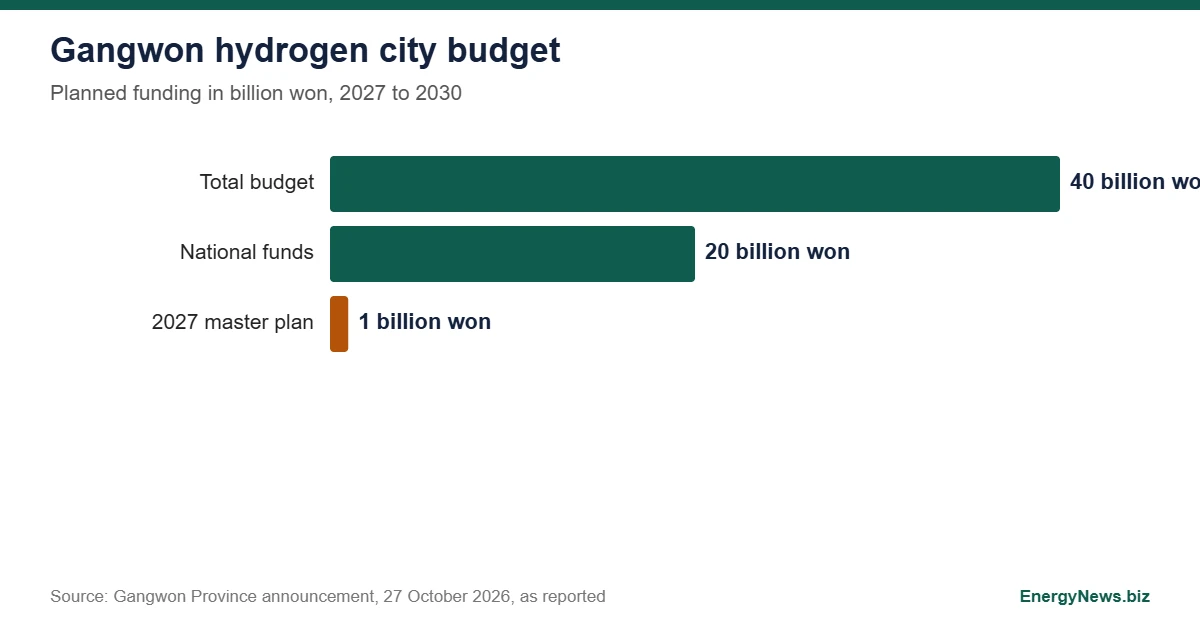
Samcheok and Donghae in Gangwon Province have been selected for South Korea’s 2027 Hydrogen City Construction Project, which carries a budget of 40 billion won, half of it from national funds. The Gangwon provincial government announced the selection on 27 October 2026, and the scheme will create the first hydrogen city in the province.
Hydrogen city budget and timeline
The project runs from 2027 to 2030 under the Ministry of Land, Infrastructure and Transport. Of the 40 billion won, 20 billion won comes from the national budget. The first year is small: 1 billion won, including 500 million won of national funds, is set aside in 2027 for a master plan. The remaining funds fall in the later years, with the hydrogen supply and use system due to be completed by 2030.
What the hydrogen city will connect
The aim is to link existing and planned hydrogen facilities into one supply chain covering production, transport, storage, use and safety management. On the production side the plan adds a new reformed hydrogen plant with a capacity of 1.3 tonnes per day, and connects a solar powered water electrolysis plant that is already under construction in Donghae. Transport and storage consist of a 2.5 kilometre hydrogen pipeline and a storage and dispatch facility in the 1 tonne class.
Demand is local and varied. Fuel cells will serve a swimming pool in Samcheok, senior citizen centres and hydrogen town houses, while a hydrogen combined power system using fuel cells and hydrogen engines is planned for a hydrogen specialised industrial complex. That mix gives the hydrogen city both small, steady heat and power users and an industrial load that can take larger volumes.
Questions the hydrogen city plan leaves open
The announced figures are modest by international standards. A plant of 1.3 tonnes per day and storage of about 1 tonne means the hydrogen city is a demonstration of integration rather than a large scale supply project, and the master plan funded in 2027 will have to set out the demand it is sized for. Reforming normally uses fossil gas as a feedstock, so the carbon intensity of the supply will depend on how much of it comes from the Donghae electrolysis plant and on the source of that plant’s power. The announcement does not give that split.
Son Chang-hwan, Global Headquarters Director of the Gangwon Province Second Government Complex, said the selection would connect hydrogen infrastructure built separately so far and make the hydrogen usable in daily life and industry, with Samcheok and Donghae developed as a hub from production to use. For a hydrogen city, that coordination is the real test. Separate plants, pipelines and fuel cell users only form a system if one operator, one safety regime and one set of offtake rules cover them, and those arrangements are not yet public.
Readers tracking Korean fuel cell supply chains can compare this with our report on a fuel cell end plate supply deal, and the programme owner is the Ministry of Land, Infrastructure and Transport.
Add EnergyNews.biz as a preferred source on Google


