




Powerline communication can carry battery data through the existing cell connections of a large pack, but the signal degrades as the series string grows. A study in the Journal of Power Sources models the channel for series connected cylindrical lithium ion cells and finds that packs of 200 and 400 cells in series keep reliable communication at 20 dB signal to noise ratio, while a 1200 cell string suffers degradation even at 25 dB.
Why powerline communication matters for smart battery packs
Smart battery cells have been proposed to improve the safety of lithium ion packs in battery electric vehicles and battery energy storage systems. Powerline communication offers a cable free, scalable way to send cell temperature, voltage and current over the electrical connections that already exist. The authors, He Hao, Matthew D. Higgins and Timothy A. Vincent, set out to learn how the channel behaves when the number of cells in series becomes large.
What the powerline communication model shows
The team built a simulation model of a series connected pack of cylindrical cells and validated it against vector network analyser measurements for 1S1P, 5S1P and 8S1P configurations. They then extended it to 50S1P, 200S1P, 400S1P and 1200S1P, and used the reconstructed channel responses to evaluate bit error rate under different noise conditions.
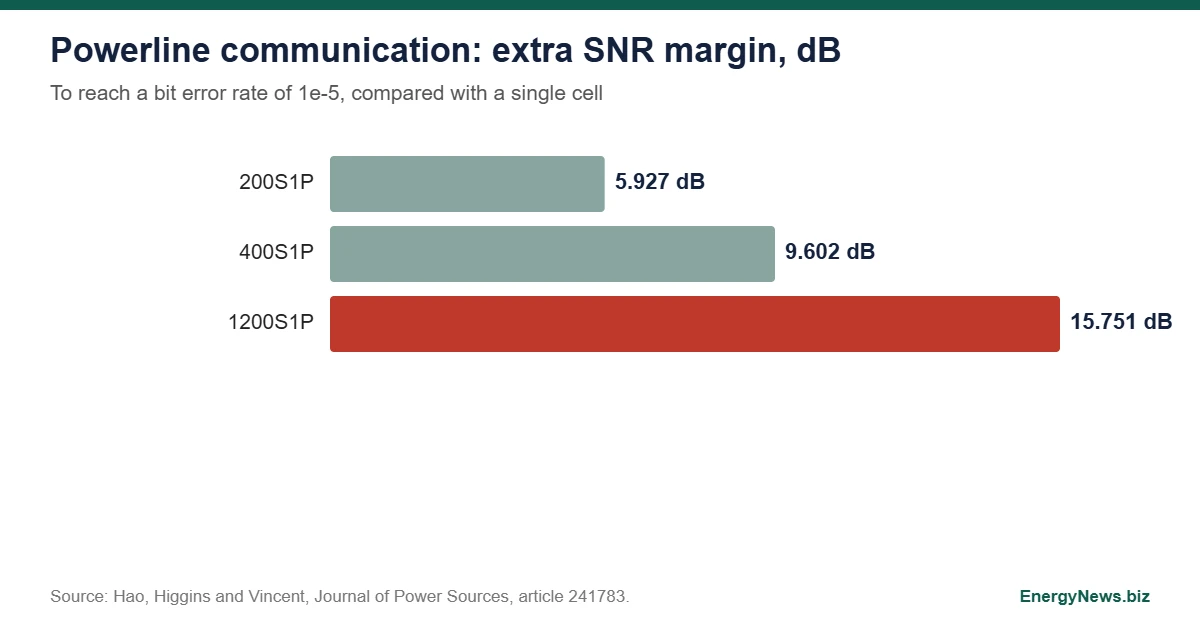
To reach a bit error rate of 1 in 100,000, the 200S1P, 400S1P and 1200S1P configurations need extra signal to noise margins of 5.927 dB, 9.602 dB and 15.751 dB respectively, compared with a single cell. Going from 200 to 1200 cells in series, a six fold increase, adds about 9.8 dB of required margin, a difference calculated from the reported figures.
What limits powerline communication in large packs
The key caveat is that validation covers only up to eight cells in series, while the headline results come from model extrapolation to 1200. The authors present the result as evidence that powerline communication is feasible for high voltage battery systems while highlighting the challenge of ultra large packs for future storage systems. Designers of very large strings may therefore need to split them into segments or add signal margin, a design choice the abstract does not address.
Safety monitoring is the reason the question matters, since thermal events in storage systems are the failure mode that cell level sensing is meant to catch, as shown by tests of BESS thermal runaway in cabinet fire conditions. The study is published as Journal of Power Sources, article 241783.
Add EnergyNews.biz as a preferred source on Google


