




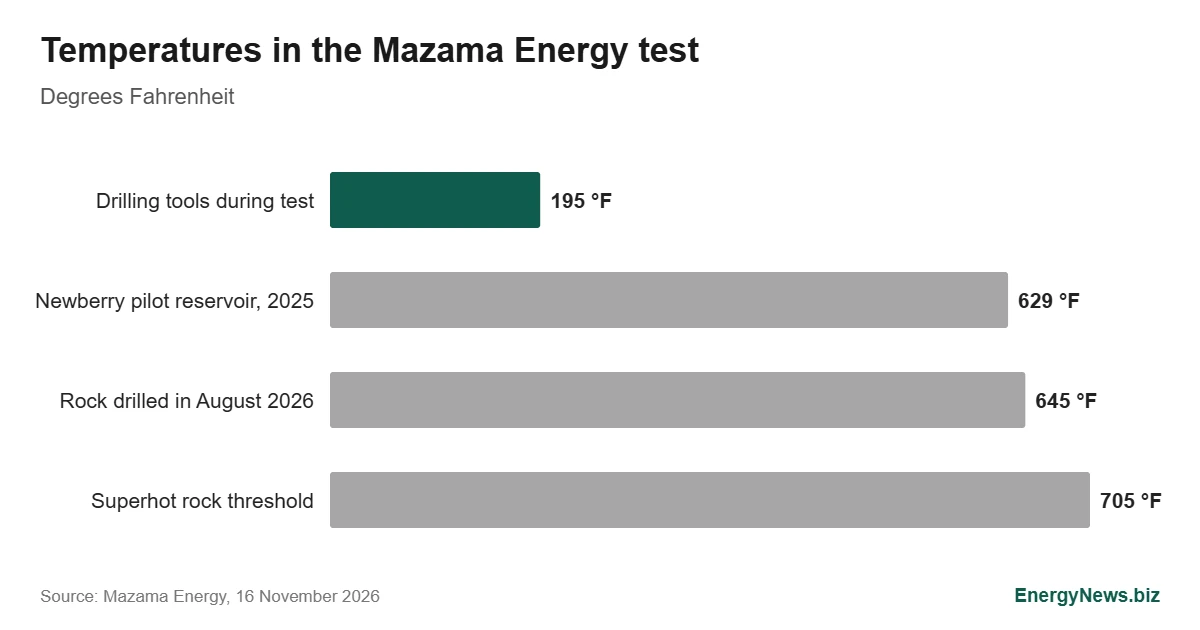
Mazama Energy has used supercritical carbon dioxide as a drilling fluid in a deep geothermal well, a first for the industry according to the company. In a field test at its Athena project at Newberry, Oregon, the technology kept the drilling tools at the bottom of the well at 195°F while the bit cut through rock at 645°F, the company said on 16 November.
The test took place in August. The company said its patented system, called Carbon Chill, also raised drilling speed by 20% to 92 feet per hour compared with conventional drilling, while keeping critical steering tools below their operating limits.
Why heat is the problem Mazama Energy is solving
Superhot rock geothermal targets resources above 705°F, or 374°C, where water becomes supercritical and carries far more energy per well. The prize is a large cut in the number of wells needed per megawatt. The obstacle is that the electronics and motors used to steer a drill fail at much lower temperatures, which slows drilling or stops it altogether.
Carbon Chill circulates supercritical CO2 to cool the bottom hole assembly, the cluster of tools behind the drill bit. The company says this allows directional drilling, the technique used to steer wells into the hottest rock, to continue at temperatures that would otherwise destroy the equipment. The company has not given a cost estimate for the system or a target for its first commercial plant.
The choice of CO2 is not arbitrary. Above about 31°C and 74 bar, carbon dioxide becomes a supercritical fluid with the density of a liquid and the low viscosity of a gas. That combination lets it carry heat away from tools efficiently while flowing easily through the drill string. Supercritical CO2 is already studied as a working fluid for power cycles and for heat extraction in geothermal reservoirs, but using it to cool drilling equipment in a deep well is new.
The test does not involve storing carbon. The CO2 is used as a process fluid, and the company has not presented the method as a form of carbon capture.
Progress at Newberry
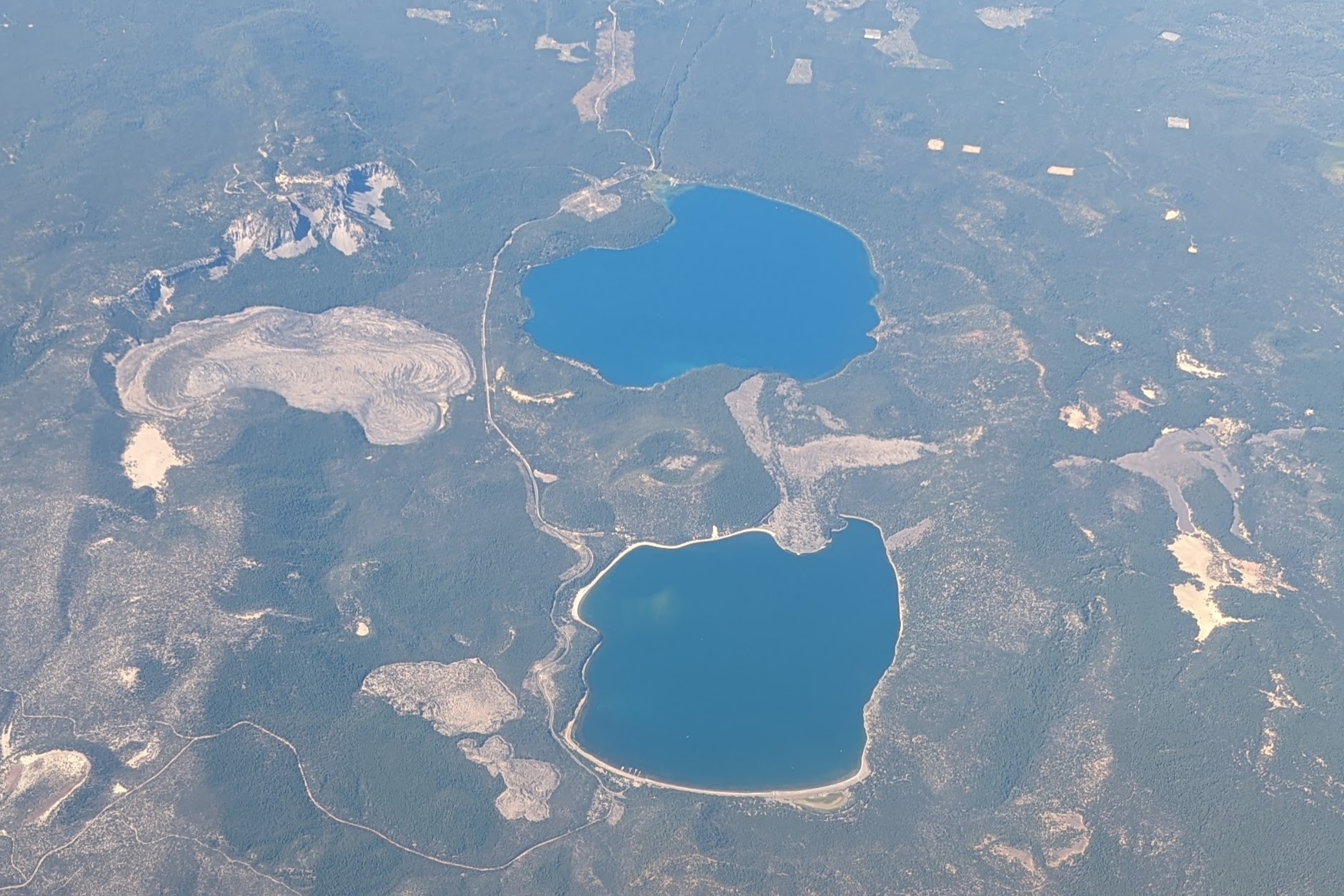
The Newberry site in central Oregon is one of the hottest geothermal resources in the United States. In 2025, Mazama said it built the world’s hottest engineered geothermal pilot there, at 629°F, and demonstrated reservoir creation and fluid circulation. In 2026, a new well reached the same depth as the earlier one with an 80% reduction in drilling time. Athena, the second well, reached 10,350 feet in 15 drilling days, the company said in September.
Carbon Chill is one part of a wider platform the company calls MUSE, which also covers well construction, advanced drilling, a reservoir design it calls Thermal Lattice and heat recovery equipment. Chief executive Sriram Vasantharajan said the system could make superhot geothermal commercially scalable and cost effective.
Mazama Energy investors and the market for firm power
Alongside the test results, Mazama Energy named investors in a Series B round including Shell Ventures, ConocoPhillips, Centaurus Capital, Doerr Capital, Khosla Ventures and Gates Frontier. The release did not state the size of the round.
Demand for firm clean power is the main pull. Researchers at the Payne Institute of the Colorado School of Mines noted on 16 November that Google, Meta and Amazon have contracted just over a gigawatt of geothermal power for data centres, more than a quarter of the US geothermal fleet. Conventional enhanced geothermal is already moving to commercial scale, as shown by Fervo’s Cape Station in Utah.
Superhot projects remain earlier stage. The next tests for Newberry will be whether faster, cooler drilling holds up across full well depths and whether reservoirs at higher temperatures can be kept stable over years of operation. Background on federal geothermal research is available from the US Department of Energy.
Add EnergyNews.biz as a preferred source on Google


