


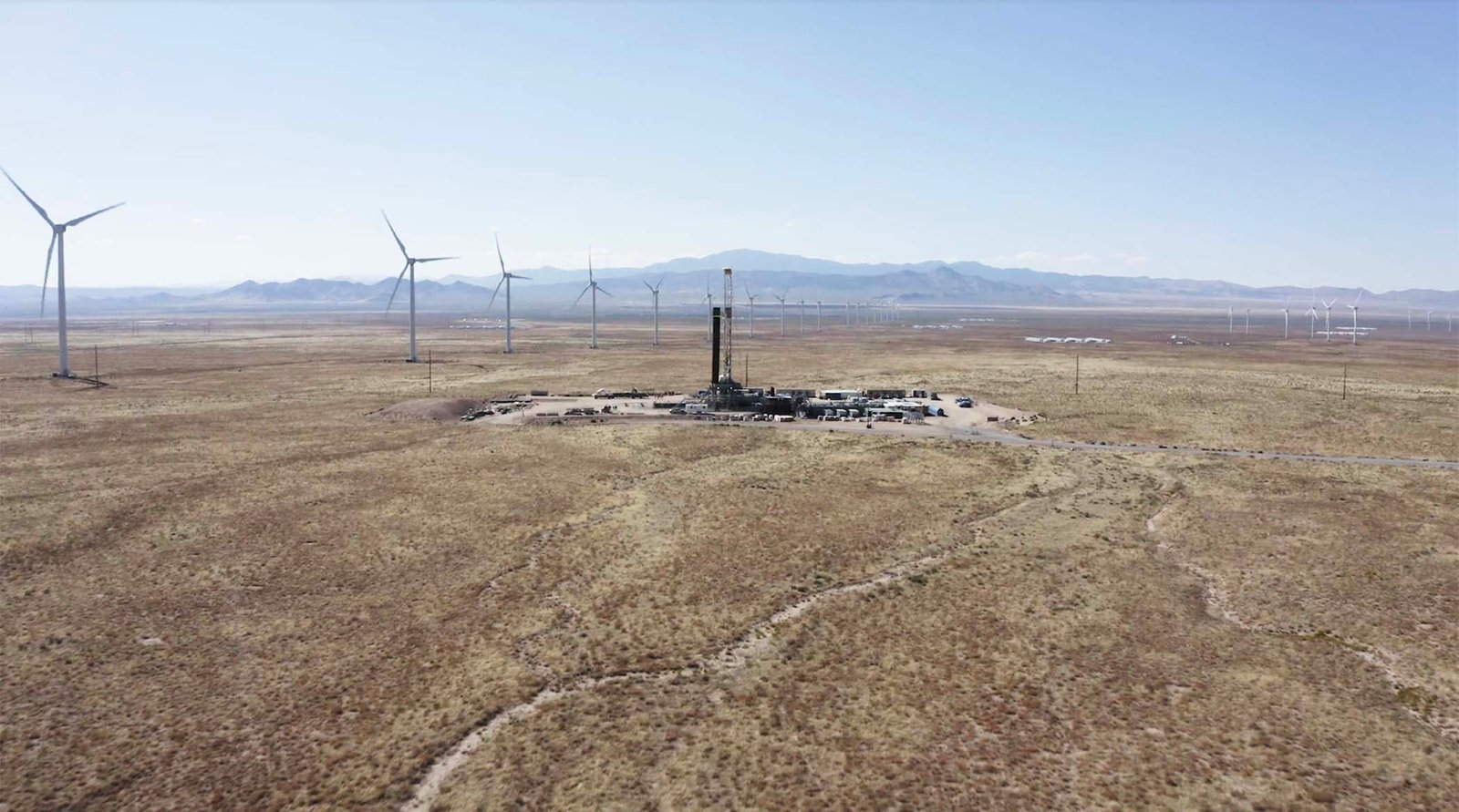


Fervo Cape Station had 36 MW in operation on 30 September 2026 against 1,054 MW under binding power purchase agreements, a gap of 1,018 MW. The geothermal developer reported third quarter results on 9 November 2026: commercial operation of the first 33 MW unit, a 396 MW, 15 year agreement with Google, and $1.9 billion of unrestricted cash. Revenue was $116,000, against $39.4 million of general and administrative cost.
That contrast fixes the stage of the company. Fervo Cape Station is a construction finance story, not yet an operating one, and the figures worth testing are the cost per kilowatt and the pace from 36 MW to the 466 MW under construction.
From 36 MW to 1,054 MW at Fervo Cape Station
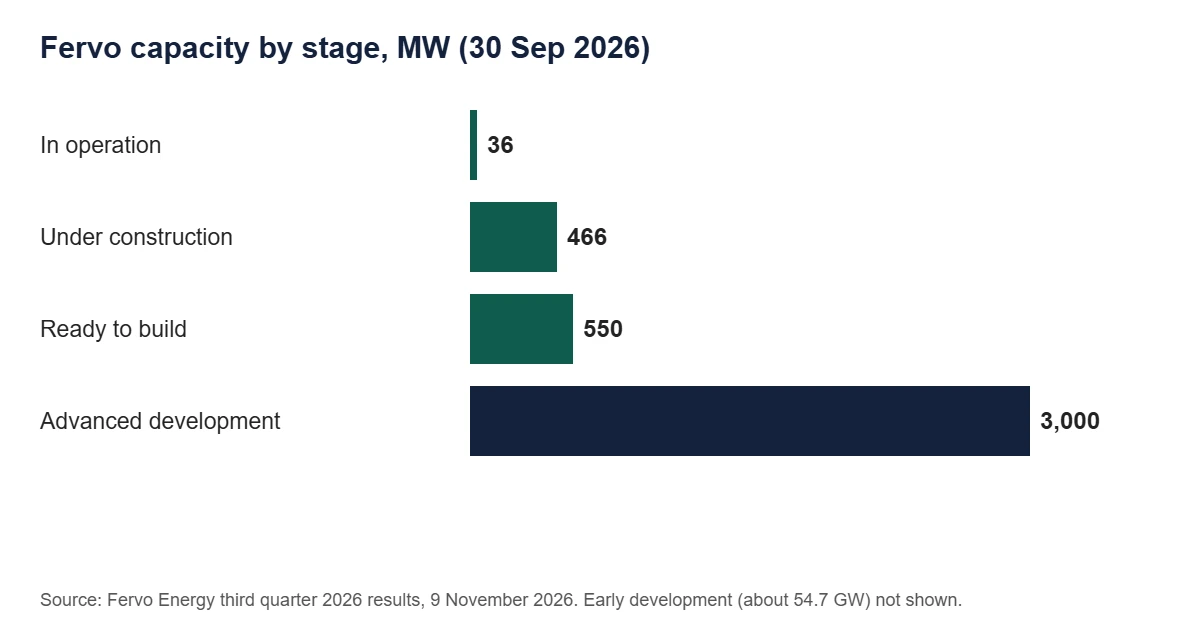
The company reports 36 MW in operation, up from 3 MW at the end of the second quarter, and 466 MW under construction across GeoBlocks 2 to 11. A further 550 MW is ready to build and 3.0 GW is in advanced development. Operating capacity is 3.4% of the contracted total, and operating plus under construction is 48% (arithmetic). The 36 MW is 3 MW more than the single 33 MW GeoBlock in commercial operation, and the release does not give the breakdown.
Contracted revenue rose from about $7.2 billion at the end of June to about $11.9 billion, while contracted capacity rose from 658 MW to 1,054 MW. The 396 MW increase equals the Google agreement, and the $4.7 billion increase over 15 years is about $313 million a year. If the contract delivers 396 MW around the clock, that is about $90 per MWh. The release does not state the Google contract value, so this is a difference between two reported totals, and a lower delivery rate would raise the implied price.
Cost per kilowatt is the number that matters
Fervo says the expected total cost of GeoBlocks 1 to 3 at Fervo Cape Station is about $7,000 per kW, unchanged. For the 400 MW Cape Google 400 phase it targets $5,500 per kW, on the way to a long term target of $3,000 per kW. Phase I of about 100 MW at $7,000 per kW is about $700 million; 400 MW at $5,500 per kW is about $2.2 billion. The target is 21% below Phase I, and $3,000 would be a further 45% below $5,500 (arithmetic).
On 30 September Fervo moved about $514.3 million from construction in progress to property, plant and equipment when GeoBlock 1 entered service. The release says this is not the standalone cost of GeoBlock 1, because it includes a larger share of Phase I wellfield and shared infrastructure plus capitalised interest. Divided by 33 MW it would be $15,600 per kW, which is why the figure cannot be read as a unit cost.
Capital spending at Fervo Cape Station was $256.7 million in the quarter. Second half capex is now guided at $700 million to $750 million, down from $850 million to $900 million, with $450 million to $500 million in the fourth quarter. Fervo says construction efficiencies moved some Cape Google 400 spending later, with no change to commercial operation dates or total investment. Cash of $1.9 billion covers fourth quarter spending about four times.
Results that need a second read
Net income was $11.7 million because of a $29.9 million tax benefit, $15.4 million of interest income and an $11.8 million gain on interest rate swaps, against an operating loss of $43.7 million. The highlights give a net loss attributable to common stockholders of $20.8 million, while the statement of operations shows $19.5 million, and the release does not reconcile the two.
The company also cites an independent study that raises its estimate of Fervo Cape Station capacity potential to about 8.4 GW from 4.3 GW. It has offered Google an option on about 600 MW more, for nearly 1 GW, and is pursuing a behind the meter route under a Utah framework for a possible data center in Beaver County. Two potential awards of about $20 million were selected under the Department of Energy geothermal pilots programme, subject to funding agreements. The per well flow figures behind the site are examined in the Cape Station flow per well analysis.
Two dated checks follow for Fervo Cape Station. GeoBlocks 2 and 3 are expected to reach commercial operation by 1 January 2027, which would complete Phase I at about 100 MW. Fervo holds an investor open house at Cape Station on 19 November 2026 and says no new disclosures will be made there.
Add EnergyNews.biz as a preferred source on Google


