



Takenaka hydrogen storage has passed its first full year. Japanese construction company Takenaka Corporation said its hydrogen-linked energy management system at a 24-unit apartment building in Kurobe, Toyama prefecture, moved surplus summer solar power into the winter months as designed. The seven-storey building, completed in March 2025, has 2,387 square metres of floor space.
A one-year evaluation of the system, which began operating in April 2025, confirmed that hydrogen produced in summer was stored and later used to generate electricity in winter, and that the battery and other distributed resources were managed as planned.
How the Takenaka hydrogen system works
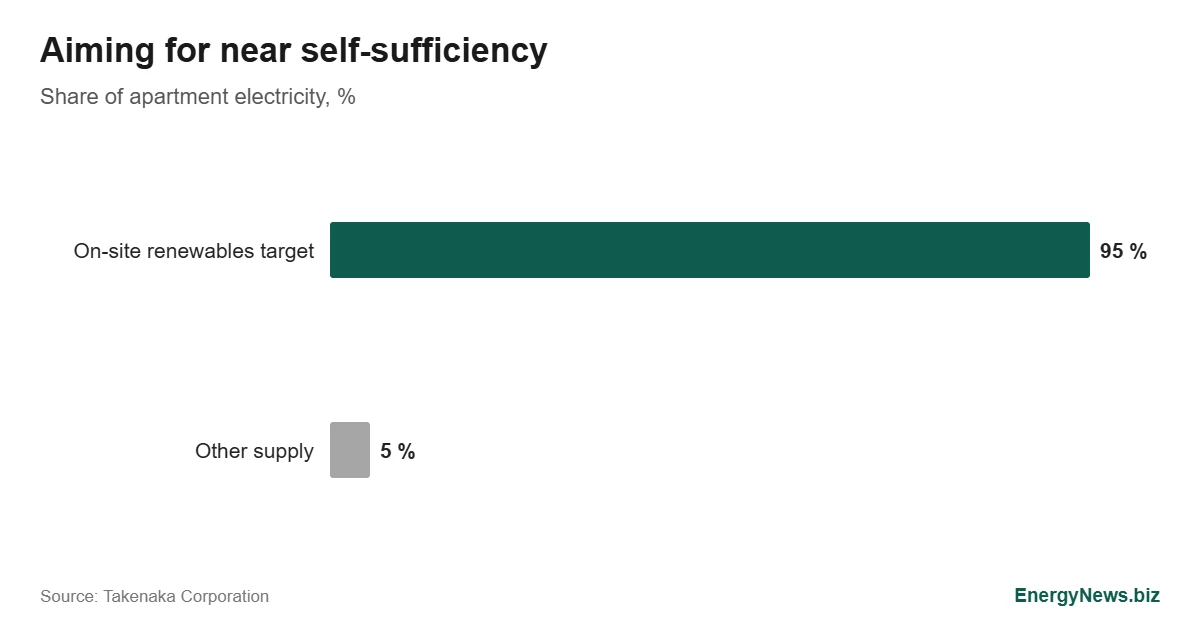
Rooftop and on-site solar supply the building. Short-term surpluses charge a battery, while longer-term surplus in summer runs an electrolyser that produces hydrogen. The hydrogen is stored and converted back to electricity in a fuel cell in winter, when solar output is lower. Takenaka aims to supply 95% of the electricity used in the apartments, excluding common areas, from on-site renewables alone.
Seasonal storage is the hardest problem for buildings that want to run on their own solar. Batteries handle day and night well, but storing summer energy for months is expensive with lithium-ion. Hydrogen tanks can hold large amounts of energy for long periods, which is why builders are testing it.
The efficiency question
The trade-off is efficiency. Converting electricity to hydrogen and back typically returns well under half of the original energy, and researchers from Finland’s LUT University and Germany’s Regensburg University of Applied Sciences have identified high investment costs and low round-trip efficiency as major drawbacks of seasonal hydrogen storage. The Kurobe result proves that the system can be operated as planned over a year; it does not yet show that it is the cheapest way to reach 95% self-supply.
Other Japanese builders are testing similar ideas. Taisei Corporation has trialled seasonal storage at a zero energy building facility in Yokohama using two 450 kWh lithium-ion batteries, a 5.0 Nm3/h PEM electrolyser, a 2,000 Nm3 hydrogen tank and a 5 kW fuel cell. Solar curtailment now occurs in every transmission area in Japan, which gives building owners a reason to store surplus rather than export it.
What the Takenaka hydrogen trial does not show yet
Takenaka has not published the size of the electrolyser, fuel cell or hydrogen tank at Kurobe, nor the share of annual demand actually met in the first year. Without those numbers, other builders cannot compare cost per kilowatt hour with alternatives such as larger batteries combined with grid imports in winter. The company describes the result as operating as intended, which is a necessary first step rather than a final verdict.
Safety and permitting also matter in a residential setting. Storing compressed hydrogen next to apartments requires approvals, ventilation and monitoring that add to cost. A successful year without incidents is itself useful evidence for regulators considering similar Takenaka hydrogen projects in dense urban areas, and for insurers asked to cover them.
Why it matters beyond Japan
Buildings that can manage their own seasonal balance reduce strain on the grid in winter, when heating demand peaks. Hydrogen at building scale remains a niche compared with industrial uses, where the economics depend on committed buyers, as the report on low-emission hydrogen set out, and on large electrolyser blocks such as Plug Power’s GenEco Scale.
Takenaka said it will keep monitoring the system and refining how the battery and hydrogen storage are dispatched across the four seasons of the year. The next Takenaka hydrogen data point to watch is the second-year share of demand met from on-site renewables. Company information is published by Takenaka Corporation.
Add EnergyNews.biz as a preferred source on Google


