



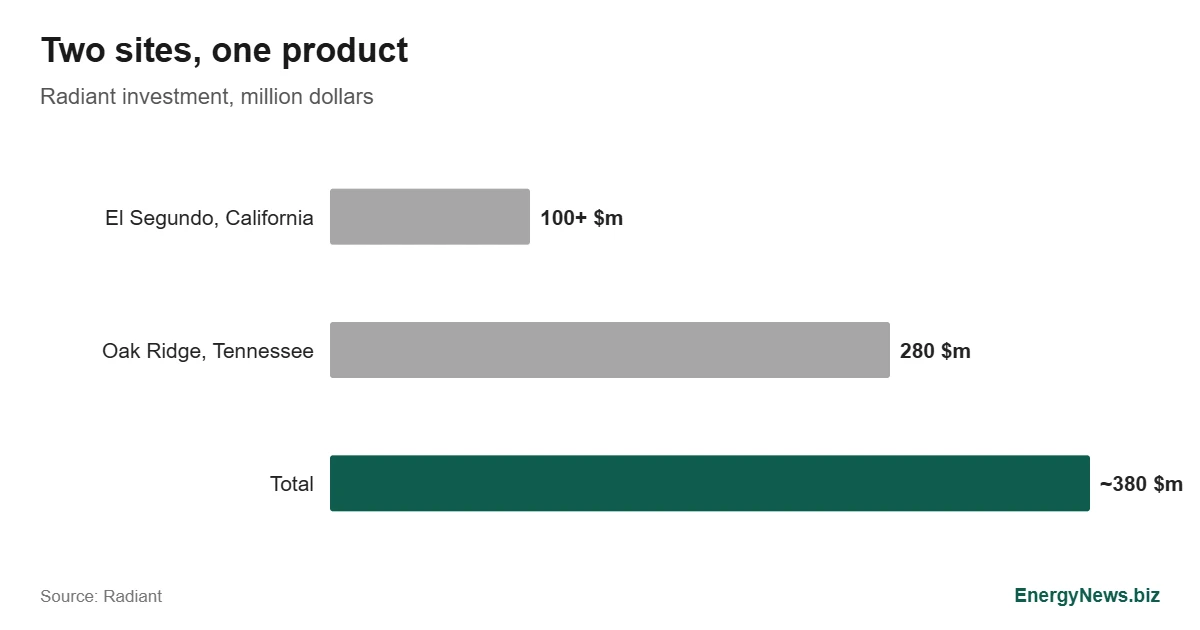
Radiant microreactor production is moving to factory scale. The California company is investing more than $100 million in the Los Angeles area, adding about 200,000 square feet (about 18,500 square metres) of manufacturing and research space at its El Segundo campus. It also plans to invest $280 million in its Oak Ridge, Tennessee, campus, where construction is already under way.
The El Segundo site will become Radiant’s headquarters and the place where its first commercial reactors are assembled, with room to build multiple Kaleidos units in parallel. It includes bridge cranes, control-system test containers, in-house turbomachinery and power generation production, and integrated testing.
What the Radiant microreactor investment covers
An ENB calculation puts the two investments at about $380 million in total. Each Kaleidos unit is a transportable high-temperature gas-cooled reactor producing 3 MW of heat, or around 1 MW of electricity, and the whole reactor fits in a single shipping container. The scale of spending ahead of the first commercial delivery shows that Radiant is betting on volume production rather than one-off projects.
The Oak Ridge campus will handle high-rate manufacturing, fuelling and storage. Radiant says it will be able to fuel reactors in a private facility and ship them to customers as factory-sealed products, which it says will be unique in the United States. Customers would then be able to buy nuclear energy without turning their site into a nuclear construction project.
Timeline for the Radiant microreactor
Fuelling operations at Oak Ridge are expected to begin in 2027, ahead of planned commercial deliveries in 2028. Chief Nuclear Officer Rita Baranwal said that building fuelling capabilities first and expanding manufacturing in phases puts the infrastructure in place to support initial deliveries and scale production as demand grows. Radiant built its first Kaleidos unit in El Segundo and shipped it to Idaho National Laboratory earlier this year for testing.
Radiant microreactor competition
Radiant is one of several companies racing to commercialise microreactors in the United States, alongside firms such as Westinghouse with its eVinci design and others developing small transportable units. The US Department of Energy and the Department of Defense have both backed demonstrations, and the Navy has selected a Radiant microreactor for deployment, which gives the company an early government customer.
Factory capacity is becoming the competitive edge. A developer that can produce and fuel several units a year can offer delivery dates that a one-off project cannot, which is the case Radiant is making with this investment. Buyers comparing offers will look closely at delivery slots, fuel supply guarantees and who carries licensing risk at each site, because those terms often matter more than the headline price per unit.
Who would buy a 1 MW reactor
A single megawatt is small for a grid but large for a remote mine, a military base or an island that runs on diesel today. Microreactors also attract data centre operators looking for firm power at sites where grid connections take years, a need explored in the analysis of data centre demand. Several units can be combined for larger loads, which is why parallel assembly matters. A site needing 10 MW would take about ten Kaleidos units.
The challenges are cost per megawatt hour, licensing for each site and fuel supply. Microreactors use high-assay low-enriched uranium in TRISO particles, and that supply chain is still being built, as noted in the report on Urenco’s HALEU plans.
The next Radiant microreactor milestones are test results from Idaho, the start of fuelling at Oak Ridge in 2027 and the first customer delivery in 2028. Company updates are published by Radiant.
Add EnergyNews.biz as a preferred source on Google


