




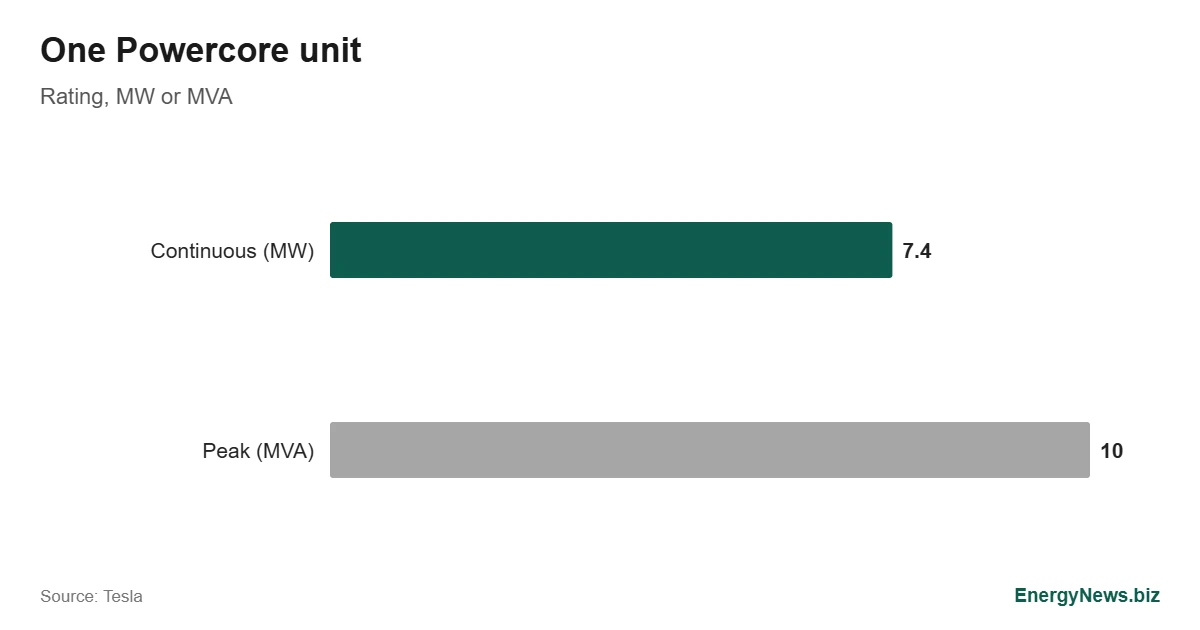
Tesla Powercore is a new power conversion unit designed to take medium-voltage grid power directly to the high-voltage direct current that next-generation data centres plan to use. It accepts alternating current at 10 to 34.5 kV and delivers direct current at 800 to 2,000 V. Each unit is rated at 7.4 MW continuous and 10 MVA peak, with a stated efficiency of 98.86%. First units are planned for 2027.
Tesla says it is working with Nvidia on the move to 800 V DC power distribution inside data centres. Nvidia has promoted that architecture for its future AI server racks, which are expected to draw far more power per rack than today’s equipment.
What Tesla Powercore replaces
A conventional data centre receives medium-voltage AC from the grid, steps it down through transformers, converts it several times between AC and DC through uninterruptible power supplies and power supply units, and finally delivers low-voltage DC to the chips. Every conversion step loses energy and takes space. Tesla Powercore aims to collapse several of those steps into one unit using power electronics.
The efficiency figure has a concrete meaning for Tesla Powercore buyers. At 98.86%, a unit running at its full 7.4 MW continuous rating loses about 84 kW as heat. Across a 100 MW data centre, the same efficiency would mean losses of about 1.1 MW, which also has to be removed by cooling systems.
Why 800 V DC is coming
AI racks are moving from tens of kilowatts toward several hundred kilowatts, and potentially a megawatt, per rack. At the low voltages used today, that much power requires very heavy copper busbars and cables. Raising the distribution voltage to 800 V DC cuts current, and with it copper weight and resistive losses, for the same power. It also fits naturally with batteries, which store DC.
Data centre power is now one of the fastest growing loads on many grids, and time to power has become a key constraint, as grid operators reform connection rules such as PJM’s fast-track energization. Operators are also pairing sites with large batteries, as at the 600 MWh Utah battery serving a Meta data centre. Equipment that shrinks the electrical room and ties in with storage fits that trend.
Tesla’s wider energy business
Tesla’s energy division already sells Megapack batteries to utilities and data centres, and the company has experience in high-power electronics from its vehicles and charging network. Tesla Powercore extends that business into the electrical infrastructure inside data centres, a market where established suppliers such as Schneider Electric, Eaton, ABB and Vertiv are also developing 800 V DC products.
Several questions remain open, including pricing, certification for grid connection in different markets and how quickly data centre operators adopt DC distribution at scale. Most existing facilities will stay on AC for years, so early demand is likely to come from new AI campuses designed from scratch.
Safety and standards are another hurdle. Direct current at 800 V and above behaves differently from AC when faults occur, because there is no natural zero crossing to help extinguish arcs. Protection devices, connectors and maintenance procedures for high-voltage DC inside buildings are still being standardised, and data centre operators will want those rules settled before they commit whole campuses to the new architecture.
For grid operators, the shift could bring benefits. Power electronics at the grid connection can control how a data centre draws power, smoothing sudden swings in AI training loads that have started to worry system planners, and could let sites provide grid services alongside on-site batteries.
The next milestone for Tesla Powercore is the first customer installations planned for 2027. Product information is published by Tesla.
Add EnergyNews.biz as a preferred source on Google


