




PJM fast energization is the grid operator’s answer to a simple complaint from data center developers: the wait for a firm connection is longer than the time it takes to build the building. PJM Interconnection, which runs the largest US power market across 13 states and Washington DC, took the proposal to its Members Committee on 5 November and has now sent it to the Federal Energy Regulatory Commission.
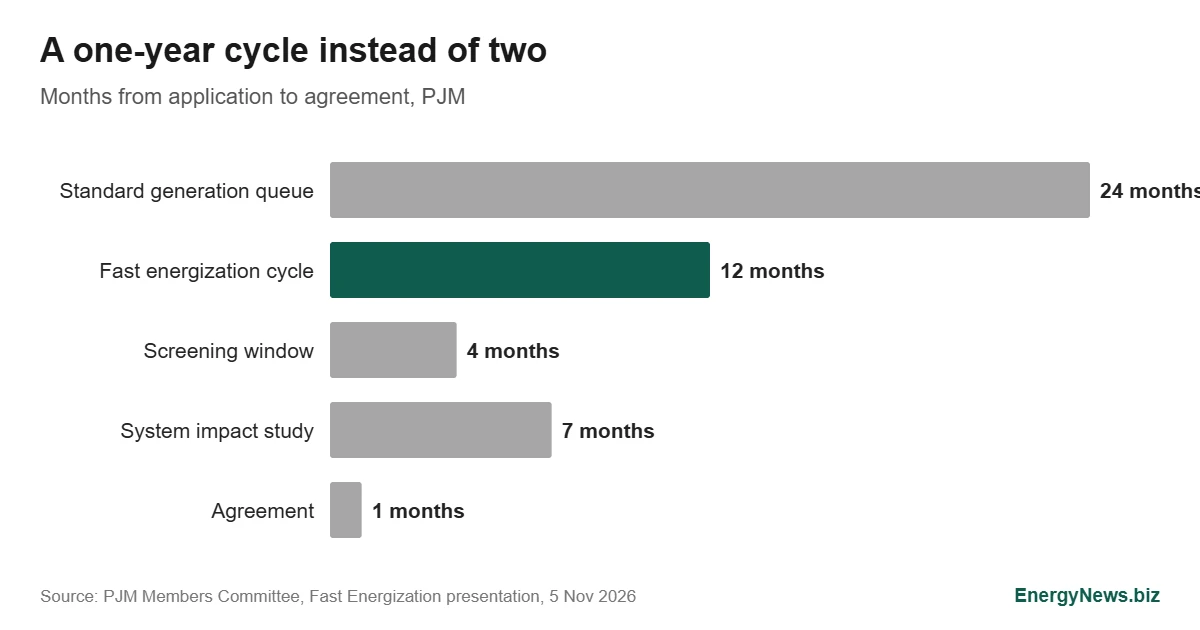
The core of the design is time. Under the standard process for new generation, PJM’s own presentation shows about two years from application to agreement unless a project drops out at one of the decision points at seven or fourteen months. Fast energization replaces that with an annual 12-month cycle.
How PJM fast energization splits the year
The cycle has three parts. A screening window of four months lets developers test whether a project is viable before money is at risk. A system impact study takes seven months. The final month is for the agreement. Four plus seven plus one gives twelve, half of the two-year baseline.
Speed is only one side. According to PJM, large loads joining through the new path carry the cost of the transmission upgrades they trigger, rather than spreading those costs across all customers in the zone. PJM spokesman Jeff Shields described this cost allocation as part of the package. A separate proposal sets ride-through requirements for data centers, so that large computing loads do not trip off the grid all at once during a voltage dip.
Why PJM fast energization matters for prices
The pressure behind the filing is visible in every recent PJM capacity auction. New data center demand is arriving faster than new supply can be studied, connected and built. Ratepayer groups and state legislators across the PJM footprint have argued that households should not pay for grid upgrades driven by single customers. Developers have argued that uncertainty, not cost, is what blocks investment.
The filing tries to answer both camps. Large loads get a fixed annual calendar and a clear end date for studies. Other customers get a rule that the load pays for its own upgrades. Whether that balance holds depends on how FERC treats the cost allocation and how many projects enter the first window.
What the 12-month cycle does not fix
A faster study does not create generation. A data center that receives an agreement after twelve months still needs supply behind it, and PJM’s reserve margins are tight. The ride-through rules also add engineering cost on the customer side, because UPS systems and control logic must be set to stay online through grid disturbances rather than disconnect.
The calendar also concentrates risk. With one window a year, a project that misses the screening deadline waits a full cycle. That gives developers a strong incentive to file early and file many sites, the same behaviour that clogged generator queues over the past decade. PJM’s screening stage is designed to filter speculative requests, but its first real test will be the number of requests in the opening window.
The numbers in PJM’s own presentation give a clear benchmark. If the first cohort reaches agreements in 12 months, PJM fast energization will have halved the wait compared with the standard two-year route. If studies slip past seven months, the advantage shrinks quickly. For context on how much power the sector already uses, a recent study put hyperscale data centers at 1.8% of US electricity.
The proposal does not change the physics of the grid. Every large load still has to be studied for thermal limits, voltage and stability, and the seven-month study window is the part of the schedule most likely to come under pressure when many requests arrive at once.
The full presentation, including the existing process for integrating large loads and the proposed timeline, is published by PJM.
Add EnergyNews.biz as a preferred source on Google


