





The NTPC Khavda battery programme has its first large contract. Indian infrastructure company Pace Digitek has won an order worth INR 2,691 crore to build a 600 MW / 1,800 MWh battery energy storage system for NTPC Renewable Energy at the Khavda renewable energy park in Gujarat. The project is cluster-01 of a wider 3,300 MWh storage programme at the site.
Khavda, in the Kutch desert near the border with Pakistan, is planned as the largest renewable energy park in the world, with tens of gigawatts of capacity under development by NTPC, Adani Green and others. Storage is now being added because solar output there peaks at midday, while India’s power demand peaks in the evening.
An ENB calculation of the NTPC Khavda battery
An ENB calculation puts the order in context. With 1,800 MWh of energy and 600 MW of power, the system can discharge at full output for three hours, enough to shift midday solar into the early evening peak. The order value works out to about INR 1.5 crore per MWh, or roughly INR 14,950 per kWh of storage capacity, for the scope covered by the contract.
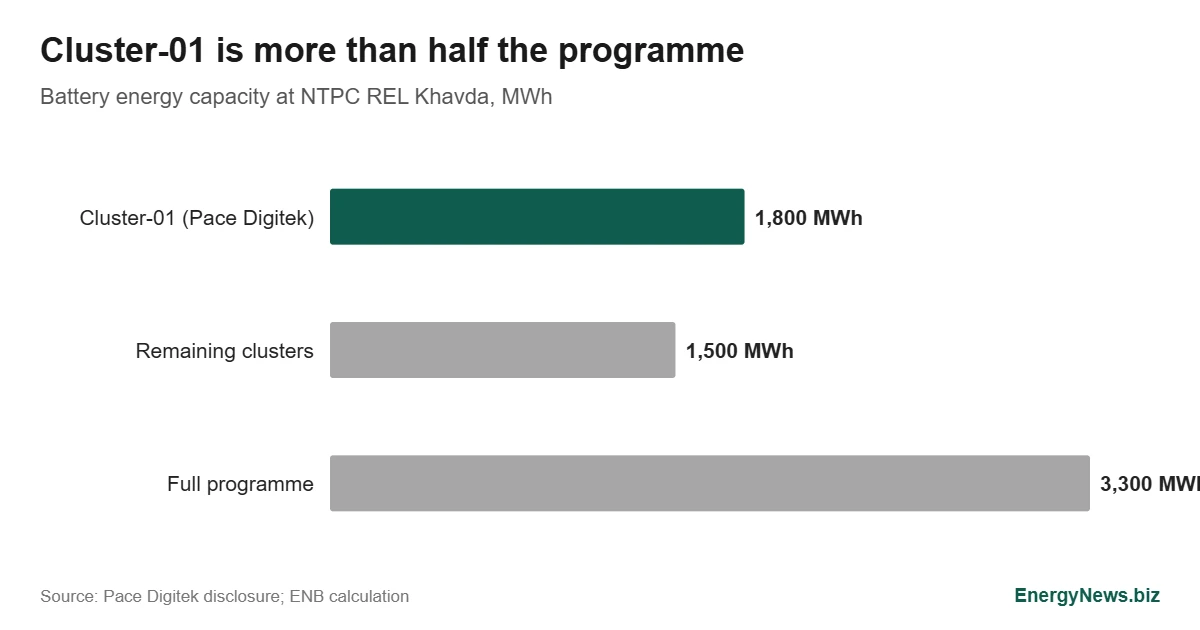
Cluster-01 alone accounts for 1,800 of the programme’s 3,300 MWh, or about 55%. That leaves around 1,500 MWh to be awarded in later clusters.
Another ENB calculation shows how much energy the system could move. At one full cycle a day, 1,800 MWh of storage shifts about 657 GWh a year from the middle of the day into the evening, before round-trip losses. That is meaningful, but small next to the scale of Khavda itself, which is planned at about 30 GW of renewable capacity. Even the full 3,300 MWh programme would cover only about seven minutes of the park’s output at full power, which is why grid planners expect many more storage rounds in Gujarat.
Why storage at Khavda matters for India’s grid
India’s grid operators have warned of evening shortages as solar grows faster than flexible capacity. The central government has used viability gap funding to support battery tenders, and state utilities now ask for storage with new solar contracts. Large utility-owned projects like the NTPC Khavda battery also help set a price benchmark for private developers bidding into tenders.
The order also signals a shift in who builds storage in India. Pace Digitek is better known for telecom infrastructure and solar EPC work. Winning a project of this size shows how quickly Indian contractors are moving into battery integration, a segment once dominated by foreign system integrators. A single cluster of 1,800 MWh needs hundreds of containerised battery units, power conversion systems and a dedicated substation, and creates a reference project that the contractor can use in later bids across India and abroad.
The NTPC Khavda battery is also a test of execution. Battery projects in India have faced delays linked to land, grid connection and equipment imports. The time from award to commercial operation on this first cluster will set expectations for the remaining clusters and for the national storage tenders that follow. NTPC has not yet disclosed the commissioning date for the first cluster.
Global context for large batteries
At 1,800 MWh, the Khavda cluster sits in the same class as the largest projects now under construction worldwide. In Germany, the 1.6 GWh Stadorf battery recently secured its TenneT grid connection, and in the United States the Energizar project near Boston broke ground at 1.2 GWh. Three-hour duration at Khavda is longer than the two-hour systems common in Europe, reflecting India’s evening peak.
Details on NTPC’s renewable energy portfolio are published by NTPC.
Add EnergyNews.biz as a preferred source on Google


