





German imbalance prices can fall to extreme lows in quarter-hours where the intraday market shows nothing unusual. Power market analyst Julien Jomaux traced part of the reason to Deterministic Frequency Deviations, the predictable frequency jumps that appear at market borders, in a newsletter published on 17 November. The mechanism matters for every balance responsible party in Germany, and for anyone holding a battery that earns money in balancing markets.
Deterministic Frequency Deviations, or DFD, come from a mismatch between how power is traded and how it is produced. Contracts change in fixed blocks. Physical plants ramp along curves. At each block border, generation and demand briefly fall out of step and the frequency of the Continental European grid moves away from 50 Hz in a pattern that repeats day after day.
Why imbalance prices react to frequency jumps
Jomaux measured the jump at each border as the difference between the frequency one minute after the border and one minute before it. His heatmap by month and hour shows a clear, repeating structure. His six-month rolling averages show the effect has grown steadily since 2022. The jumps at the hourly border have eased slightly, while the jumps at :15, :30 and :45 have risen sharply and have now almost caught up with the full hour.
The turning point was the move of the European day-ahead market to 15-minute products, live since 1 October 2025. An hourly market has 24 borders a day. A quarter-hourly market has 96. Four times as many schedule changes means four times as many moments in which the system can jump, and the data now show it does.
How large a frequency jump is in megawatts
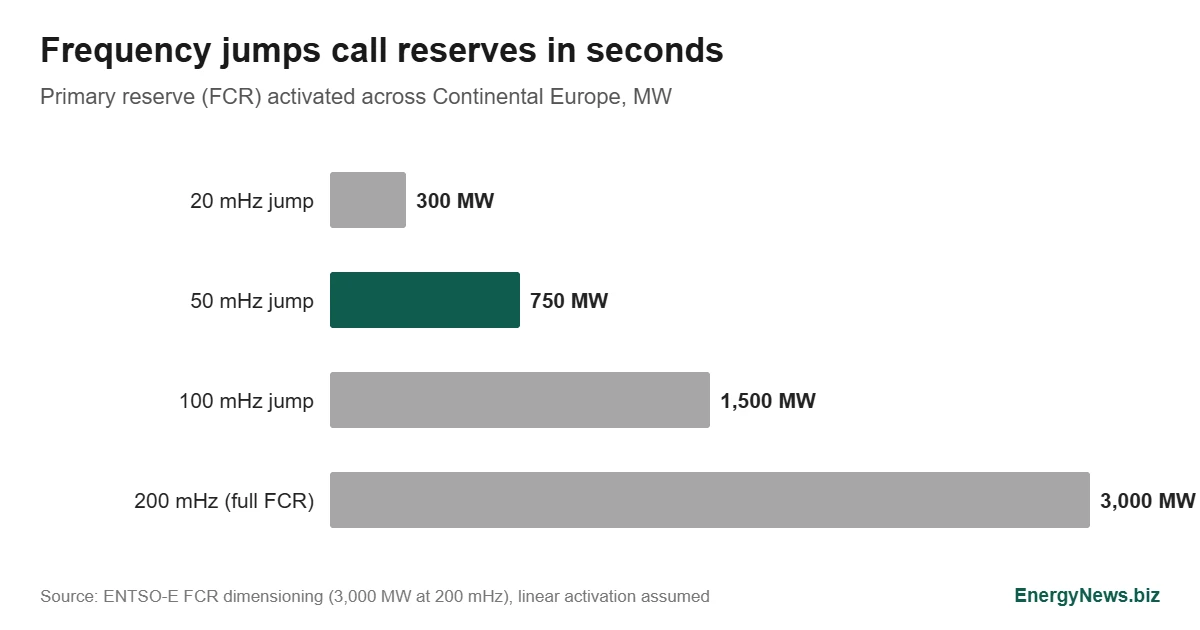
Frequency is not an abstract number. In Continental Europe, the frequency containment reserve is dimensioned at 3,000 MW and is fully activated at a deviation of 200 mHz. Assuming linear activation, every 10 mHz of deviation calls on about 150 MW of primary reserve within seconds. A 50 mHz jump at a quarter-hour border therefore equals roughly 750 MW of reserve moving across the synchronous area, before any secondary control steps in.
That secondary layer is where the money sits. German TSOs settle imbalances every 15 minutes through the reBAP, which compares three components: the average cost of activated aFRR and mFRR balancing energy, a coupling to the intraday ID Full Index so that parties cannot profit from causing imbalances, and a scarcity surcharge for extreme stress. In a deficit the highest component sets the price. In a surplus the lowest one does.
Imbalance prices on 19 July: the warning case
Jomaux points to 19 July as an example. The balancing module produced an extremely low imbalance price while the intraday module stayed at normal levels. Intraday prices did not drift toward the final imbalance price, which suggests traders did not see the extreme balancing conditions coming. When the balancing energy merit order is steep, a burst of frequency driven activations can push the marginal price far down in a single quarter-hour.
His full explanation of why the risk is mostly asymmetric, pointing to the downside, sits behind a paywall. The free part is enough to frame the practical point. Low imbalance prices in surplus quarter-hours are not random noise. They cluster around market borders, and the number of borders rose fourfold with the 15-minute day-ahead market.
What it means for traders and battery owners
For balance responsible parties, the risk sits in the minutes around each border, not in the quarter-hour average. Portfolios that ramp in steps aligned with the schedule add to the jump. Ramping across the border, as several TSOs have asked for years, reduces it.
For batteries the same pattern is an opportunity. A storage asset that can absorb energy in the seconds after a border is paid twice: once through FCR or aFRR, and once through a low reBAP in surplus periods. Its exposure flips when it is short in those quarter-hours. That makes border-aware scheduling a design choice, not a detail, as large German projects such as the 1.6 GWh Stadorf battery approach the market.
The official reBAP data and the methodology used by the four German TSOs are published on netztransparenz.de. Anyone testing the link between frequency jumps and imbalance prices can match those settlement series with ENTSO-E frequency data quarter-hour by quarter-hour and border by border.
Add EnergyNews.biz as a preferred source on Google


