




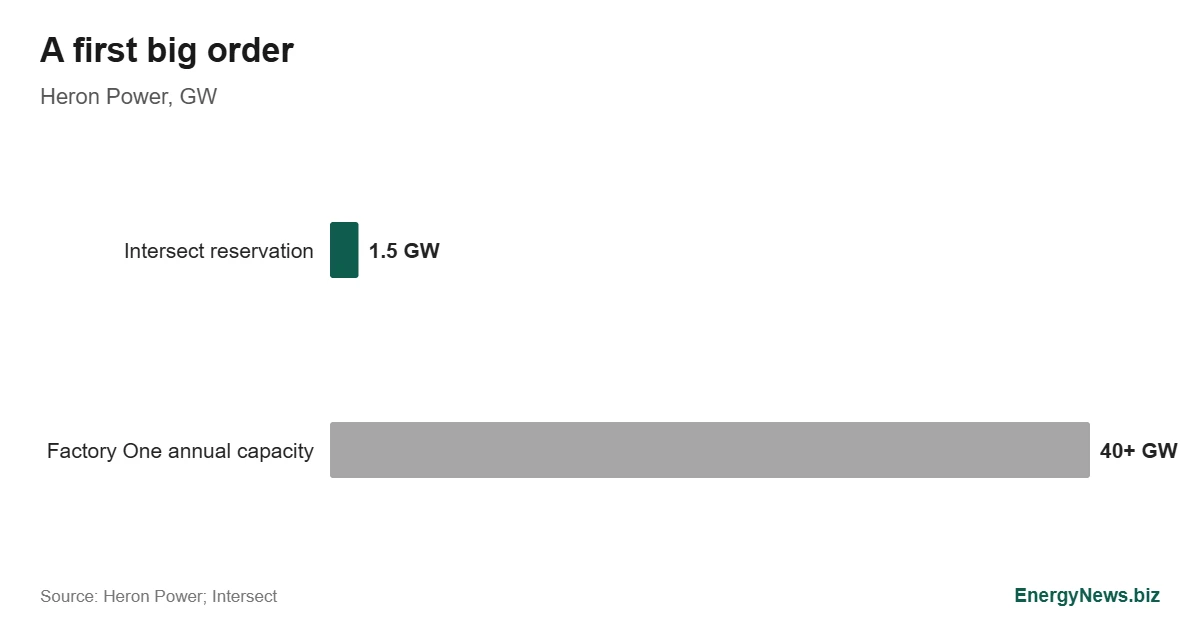
Heron Power has secured a reservation for 1.5 GW of its Heron Link power conversion units from Intersect, the solar and storage developer acquired by Alphabet for $4.75 billion. Each Heron Link unit is rated at 5 MW and converts power between solar, batteries and the medium-voltage grid with an efficiency of 98.6%, according to the company. Deliveries are scheduled to start in 2028.
Heron Power is building its first plant, Factory One, in Morgan Hill, California, with an investment of more than $100 million. The factory is designed to make 10,000 units a year, equal to more than 40 GW of capacity, with mass production starting in late 2027.
What the Heron Power order adds up to
An ENB calculation breaks down the reservation. At 5 MW per unit, 1.5 GW is about 300 Heron Link units. Measured against Factory One’s planned output of more than 40 GW a year, the Intersect order represents about 3.75% of one year’s capacity. It is a large anchor order for a start-up, but the factory will need many more customers to run at scale.
The efficiency figure has a practical meaning too. At 98.6%, a 1.5 GW fleet running at full output would lose about 21 MW in conversion. Every tenth of a percentage point gained or lost on that scale is worth about 1.5 MW, which adds up over the decades a solar or storage plant operates.
Why Heron Power targets the conversion layer
Conventional solar and storage plants use inverters, step-up transformers and switchgear in separate pieces of equipment. Heron Power’s approach uses solid-state power electronics to combine several of those functions into one unit. The aim is to reduce the number of components, shrink the footprint of a plant and speed up construction, at a time when transformer lead times stretch to years.
Solid-state conversion also gives operators finer control over how a plant behaves on the grid. That matters as grids rely more on inverter-based resources and need them to provide stability services, as in China’s large grid-forming hybrid storage projects. Similar flexibility is being drawn from vehicles, as with the vehicle-to-grid programme in California.
Why Intersect is the right first customer
Intersect builds large solar and storage projects, increasingly paired with data centre loads. Alphabet’s purchase gives it the balance sheet to commit to equipment years ahead, which is what a reservation of this size requires. For Heron Power, a buyer with a large pipeline reduces the risk of building a factory before demand is proven.
Investors have backed the company because the conversion layer has become a bottleneck. Transformer shortages have delayed solar, storage and data centre projects across the United States, and utilities report waiting years for some equipment. A product that removes or shrinks part of that chain, and is made domestically, addresses both supply and policy concerns, since federal incentives increasingly reward US-made components.
Heron Power is not alone in the field. Several start-ups and established electrical companies are developing solid-state transformers and medium-voltage converters, including for data centres moving to higher-voltage direct current inside their halls. The Intersect reservation gives Heron Power an early reference customer in a market that is still forming, and a public benchmark that rivals will now be measured against.
The main risks are timing and technology. Factory One has to start mass production on schedule in late 2027, and the units have to meet utility and grid code requirements in the field. The next milestone is the start of factory production, followed by the first field installations on Intersect sites in 2028. Company details are published by Heron Power.
Add EnergyNews.biz as a preferred source on Google


