




EU permitting rules for clean energy projects are set to tighten sharply after negotiators from the European Parliament and the Council reached a provisional agreement on 19 November. The deal sets maximum deadlines for approving solar plants with co-located storage, standalone batteries, EV charging points, pumped hydro and grid connections. It is part of the Grids Package the European Commission presented on 10 December 2025.
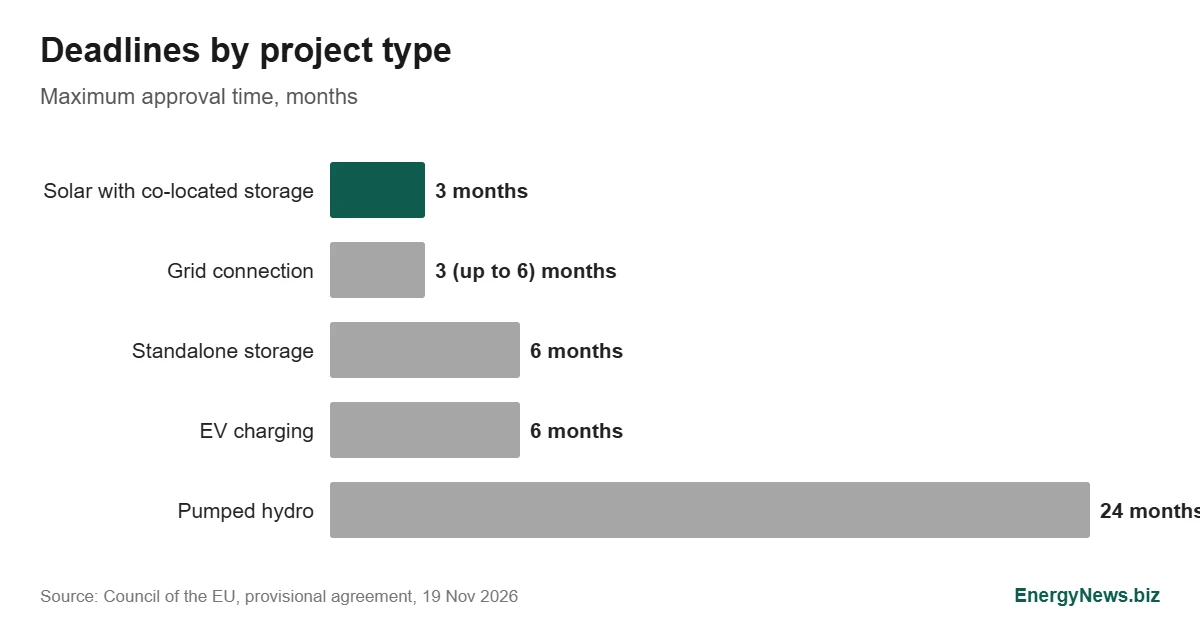
Under the agreement, solar installations combined with storage must receive approval within 3 months. Standalone storage and EV charging get 6 months. Pumped hydro projects get up to 2 years. Grid connection decisions must come within 3 months, extendable to 6 in justified cases. The projects are also to be treated as being in the overriding public interest, which limits the grounds for blocking them.
What changes under the EU permitting deal
Several thresholds move. Small-scale installations up to 200 kW, up from 100 kW, qualify for the simplified permit route. EV charging points of 1 MW or less installed on artificial structures, such as car parks and building roofs, will need no administrative permit at all. And the threshold above which projects must share benefits with local communities falls from 10 MW to 7 MW.
An ENB calculation shows the spread of the new regime. Pumped hydro still gets eight times the approval window of solar with storage, 24 months against 3, reflecting the larger civil works and environmental assessment involved. The small-scale permit threshold doubles, while the community benefit threshold falls by 30%, which brings more mid-sized projects into benefit-sharing schemes.
Why EU permitting has been the bottleneck
Permitting and grid connection, not equipment or capital, have become the main reasons projects stall in many member states. Developers report waiting years for approvals and connection offers, while panels, batteries and transformers sit ready. Long queues also distort markets, because projects that cannot connect cannot respond to price signals such as those described in the report on German imbalance prices.
The new deadlines target the slow middle of the process. A 3 month limit for solar with storage is designed to reward projects that add flexibility, not only generation. Faster rules for charging points support transport electrification, while the pumped hydro timeline acknowledges that large storage needs time to assess properly.
What comes next
The provisional deal is not yet law. It must be endorsed by the Parliament’s industry committee, ITRE, then formally adopted by the full Parliament and the Council, before publication in the Official Journal. Member states will then have a transposition period to bring national procedures into line, and the new EU permitting deadlines will apply only once national law reflects them.
Industry groups have broadly welcomed the direction while warning that deadlines without enforcement change little. One open question is what happens when an authority misses a deadline. Some national systems apply tacit approval, where silence counts as consent, while others simply leave the developer waiting. How the final text and national laws handle missed deadlines will shape whether EU permitting actually speeds up on the ground.
For storage developers, the 6 month deadline for standalone batteries is the most significant change. Battery projects have often been treated under rules written for power plants or industrial sites, with long assessments that do not fit their small footprint and short construction time. A dedicated timeline should help the many projects now queuing for grid connection across the continent.
Implementation will decide the impact. EU permitting deadlines already existed for some technologies under earlier rules, and many authorities missed them because they lacked staff and digital systems. Local heat and energy projects, such as district heating in Galway, show how much depends on administrative capacity. The text of the agreement is published by the Council of the EU.
Add EnergyNews.biz as a preferred source on Google


