





Galway district heating is set to become the first large-scale scheme of its kind in Ireland. HeatGrid Ireland, the developer, says the network in the east of Galway city has planning permission, support from potential public and private customers, and is on track to start supplying heat in 2029, or 2030 at the latest.
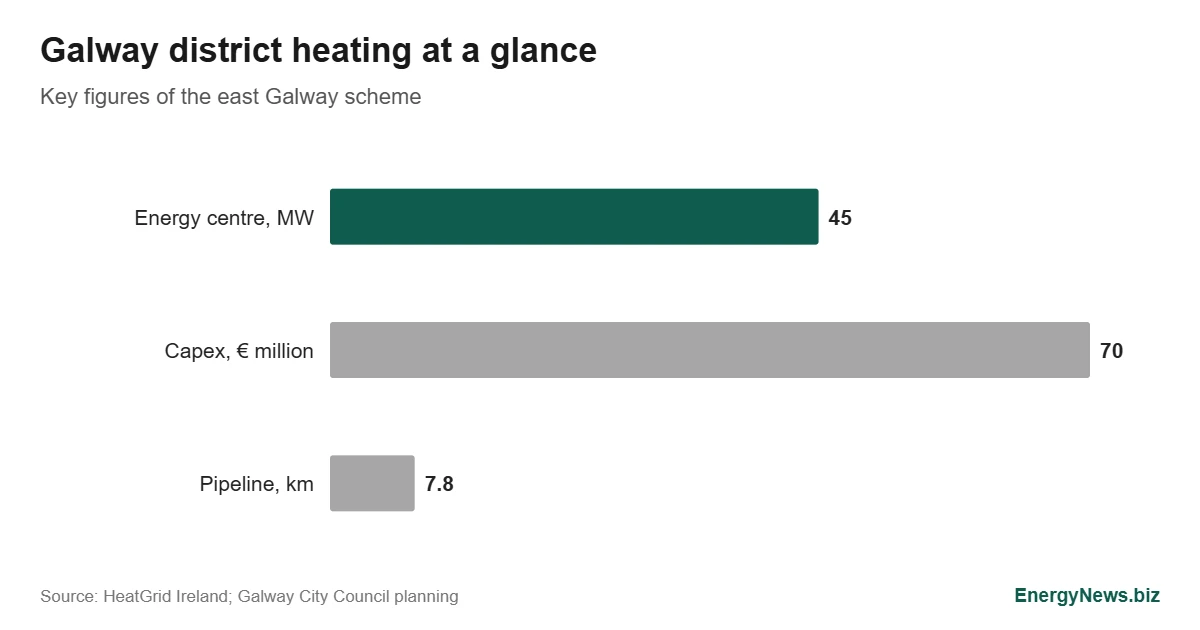
The project centres on a 45 MW district heating energy centre to be built on part of the Galway Crystal site on the Dublin Road, near Merlin Park. A pipeline of about 7.8 km will carry hot water to the first customers: Atlantic Technological University’s Galway campus and three hospitals on the east side of the city. The first phase is estimated at €70 million.
An ENB calculation for Galway district heating
An ENB calculation puts the first phase at about €1.56 million per MW of heat capacity, based on €70 million for a 45 MW energy centre and network. That figure covers the energy centre, pipes and connections for the anchor customers, so it is not directly comparable with the cost of a single boiler or heat pump. It does give a benchmark for the later phases, when HeatGrid plans to extend the network to smaller commercial buildings and homes.
District heating works by producing heat centrally and moving it through insulated pipes to buildings, which use heat exchangers instead of individual boilers. The benefit of Galway district heating is flexibility: the energy centre can switch to new heat sources over time, from large heat pumps to industrial waste heat, without changes inside each building. HeatGrid has pointed to a district heating project in Bradford in the UK that went from concept to heat in four years as a reference timeline.
The design allows heat to come from several sources over time. HeatGrid’s chief executive David Connolly, a long-time district heating researcher, has worked on studies with the University of Galway and the Sustainable Energy Authority of Ireland on using industrial waste heat and other low-carbon sources.
Ireland starts from a low base
District heating supplies a large share of heat in Denmark, Sweden and Finland, but almost none in Ireland. About 11,000 Irish homes are heated by group schemes, which typically serve one building, according to researchers at University College Cork. Dublin’s Tallaght network, which uses waste heat from a data center, is still small.
The government has started to fund early stages. In October, it approved €5 million for pre-construction work on nine pilot district heating projects, including HeatGrid’s schemes in Galway, Portlaoise and Castletroy. HeatGrid says its pipeline across Ireland represents more than 1,000 GWh of annual heat demand.
Beyond Galway, HeatGrid is working on similar networks in Limerick and Portlaoise. If the Galway district heating scheme delivers on time, it will give Irish planners and investors the first full-scale reference project in the country, which is often the missing step for district heating to spread. Construction timing will depend on financing and on long-term heat supply agreements with large public buildings, which give lenders the predictable revenue they need. That is why hospitals and universities often form the first phase of new networks.
Waste heat from data centers
Ireland’s large data center sector is an obvious heat source. In Dublin 15, operator Pure DC has signed an exclusivity agreement to export about 10 MW of waste heat to a HeatGrid network in Blanchardstown. Using that heat instead of releasing it into the air is one of the few ways data centers can lower the net energy footprint described in our report on hyperscale data center electricity use.
Project details are available from HeatGrid Ireland.
Add EnergyNews.biz as a preferred source on Google


