




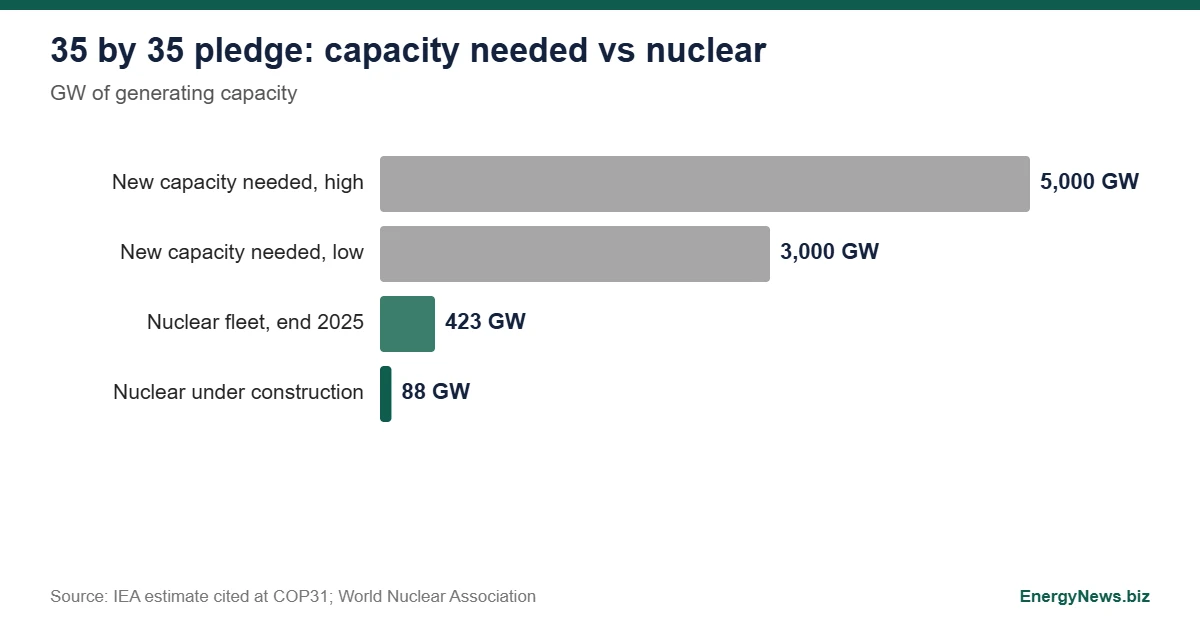
The 35 by 35 pledge, the flagship of the Turkish COP31 presidency, asks countries to raise electricity’s share of global final energy consumption from about 23% today to 35% by 2035. According to the International Energy Agency, that requires more than 15,000 TWh of additional generation a year, nearly half of today’s output, and between 3,000 and 5,000 GW of new capacity depending on the mix.
The nuclear industry wants the pledge to name nuclear power. The arithmetic says the bigger issue lies elsewhere. The draft text is source neutral: it would count a new gas or coal plant exactly as it counts a wind farm or a reactor. The fight over one word, clean, decides more than any mention of nuclear.
What the 35 by 35 pledge says
The draft of the COP31 Global Electrification Pledge, published in September, declares the intent “to increase electricity’s share of total final energy consumption, to reach 35% globally by 2035”. It refers to energy efficiency, renewable energy, electrification, emissions abatement and removals, and calls the target complementary to efforts to expand renewables and improve efficiency. It does not set any requirement on how the extra electricity is generated.
That gap in the 35 by 35 pledge is now part of the negotiation. The EU entered COP31 with a mandate to push for clean electrification, but its chief negotiator Wopke Hoekstra said on 13 November that “a certain degree of pragmatism” may be needed to keep the group of signatories as large as possible. Several large developing countries have pushed back on sectoral targets, including this one. Ministers arrive in Antalya for the second week of talks from 16 November.
The 35 by 35 pledge in terawatt-hours
The IEA range for the 35 by 35 pledge can be tested. 15,000 TWh a year produced by 3,000 GW implies an average capacity factor of about 57%. The same energy from 5,000 GW implies about 34%. The low end of the range therefore assumes a large share of firm plants; the high end assumes mostly solar and wind.
Nuclear’s possible contribution is small on that scale. Reactors under construction worldwide total about 88 GWe, including four in Türkiye, according to the World Nuclear Association. At a 90% capacity factor, 88 GW produces about 690 TWh a year, roughly 4.6% of the 15,000 TWh the pledge requires. Even the whole existing fleet of 423 GWe at the end of 2025 is smaller than the low end of the new capacity needed.
The nuclear ask at COP31
“The Presidency’s pledge to raise electricity to 35% of final energy demand by 2035 is a welcome ambition, but it does not specifically acknowledge the role nuclear could play,” said Sama Bilbao y León, director general of the World Nuclear Association. “Clean energy should be treated on equal terms.” A letter to COP31 president Murat Kurum, coordinated by Nuclear for Climate on behalf of more than 150 associations, asks for nuclear to be advanced in the implementation of the target.
The industry also points to momentum behind the 2050 goal of tripling nuclear capacity. The declaration launched with 22 countries at COP28 now has 39 signatories, six of them added since COP30: Belgium, Brazil, China, Italy, South Africa and Togo. Tripling refers to 2050, however, and reactors that start construction after 2028 will rarely deliver power before 2035.
What decides the 35 by 35 pledge
Electrification only cuts emissions if the electricity is low carbon. Efficiency matters as much as supply, as the analysis of why energy efficiency decides 35% electrification showed, and the related Belém Pledge on sustainable fuels already runs short of its 2030 numbers.
A 35 by 35 pledge without the word clean could be met with gas. A pledge with clean in it, but without nuclear named, still leaves reactors eligible under the wording. Negotiation records are posted on the UNFCCC COP31 page. The test for the final text in Antalya is not whether nuclear is mentioned, but whether the 15,000 TWh must come from low-emission sources.
Add EnergyNews.biz as a preferred source on Google


