





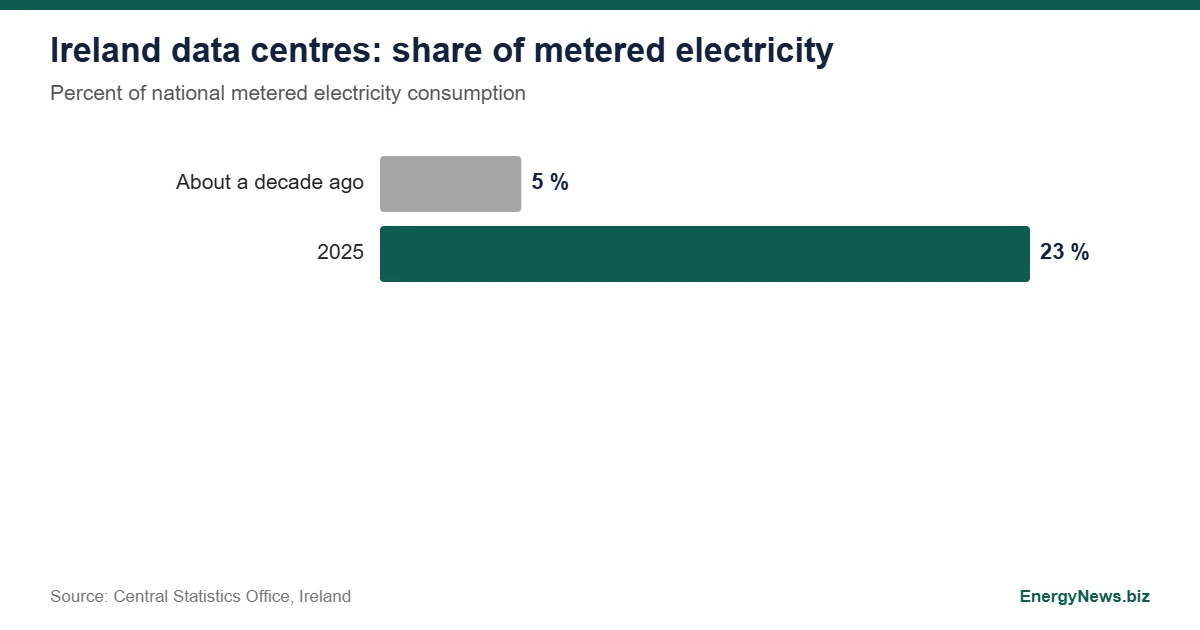
Ireland data centres consumed 23% of the country’s metered electricity in 2025, up from about 5% a decade earlier and more than all urban households combined. That share is now at the centre of a High Court case in Dublin, where three environmental groups are asking the court to quash the rules that reopened the national grid to new data centres.
The challenge, brought by ClientEarth, Friends of the Irish Environment and Friends of the Earth Ireland against the Commission for Regulation of Utilities (CRU), was heard in the week to 13 November 2026. It targets the regulator’s policy for connecting large energy users rather than any single project. The CRU declined to comment, and no ruling has been reported.
From a 2021 moratorium to on-site power for Ireland data centres
In November 2021 the CRU set strict criteria on where new data centres could connect and what on-site generation or storage they needed, which in practice froze most new connections. The policy now under challenge, published in December 2025, ended that freeze but set new terms. Any data centre seeking a connection must install on-site generation or battery systems able to meet its full electricity demand, and those systems must be able to feed power back to the grid when needed.
The rules also allow a new site to run on non-renewable energy for six years. After that, at least 80% of its energy must be renewable. The groups point out that the 80% calculation excludes back-up generation, which in practice often runs on fossil gas. Their case argues that the CRU decision breaches Irish and European law and would lock Ireland into gas-fired supply for years. The regulator publishes its large energy user decisions on the CRU website.
Ireland data centres against a 42% target and a 13% projection
The legal argument rests on Ireland’s climate obligations. Under EU rules the country must cut emissions in the relevant sectors by 42% by 2030 compared with 2005. The Environmental Protection Agency projects a cut of about 13%. Every new gigawatt of demand served by gas widens that gap, which is why the groups chose to challenge the connection policy itself.
“We cannot allow new renewable capacity to be effectively cannibalized by one sector,” said Alex White, chair of the Climate Change Advisory Council, who has warned that progress on renewables is being offset by data centre demand. Natascha Hospedales, lead lawyer at ClientEarth, said regulators like the CRU must make sure their approach to the infrastructure boom is responsible.
Ireland data centres number about 89, roughly ten times the European average per head of population. An ENB calculation: the jump from 5% to 23% means data centres’ share of metered consumption grew about 4.6 times in ten years.
Ireland data centres in a wider European squeeze
Investment in Ireland data centres is already moving. TikTok dropped plans for another Irish data centre in April, and hundreds of people protested against data centre growth in Dublin in early November. Developers are looking to the Nordics and southern Europe, where grids are also tightening.
Norway shows how fast that can change. On 9 November its grid operator Statnett paused new grid reservations for data centres until 1 August 2027 at the latest, with about 800 MW connected, 4,200 MW reserved and 9,100 MW queued against a national peak demand of just over 25,000 MW. Statnett had already cut its long-term demand outlook, as reported in its 2026 market analysis. In the US, the question of who pays for data centre load dominates the PJM capacity market.
For Ireland data centres, a ruling against the CRU would reopen the connection rules almost a year after they were published. A ruling in the regulator’s favour would leave the six-year non-renewable window, and the exclusion of back-up generation from the 80% test, as the framework for the next wave of Ireland data centres.
Add EnergyNews.biz as a preferred source on Google


