




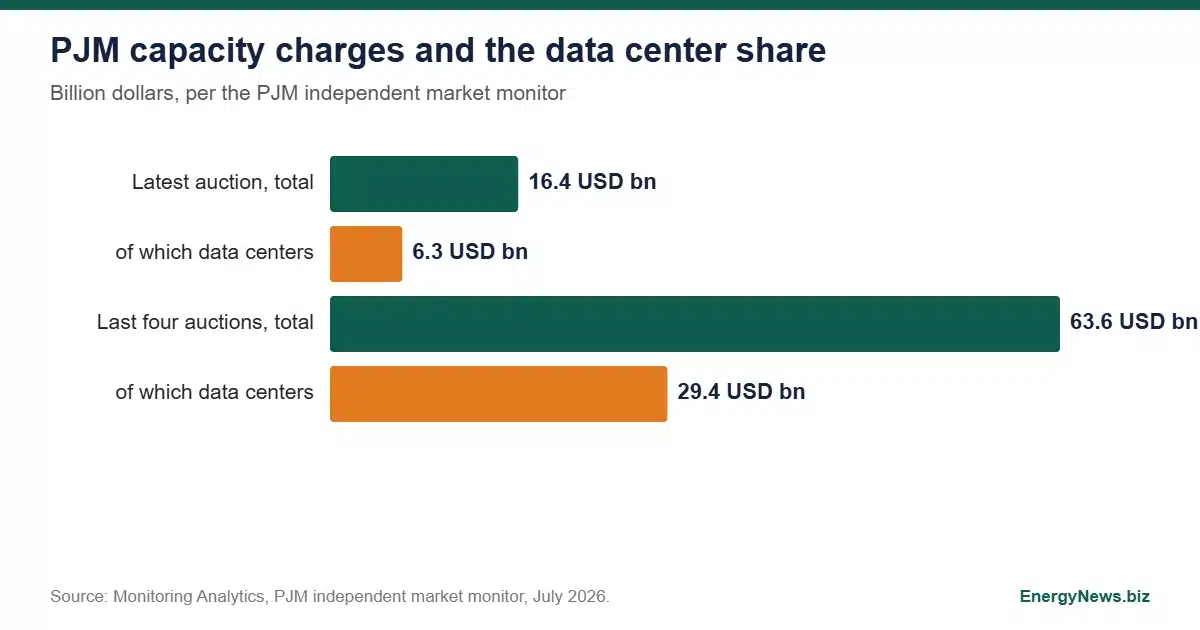
The latest PJM capacity auction has turned a technical market into a household question: who pays for the data centers? According to the independent market monitor for PJM, data centers were responsible for 6.3 billion dollars, or 38 percent, of the 16.4 billion dollars of charges in the auction held in July. The grid operator serves some of the densest data center regions in the world, and the bill is landing on everyone connected to it.
The monitor, Joseph Bowring of Monitoring Analytics, says the pattern is not a one off. Across the last four base auctions, data center driven charges totalled 29.4 billion dollars, 46 percent of 63.6 billion dollars in total capacity charges.
What the PJM capacity auction actually buys
A capacity auction does not buy electricity. It buys the promise that enough generation will be available years from now to meet peak demand, and the cost is passed to retail customers through their supply charges. When forecast demand jumps, the price of that promise jumps with it. The share the monitor attributes to data centers is therefore an estimate of how much of the increase would disappear if the new large loads were not expected.
By ENB calculation the non data center portion of the latest auction was about 10.1 billion dollars. In other words, even without new demand there was a large bill, but the added load turned a large bill into a much larger one.
Other costs sit on top
Capacity charges are only part of it. Bowring notes that ratepayers also face higher energy and transmission costs that follow data center growth, since new lines and substations must be built and paid for somewhere. These are harder to separate from other drivers, which is why the 38 percent and 46 percent figures should be read as the part that can be isolated, not the whole.
The picture matches what we saw when a single data center operator in Australia found its expansion held up by the arrival of power, described in our report on the Melbourne delay. The constraint is the same on two continents: demand is arriving faster than the generation and wires that must serve it.
Reliability and a one time fix
There is also a physical shortfall. PJM staff proposed procuring the shortfall left over from the last base auction, about 6.8 GW, in a one time backstop auction. That is a sign the normal market did not secure enough supply, which is a more serious message than a high price.
The monitor’s proposal
Bowring argues that large loads should bring their own generation. Whatever large load capacity remains should be bought in a separate auction on 15 year contracts, so that the companies causing the demand also carry the cost of meeting it. His phrasing is blunt: the monitor says there is one way to do what hyperscalers agree is the right thing, and that is to run a separate auction.
The logic is easy to follow. If a data center operator is willing to pay for new power, a dedicated auction lets it do so without forcing every other customer to share the price of the shortage. If it is not willing, that is information too.
Why this is more than a US story
Every power system that attracts large computing loads faces some version of the same choice. Either the new load pays directly for the capacity it needs, or the cost is socialised across everyone else and the cost of delay is paid in political resistance. States and regulators in the United States are moving toward large load tariffs, but the details differ and the debate is far from settled.
For energy investors the point is simpler. Rising capacity prices are a signal that new generation and storage will be paid well in constrained markets, but the rules that decide who signs the contract are still being written. Market data and auction reports are published by the grid operator at pjm.com.
The test to watch
The next PJM capacity auction will show whether the pressure continues, and whether regulators back a separate large load process. If they do, the 38 percent figure may become a number data center developers try to shrink by bringing their own power. If they do not, ordinary customers will keep funding the buildout without having a say in it.
Add EnergyNews.biz as a preferred source on Google


