


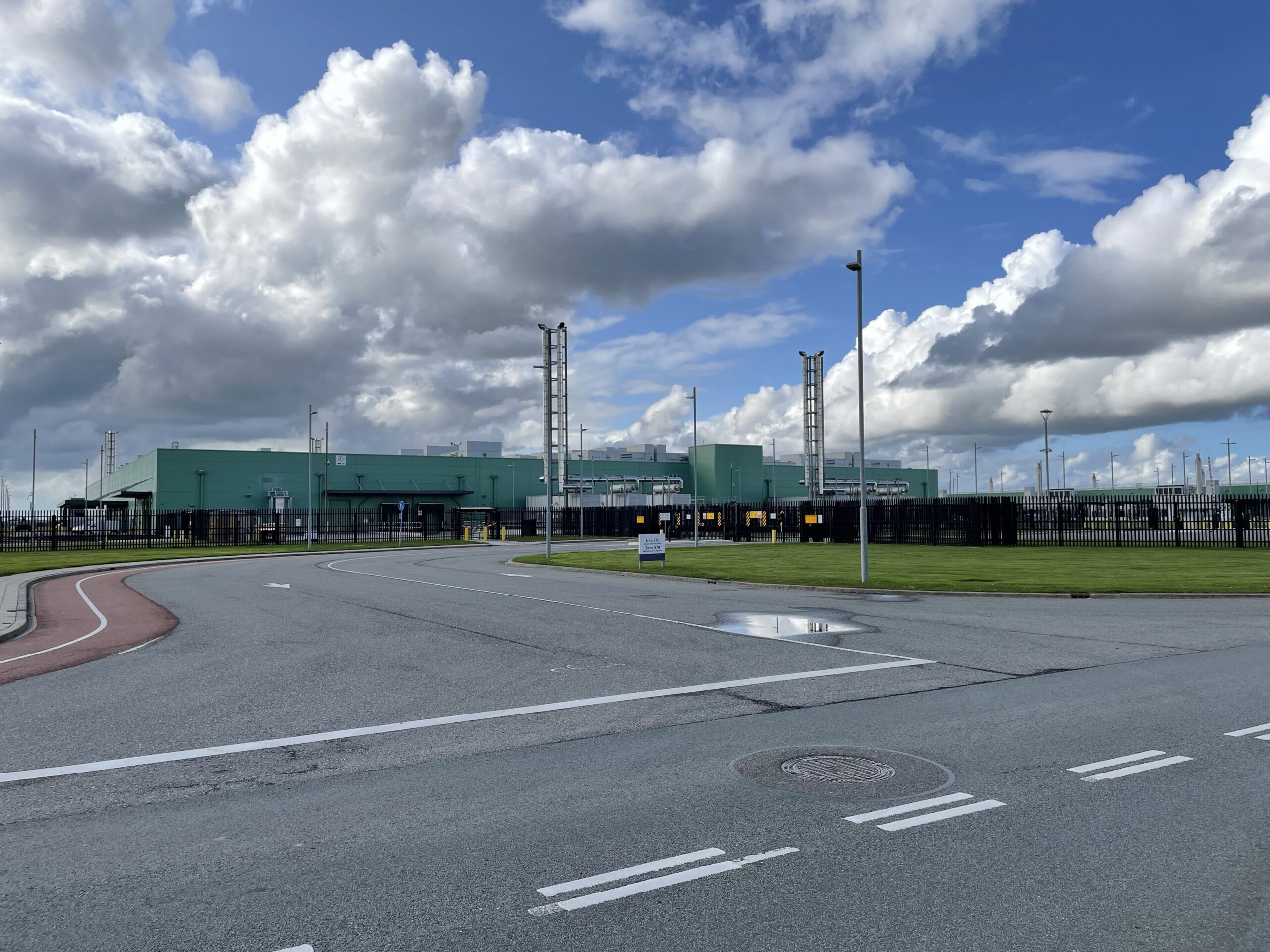


The Nextdc M3 power delay turned a grid works dispute in Melbourne into a A$140 million hit to the company’s revenue guidance. The data centre operator asked for a trading halt on 19 October over a delay to the supply of power at its M3 facility, then published revised FY27 guidance on 21 October. The company’s two stock exchange releases give the cause, the new timetable and the numbers.
What the filings say about the Nextdc M3 power delay
The cause sits outside the data centre. The distributor Jemena suspended parts of its 66 kV line augmentation works in September 2026, citing community and stakeholder opposition and the local council not giving consent pending consultation. Jemena does not expect to restart before February 2027. The next increase in grid supply at M3 is now expected in FY28.
A second constraint follows behind the first. Later power increases at M3 depend on new transformer projects at the Brooklyn Terminal Station, and the first of those is now later than expected. Separately, the Victorian planning decision on Stages 6 and 7 of M3 is not expected until 2027, after the state election on 28 November 2026. Neither filing gives a megawatt figure for M3 or a revised power ramp.
The guidance arithmetic
Revised FY27 net revenue guidance is A$475 million to A$500 million, down from A$615 million to A$640 million. Underlying EBITDA guidance falls from A$385 million to A$410 million to A$245 million to A$265 million. Both revised ranges exclude the affected M3 contracts, which the company put at about A$140 million each in its August guidance.
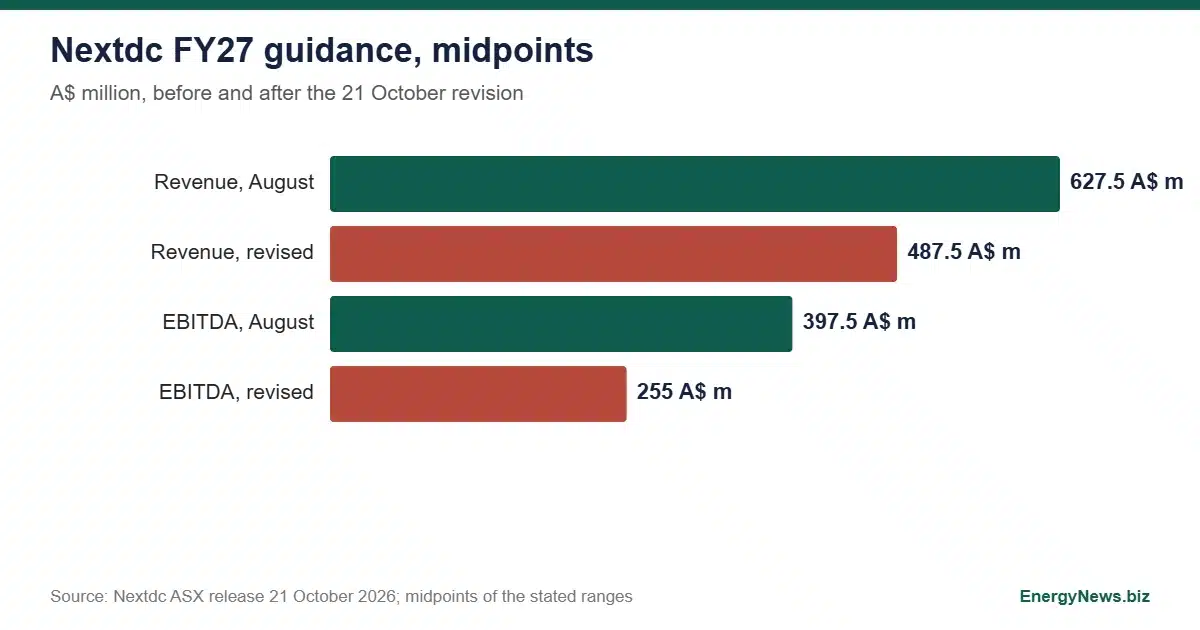
The difference between the ranges is simple to calculate from the stated figures. Revenue falls by A$140 million at both ends of the range. EBITDA falls by A$140 million at the low end and A$145 million at the high end. Almost every lost dollar of revenue is therefore a lost dollar of EBITDA, which is what a delayed capacity ramp looks like when the building, the staff and the equipment are already paid for.
Capital expenditure guidance also drops, from A$5,250 million to A$5,750 million to A$4,500 million to A$5,000 million, including about A$230 million of capitalised interest. The company says it has paused all new development projects and land acquisitions, and projects that are not backed by customer contracts.
A grid problem, not a funding problem
The balance sheet is not what holds the Nextdc M3 power delay in place. The filing reports liquidity of A$8,675 million, made up of A$1,275 million of cash, A$6,700 million of undrawn senior facilities and a A$700 million hybrid delayed draw. Money is available; a consented power line is not.
That is the lesson for any data centre developer planning around grid timelines. A project can be financed, designed and built, and still sit idle because a distribution line needs a council’s agreement. Community opposition to a line, rather than to the data centre itself, has become a path by which local objections reach a hyperscale schedule. The planning decision after the state election adds political timing to technical timing. The same squeeze is visible in the market for high voltage components, where supply is tight too.
What to watch
Four dates frame the next months: the company’s annual general meeting on 20 November, the Victorian election on 28 November, Jemena’s earliest restart in February 2027, and the first grid supply increase in FY28. The Nextdc M3 power delay will also be read by other operators in Australia as a test of how much grid capacity can be assumed when contracts are signed. Customers who signed for M3 capacity will see the revised timetable as a statement about delivery risk, and future contracts may carry more explicit power conditions as a result.
Add EnergyNews.biz as a preferred source on Google


