


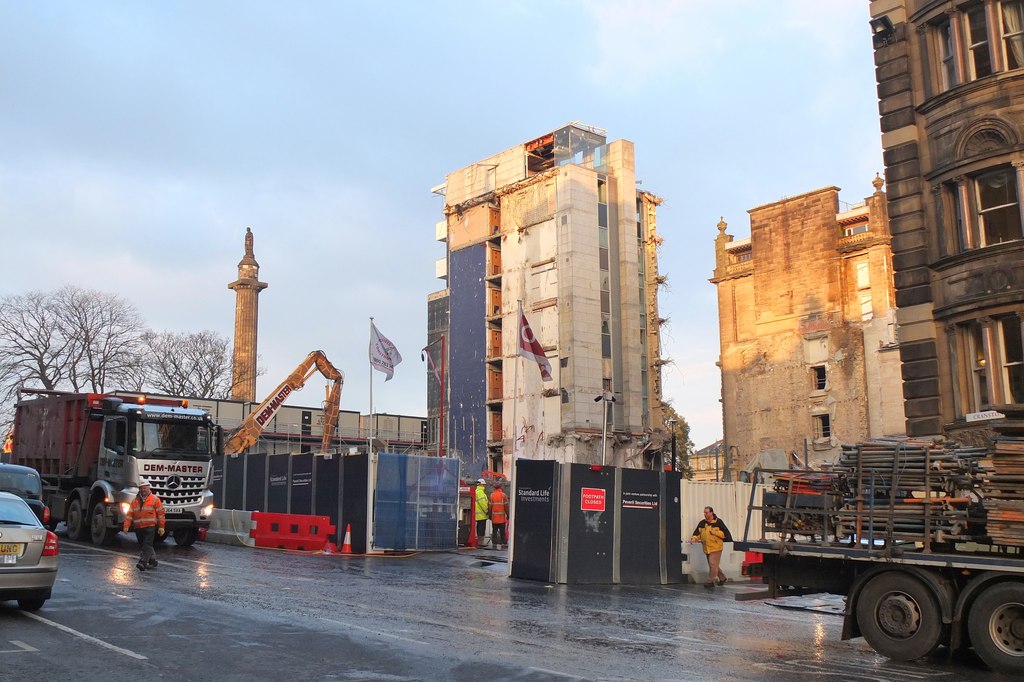


Construction and demolition make up about half of all waste produced in Scotland, and Zero Waste Scotland has published a circular economy roadmap for the built environment with 12 interventions to change that. The roadmap is the second of four sector documents under the Scottish Government’s Circular Economy Strategy, and an industry led Mission Board now has to turn it into delivery. A promotional item about it published on 17 October 2026 is labelled an ad feature by Zero Waste Scotland, so its claims are treated here as the organisation’s own.
The circular economy roadmap in numbers
The roadmap states that construction and demolition account for around half of Scotland’s waste, and that outputs linked to these activities made up an estimated 10 percent of the country’s greenhouse gas emissions in 2022. The first figure is consistent with an earlier Scottish Government route map consultation, which put construction and demolition waste at 5.8 million tonnes in 2018, against a low of 3.7 million tonnes in 2012, mostly soil and stone from excavations and demolition rubble. A figure of 5.8 million tonnes as half would imply total waste of about 11.6 million tonnes (a derived number, not a reported one).
The roadmap was launched at the first workshop of the Mission Board in Stirling on 29 May. The board is chaired by Professor Sean Smith, director of the Centre for Future Infrastructure at the University of Edinburgh, and the detailed action plans that follow from the 12 interventions are being developed through 2026. It follows the energy infrastructure roadmap published in May, and roadmaps for textiles and the bioeconomy are planned.
What the 12 interventions cover
The Mission Board is the first intervention. The others range from a national hub infrastructure for reusing materials from the built environment and sustainable procurement, which the roadmap calls one of the biggest unused levers, to new metrics and standards, finance and policy measures, and communications meant to make circular practice normal in the sector. Scotland is also one of four European locations, with Munich, Lisbon and Denmark, piloting a circular construction hub under the Horizon Europe funded CirCoFin project, which Zero Waste Scotland leads.
| Claim | Where it comes from | Status |
|---|---|---|
| Construction and demolition are about half of Scotland’s waste | Roadmap and earlier government route map (5.8 Mt in 2018) | Confirmed in primary documents |
| About 10 percent of 2022 emissions are linked to these activities | Roadmap estimate | Estimate, source method not reviewed |
| Savings at BAM Construction in waste, cost and carbon | Ad feature interview | No figures given |
| IndiNature hemp insulation supports rural jobs and local supply chains | Ad feature interview | No figures given |
What the circular economy pitch leaves out
The ad feature quotes three people. Dr Jane Beasley, circular economy delivery director at Zero Waste Scotland, says the barrier is not convincing businesses but helping them take a first step, and points to the Business Information Hub. Lorraine Wood, head of sectors, says businesses can cut purchasing and disposal costs and reduce exposure to volatile material prices. Dr Jocelyne Fleming of the Chartered Institute of Building, deputy chair of the Mission Board, says the industry is willing to innovate but is often trying to survive, so tools and advice need to fit that reality.
All three describe benefits in general terms. None gives a tonne, a pound or a percentage for what the circular economy has saved a Scottish builder, apart from the roadmap’s own sector totals, and the examples named, IndiNature and BAM Construction, come with no data. That is normal for a promotional piece, but it means the commercial case for the circular economy in Scottish construction is asserted and not shown in this material.
The dated facts are firm enough to track. The Mission Board’s action plans are due through 2026, and the first measurable test is whether the national reuse hub infrastructure and procurement changes get dates, targets and funding. For how the same logic is argued at European level, see the EU circular economy analysis, and for a recycling process measured in hard numbers, the mobile battery recycler’s black mass capture. Sources: Zero Waste Scotland, Built Environment Roadmap to Circularity; Scottish Government route map consultation, Delivering Scotland’s circular economy; the ad feature of 17 October 2026 sponsored by Zero Waste Scotland.
Add EnergyNews.biz as a preferred source on Google


