




GE Vernova agreed on 28 October to acquire Trench Group from the investment firm Triton Partners for $9.0 billion, a price based on a EUR/USD rate of 1.12, according to the company’s release. The GE Vernova Trench acquisition is expected to close in late 2027, subject to regulatory approvals and employee consultation, and is to be funded equally with cash and debt.
What Trench makes
Trench is headquartered in Berlin and makes bushings, cable terminations, instrument transformers, coils and capacitors. These are parts that sit inside substations and high voltage equipment rather than headline machines. The release says the company has annual revenue of more than 1 billion euro, more than 3,000 people, 11 factories in 8 countries and more than 800 utility and hyperscaler customers.
The price in context
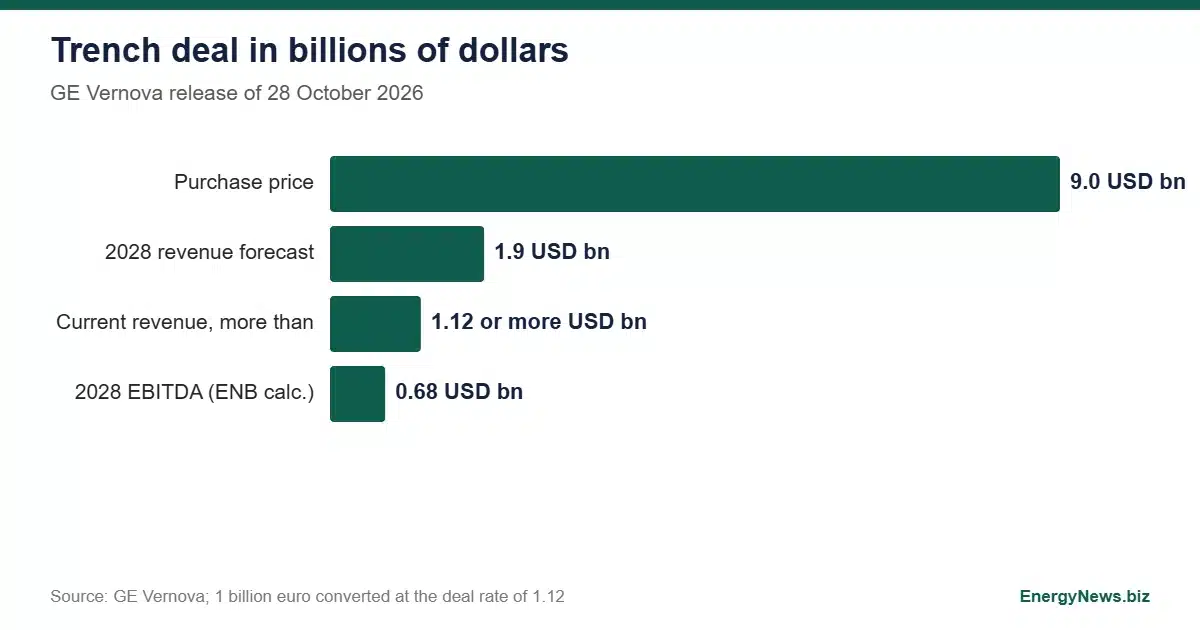
The release states the price at 13 times Trench’s 2028 adjusted EBITDA before synergies, and it forecasts 2028 revenue of $1.9 billion at an adjusted EBITDA margin of about 36%. Those are forecasts, not reported results. The table below adds simple arithmetic from the stated figures.
| Measure | Value | Basis |
|---|---|---|
| Purchase price | $9.0 billion | Stated by GE Vernova |
| Multiple of 2028 adjusted EBITDA | 13 times | Stated, before synergies |
| 2028 revenue forecast | $1.9 billion | Stated forecast |
| Implied 2028 adjusted EBITDA | About $0.68 billion | ENB calculation, 36% of $1.9 billion |
| Price against 2028 revenue | About 4.7 times | ENB calculation |
| Price against current revenue | At most about 8 times | ENB calculation, revenue more than 1 billion euro at 1.12 |
The gap between today’s revenue and the 2028 forecast is large. If current revenue is only just above 1 billion euro, the forecast implies growth of up to about 70% in roughly two years. The release does not give current revenue or EBITDA, so the buyer is paying largely for the order book and the growth path.
Why grid parts are the prize
The release describes the deal as vertical integration of an existing supplier that strengthens GE Vernova’s Grid Systems Integration and Power Transmission work. It cites about $5 billion in backlog and framework agreements, and it says a new Charlotte, North Carolina facility for 765 kV manufacturing is expected to begin in late 2027. The GE Vernova Trench acquisition therefore ties a buyer to a supplier of components that transmission projects cannot be built without.
ENB’s reading is that the price reflects scarcity. Bushings and instrument transformers are small in value next to a transformer or a converter, but a project cannot be energised without them. Owning the maker removes a dependency for the buyer and raises one for its rivals, who may now have to buy from a competitor’s subsidiary.
For customers, the practical effect is a larger supplier with control over a scarce part of the transmission chain. For competitors, it narrows the pool of independent makers. The GE Vernova Trench acquisition also fits a pattern in which grid equipment, not generation, is where the longest waits and the highest prices now sit, and buyers are willing to pay up front to shorten them. The same constraint shows in the latest global clean power capacity figures.
What is not disclosed and what to watch
The release does not state Trench’s current revenue or EBITDA, nor the exact split between cash and debt beyond the equal funding. Watch three things. The first is regulatory review, since the deal closes only in late 2027. The second is the employee consultation that the release names as a condition. The third is whether other grid equipment makers respond with purchases of their own, because the GE Vernova Trench acquisition shows that high voltage components now carry a strategic premium.
Add EnergyNews.biz as a preferred source on Google


