




The world will add less clean energy capacity in 2026 than it did in 2025, the first such drop in five years, according to Francesco La Camera, director general of the International Renewable Energy Agency. He made the remark on 27 October on the sidelines of the Singapore International Energy Week conference. La Camera declined to give a numerical forecast for 2026, so the size of the slowdown is not yet known.
The reason he gave is not money or demand. In his words, the main cause of the lack of a new record this year is the mismatch between generation capacity and the capacity to distribute and transmit electricity. Wind and solar can be built faster than the lines that carry their output, and the gap is now visible in the annual statistics.
The grid is the constraint on clean energy capacity
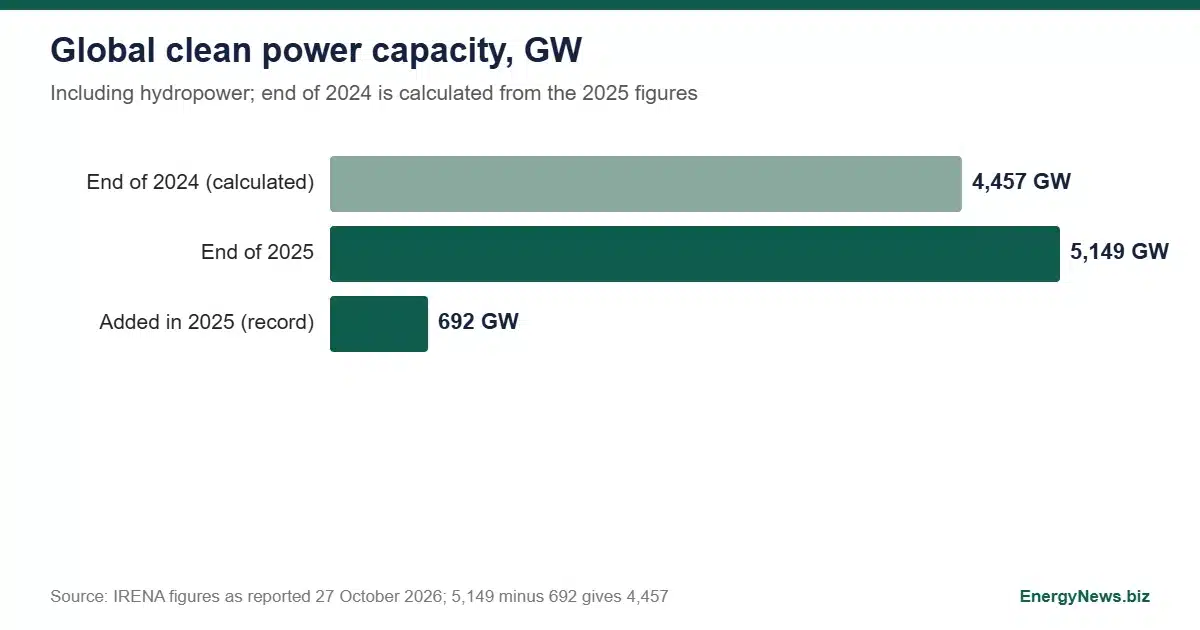
The agency’s figures for 2025 set the bar. Clean power installations, including hydropower, were a record 692 GW, up 15.5%, taking the global total to 5,149 GW. A simple subtraction from those figures gives about 4,457 GW at the end of 2024. The 2025 additions therefore equal about 13% of the whole stock in a single year, which is a pace that depends on connection capacity as much as on equipment supply.
When transmission and distribution fall behind, the first symptom is not an empty construction site. It is a built plant that cannot deliver all of its power. That is what curtailment means, and La Camera linked China’s slowdown to it.
China turned power away
La Camera said China turned away enough clean power in the first half of 2026 to supply Mexico for a year. China is the largest market for new wind and solar, so a slowdown there moves the global total. The country has been changing how power is priced and traded, and a recent article on the launch of China’s southern power market describes one regional step, with 15 minute settlement and direct consumer participation, that is meant to give clean generation a clearer price signal.
Market design cannot build a line. It can, however, decide who pays for flexibility and when. If prices show scarcity in the hours that matter, storage and flexible demand have a reason to be built where the curtailed power is.
What it means for developers and investors
For developers, the message is that a connection date is now as valuable as a permit. Projects with secured grid capacity are likely to be the ones that count in the 2026 numbers, and projects without it risk waiting. For investors, the pace of clean energy capacity growth is no longer a pure function of module prices and auction volumes.
The same pattern is visible outside China. A Melbourne data centre operator recently cut its guidance because a distributor paused work on a 66 kV line, and a US group agreed to pay $9.0 billion for a maker of high voltage components. These are different faces of the same shortage: the wires, transformers and consents that connect clean power to the people who use it. Each adds time to a project that the equipment makers and developers had already scheduled.
What remains unknown
La Camera gave no gigawatt figure for 2026, and the report of his remarks does not elaborate on trade barriers that appear in its headline. Until the agency publishes its full 2026 statistics, the size of the slowdown cannot be checked. In the meantime, the clean energy capacity story of 2026 is one of strong build rates meeting a network that was not designed for them.
Add EnergyNews.biz as a preferred source on Google


