


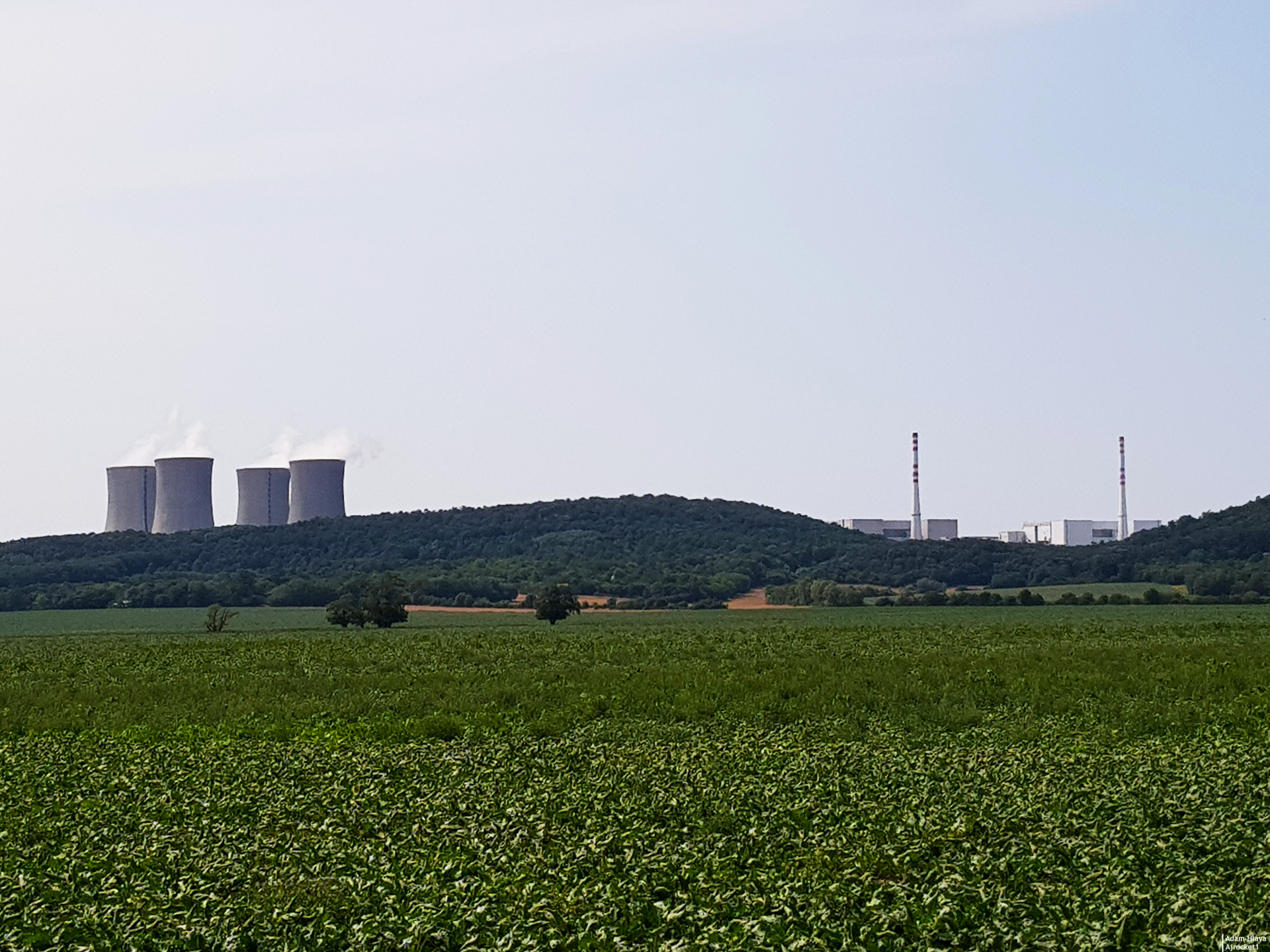


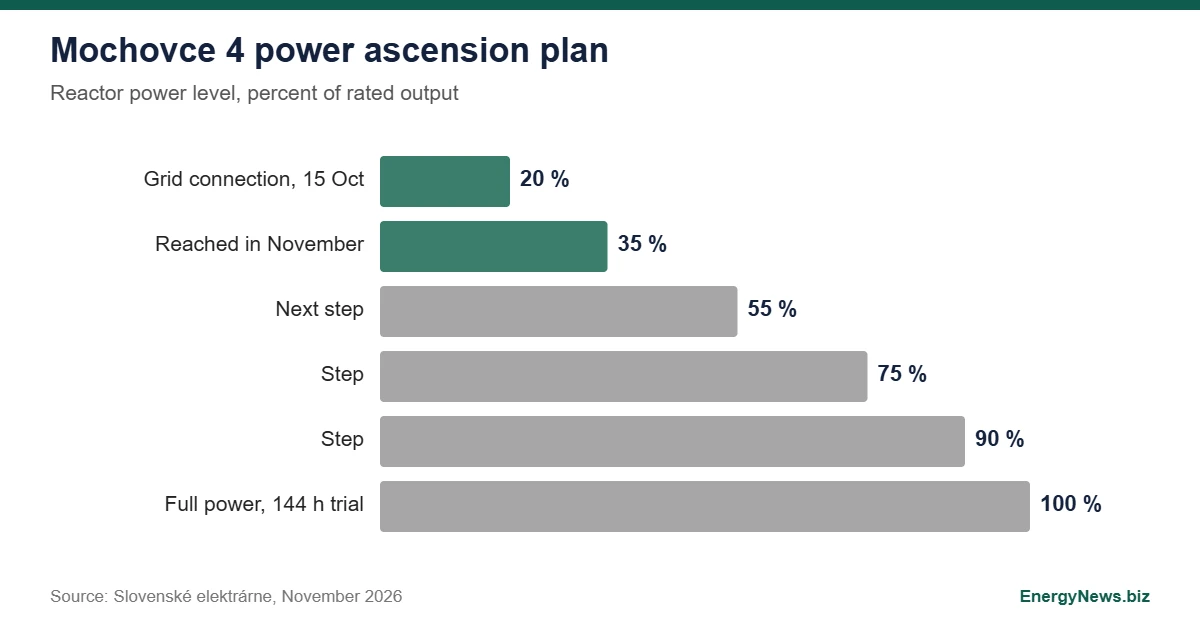
Mochovce 4, the last unit of Slovakia’s four-unit Mochovce nuclear plant, has been raised to 35% of its rated power, operator Slovenské elektrárne said on 12 November 2026. The 471 MWe VVER-440 unit was first connected to the grid on 15 October at about 20% power and has since produced about 16.2 GWh of electricity, which the operator equates to the annual consumption of about 6,500 households.
The figure was published by the operator as “16.2 GW”, which only makes sense as an amount of energy. An ENB calculation: 16.2 GWh shared by 6,500 households is about 2,500 kWh per household a year, a plausible level for Slovak homes.
Mochovce 4 power steps to full output
Power was raised after a series of tests and measurements at the 20% level. Similar checks now take place at 35%, before the output is increased in stages to 55%, 75%, 90% and finally 100%. The last step of commissioning will be a 144-hour trial run at full power, six days of continuous operation.
“By achieving 35% performance, we are entering the next part of the energy start-up programme. At each performance level, we have a set range of tests, with which we verify the behaviour of the unit in specific operating conditions. Only after their completion and evaluation do we continue with higher performance,” said Martin Mráz, Slovenské elektrárne’s project director for completing the units.
A Mochovce 4 timeline that began in 1986
Construction of Mochovce 1 and 2 started in 1982. Work on units 3 and 4 began in 1986 but stalled in 1992. Units 1 and 2 entered operation in 1998 and 1999. A project to complete units 3 and 4 started about ten years later, with an estimated cost of EUR6.7 billion (USD7.6 billion). Mochovce 3 entered commercial operation in October 2023. Mochovce 4 reached first criticality on 6 August 2026, ahead of its October grid connection.
An ENB calculation: from the 1986 start of work to the October 2026 grid connection, Mochovce 4 took 40 years, of which construction was halted for about 16.
13% of Slovakia’s consumption from one unit
At full power the unit will equal about 13% of Slovakia’s current electricity consumption, according to the operator. Slovakia already gets more than 60% of its electricity from five reactors: Mochovce 1 to 3 and two units at Bohunice, which entered commercial operation in 1984 and 1985. With Mochovce 4 running at full capacity, Slovakia will strengthen its position as the country with the highest nuclear share in its power mix. Reactor data are listed in the IAEA’s Power Reactor Information System.
Slovenské elektrárne is majority owned by Slovak Power Holding BV, which belongs to the Czech group Energetický a průmyslový holding. The Slovak state holds 34%. The government plans a new Westinghouse AP1000 unit at Bohunice and is exploring small modular reactors, as neighbouring Poland is doing with the Orlen SMR project at Włocławek. Other new units are moving through the same commissioning stages, such as Linglong One in China, which entered hot testing this year.
Mochovce 4 among 2026 grid connections in Europe
Mochovce 4 is listed by the World Nuclear Association with a net capacity of 440 MWe, against the 471 MWe gross figure used by the operator. It is one of two new units connected to the grid in Central Europe this year, alongside Paks II unit 1 in Hungary, a 1,100 MWe unit connected on 5 February 2026. Most of the other grid connections recorded worldwide in 2026 are in China.
What to watch
Results of the tests at 35%; the next steps to 55%, 75% and 90%; and the 144-hour full power trial run that will close commissioning of Mochovce 4 and hand the unit to commercial operation.
Add EnergyNews.biz as a preferred source on Google


