


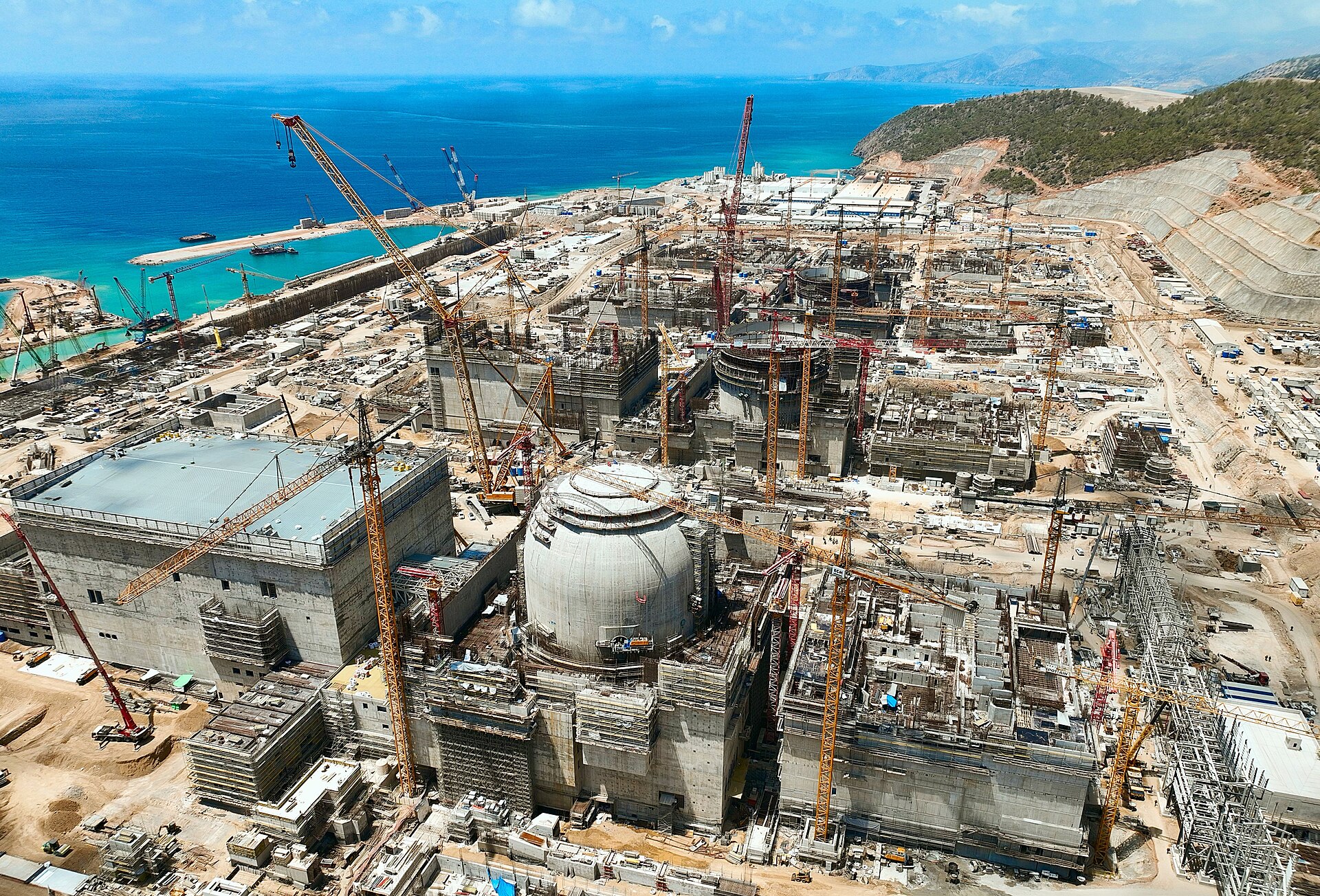


Akkuyu 1, the first unit of Turkey’s first nuclear power plant, has completed strength and leak-tightness tests of its reactor containment, Akkuyu Nuclear JSC said on 13 November 2026. During the tests the air pressure inside the containment was raised to 0.46 MPa, which loads every square metre of the containment surface with the equivalent of about 47 tonnes.
The operator says the results allow Akkuyu 1 to move “shortly” to the next stage of pre-start-up commissioning: cold and hot functional testing of the reactor plant. Akkuyu, in Mersin province on the Mediterranean coast, is being built by Rosatom under a build-own-operate model.
How the Akkuyu 1 containment was tested
The VVER-1200 design has two containments. The inner one protects the main reactor equipment and prevents any release to the environment. The outer reinforced concrete building protects the unit from extreme external events.
After the peak of 0.46 MPa, the pressure was reduced in stages, down to below atmospheric pressure. At each stage engineers checked the stresses within the structure and changes in its shape and dimensions under load. Leak-tightness was checked at both elevated and reduced pressure.
The 47 tonne figure is consistent with simple physics. An ENB calculation: 0.46 MPa is 460,000 newtons per square metre, which equals about 46,900 kilograms of force on each square metre.
“The results confirm the high quality of the containment construction work and enable us to move shortly to the next stage of pre-start-up commissioning: cold and hot functional testing of the reactor plant,” said Sergei Butckikh, chief executive of Akkuyu Nuclear JSC.
Akkuyu 1 commissioning steps so far
The containment tests follow pressure tests on the reactor circuits earlier this autumn. In October, the primary circuit of Akkuyu 1 was tested for strength at 24.5 MPa, about one and a half times its operating pressure of roughly 16 MPa. The four steam generators and connected secondary circuit pipework were then tested at 12.6 MPa, 15% above design operating pressure, over three days.
The construction licence for Akkuyu 1 was issued in 2018 and work started that year. Nuclear fuel was delivered to the site in April 2023. First concrete for unit 4 was poured in July 2022. The target has been for Akkuyu 1 to start supplying Turkey’s power system by the end of 2026. Similar hot testing stages are under way elsewhere, as at the Linglong One SMR in China.
A 4,800 MWe plant and what comes after it
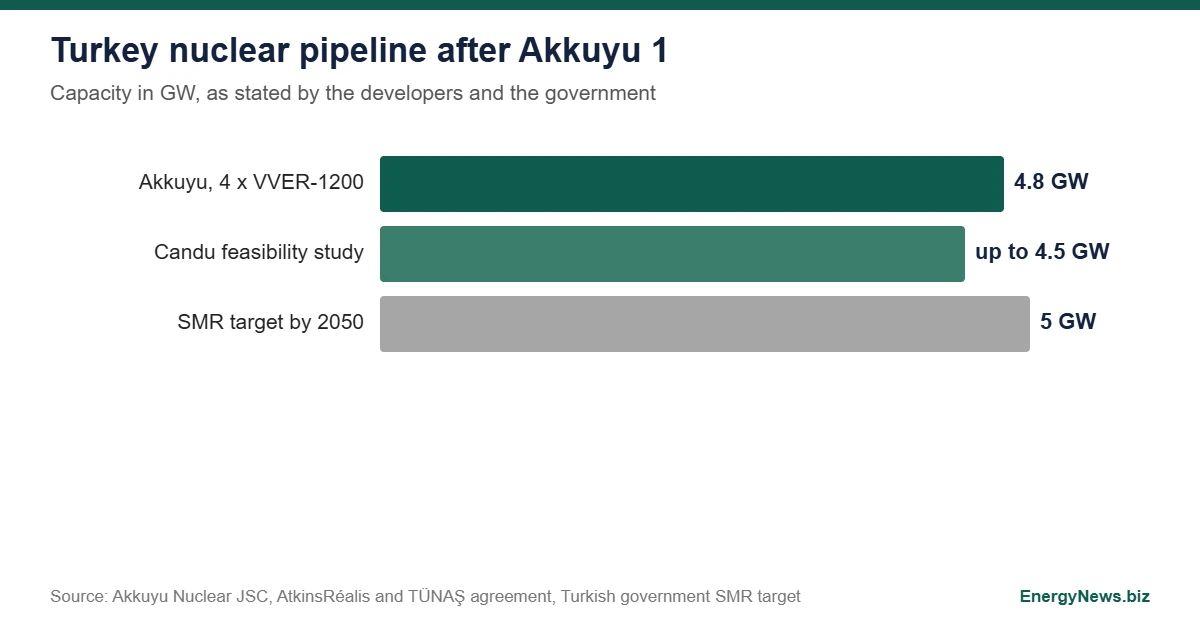
When all four 1,200 MW units are running, the 4,800 MWe plant is expected to cover about 10% of Turkey’s electricity needs. Under the 2010 intergovernmental agreement between Russia and Turkey, the first unit was to be commissioned within seven years of receiving all permits.
Turkey is already planning beyond Akkuyu. A second plant is planned at Sinop, and talks have been held with China about a third plant in the Thrace region. On 12 November, Candu Energy, part of AtkinsRéalis, and state-owned Türkiye Nükleer Enerji signed a memorandum of agreement that includes a feasibility study for a plant of up to 4.5 GW with up to six Candu reactors, a design also studied in the US, as in the Indiana Candu memorandum.
The government also targets 5 GWe of small modular reactors by 2050, which would mean at least 16 individual SMRs. Reactor status data for Turkey are published in the IAEA’s Power Reactor Information System.
What to watch at Akkuyu 1
Next: cold and hot functional testing of the reactor plant, then fuel loading, first criticality and grid connection. The end-2026 grid target leaves about six weeks from the containment results for those steps, an ENB calculation from the 13 November announcement to 31 December.
Add EnergyNews.biz as a preferred source on Google


