




The Indiana nuclear memorandum of understanding signed on 19 October sets a ceiling of 6 GW and little else. AtkinsRéalis, the State of Indiana and Hoosier Energy Rural Electric Cooperative agreed to evaluate a campus of up to eight CANDU reactors, but the document names no site, no cost and no schedule, and the published text does not say whether it binds anyone to build.
What the Indiana nuclear memorandum covers
The scope is an evaluation, and that distinction defines the Indiana nuclear story: a memorandum of this kind opens talks rather than orders reactors. The parties will hold initial discussions on deployment scenarios and assess site selection, commercial structures and power purchase agreements, workforce development and grid integration. The release lists what any timeline depends on: site selection, financing, utility or offtake arrangements, regulatory and licensing steps, environmental review, transmission and interconnection planning, and community engagement.
Hoosier Energy is a not for profit generation and transmission cooperative serving distribution cooperatives in central and southern Indiana and southeastern Illinois, with more than 700,000 member consumers. Its stated role is to bring expertise to early talks on whether advanced nuclear merits consideration.
The arithmetic behind 6 GW
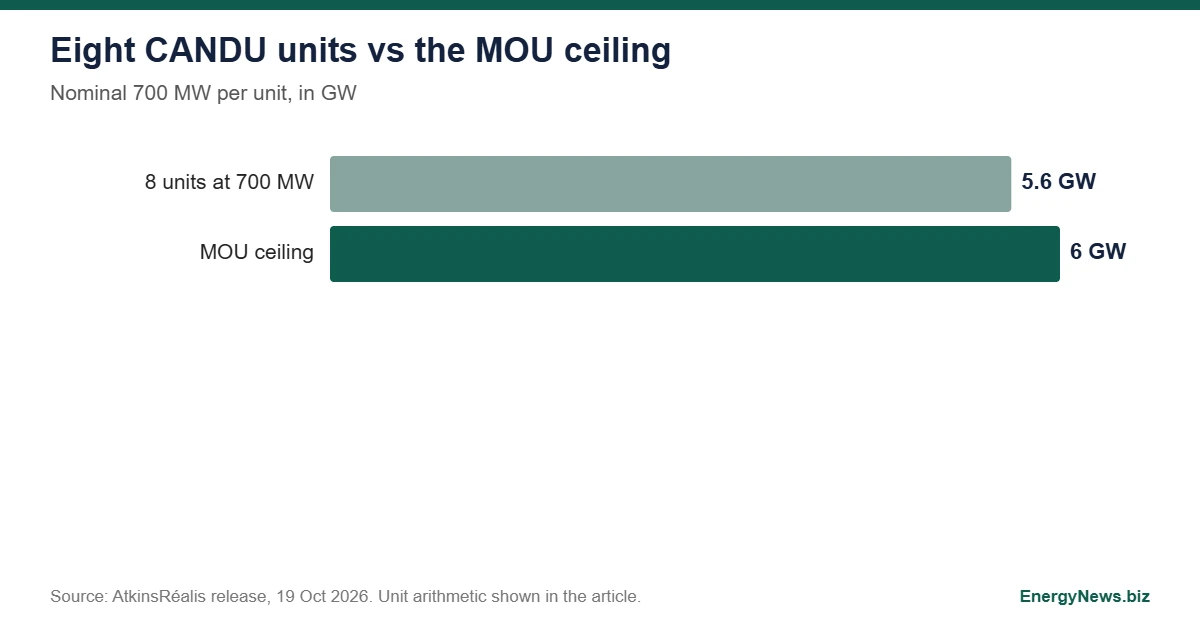
AtkinsRéalis highlights the Enhanced CANDU 6, a 700 MW class Generation III+ pressurised heavy water reactor. Eight units at a nominal 700 MW would total 5.6 GW, which is 0.4 GW short of the ceiling. The release does not name the reactor model for the campus, so the gap implies either larger units or a different configuration. The figure is a calculation from the release, not a disclosed design. Any Indiana nuclear campus of that size would depend first on site selection and transmission planning, both on the list of conditions.
The technology itself is mature. About 34 CANDU units have been built across four continents, including all 17 operating reactors in Canada, and the design runs on natural uranium with online refuelling. Fuel supply is still a recurring stress point for new reactor programmes, as our earlier look at Canada’s SMR strategy and its fuel dependence showed. Natural uranium sidesteps enrichment but not the wider supply chain.
Gas first, nuclear later
The most consequential detail is sequencing. The memorandum asks the parties to consider gas turbine plants, simple or combined cycle, built ahead of the nuclear units to bring capacity online sooner, and to consider gas to nuclear conversion at retired or retiring generation sites.
That framing addresses the central problem of any reactor programme, which is that demand arrives years before nuclear capacity can. Building gas first covers the interim. Using retired generation sites would in principle reuse existing grid connections, one of the longest lead items in any new build, although the release does not quantify the saving or name a single site.
Licensing status
AtkinsRéalis has begun pre application engagement with the US Nuclear Regulatory Commission, building on a June 2026 filing. The first public meeting on the licensing process took place in August 2026, and the first of seven planned topical reports, covering the quality assurance programme, has been submitted. That work concerns the CANDU technology in general. It is not a licence application for an Indiana site.
Where Indiana nuclear plans stand
A separate project was announced the same week: AEP, X energy and Amazon are reported to be planning 960 MW at a former coal plant site in Sullivan County. Together the two announcements show Indiana sourcing nuclear options from both advanced small reactors and large heavy water units.
No date has been set for the next step. Until a site, a cost estimate and an offtaker are named, the Indiana nuclear agreement remains a framework for discussions rather than a project.
Add EnergyNews.biz as a preferred source on Google


