



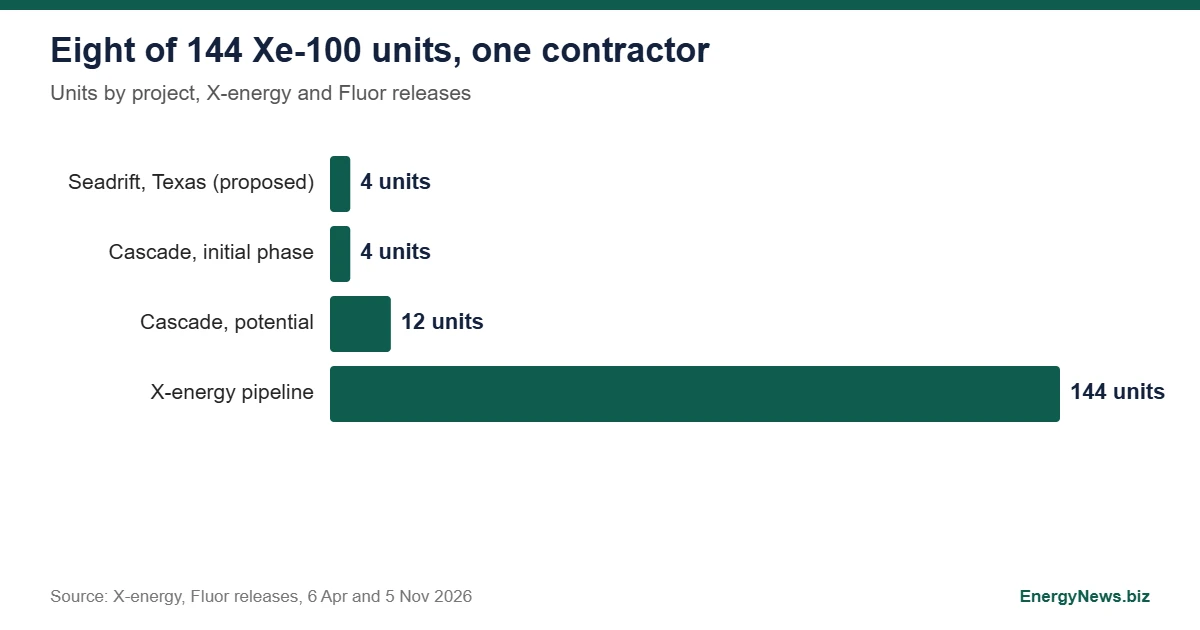
Eight of the 144 Xe-100 reactors in X-energy’s commercial pipeline now share one engineering contractor. On 5 November 2026 the company announced that Fluor will provide design and engineering services for Energy Northwest’s Cascade Advanced Energy Facility near Richland, Washington. The Xe-100 Cascade project is the second after the proposed four-unit plant at Dow’s Seadrift site in Texas, where Fluor signed in April 2026.
What Fluor will do at Xe-100 Cascade
Fluor will deliver engineering, design development, supply chain, estimating and project controls for the nuclear island, defined in the announcement as the areas of the plant that contain the Xe-100 reactors and the systems that support them. Cascade Nuclear Partners, a joint venture of Kiewit Nuclear Solutions, Black & Veatch and Aecon, is Energy Northwest’s progressive design-builder and covers the conventional island and the integrating requirements across the plant. X-energy’s announcement gives no contract value and no schedule.
The split is the point. X-energy says the reactor’s physics-based safety characteristics allow far fewer safety-related systems than a light-water plant, grouped together in a compact nuclear island. Most of the rest of the plant can then use commercial, off-the-shelf components, which lets two partners work on different areas in parallel. That is the company’s claim, and nothing in the announcement tests it.
The arithmetic of a repeated design
An Xe-100 is rated at 80 MWe. The initial Cascade configuration of four units is 320 MWe, the same as the four units proposed at Seadrift. The plant can be built in four or twelve unit configurations, and twelve units would be 960 MWe. X-energy puts its commercial pipeline at 11.5 GW, equal to 144 Xe-100 units, and 144 times 80 MWe is 11,520 MWe, so the two figures agree.
Against Amazon’s goal of 5 GW of new nuclear by 2039, the first project in the X-energy and Amazon collaboration is Cascade. Four units are 6.4% of that goal and twelve units would be 19.2%. A second Amazon project, with American Electric Power in Indiana, has been announced, but its size does not appear in the X-energy release. The pipeline is 2.3 times the Amazon target, so most of it depends on customers other than Amazon.
Fluor is now engaged on 8 of the 144 pipeline units, or 5.6%, counting the four at Seadrift and the initial four at Cascade.
What a second contract does and does not show
Repeatability is the argument that decides whether small modular reactors can beat large ones on cost. A second contract with the same contractor is a necessary condition for it. It is not evidence. X-energy and Fluor state the aim as long-term cost and schedule reductions through standardisation. Neither has published the engineering cost of the first project, so a reduction on the second cannot be measured.
Seadrift also shows how far the first project still has to go. Fluor’s April announcement describes front-end loading stage 2 work, which covers project definition, feasibility and cost control. The same announcement says the construction permit application was submitted in March 2025 and is under review by the US Nuclear Regulatory Commission. The Seadrift project is described as supported by the Department of Energy’s Advanced Reactor Demonstration Program, under which X-energy was selected in 2020 to develop, license and build the Xe-100 and a TRISO-X fuel fabrication facility in Oak Ridge, Tennessee.
The same reactor design was chosen by Centrica and X-energy for a first UK fleet, as reported on the Hartlepool selection. Three sites on two continents now point to one reactor that has no operating unit, no issued construction permit and no published engineering cost.
The first dated check is the NRC’s decision on the Seadrift construction permit, filed in March 2025. No decision date appears in either company’s material. The second is a published cost for any of the 8 units that Fluor is now engineering.
Add EnergyNews.biz as a preferred source on Google


